
Download CodifyCore’s free Digital Product Passport (DPP) procurement toolkit to screen providers, issue an RFI, RFQ or RFP, and document the decision. The pack includes an editable Word pre-assessment, a fillable PDF, a security questionnaire, a standalone pricing annex, sector annexes, and Excel workbooks for supplier pricing and buyer evaluation. You can adapt the templates to your products and share them with vendors or clients, including for commercial work.
Toolkit v1.0.0 · 14 November 2026 · CC0 1.0 Universal
Download the complete DPP procurement toolkit (ZIP)
Download individual templates
| Download | Format | What to do with it |
|---|---|---|
| Provider pre-assessment or fillable pre-assessment | Word, PDF | Complete the buyer details and send one copy per provider. Use the returned answers and evidence to shortlist or request clarification. |
| Request for information | Word | Ask providers about delivery options, dependencies and indicative costs. Use responses to settle the scope before requesting a formal bid. |
| Request for quotation | Word | Issue with Annex C and the pricing workbook once scope and acceptance criteria are fixed. Request comparable signed quotes. |
| Request for proposal | Word | Set scope, submission rules and the evaluation method. Attach relevant requirements and tests and collect solution proposals, delivery plans and evidence. |
| Trust and security questionnaire | Word | Request controls and assurance evidence for the exact offered service. Verify document scope and record gaps through the approved evidence route. |
| Sector and purpose annexes | Word | Select and adapt the relevant rows. Carry their IDs into the requirements workbook and test schedule to trace evidence and results. |
| Annex C Pricing and Commercial Schedule | Word | Set volumes, term, currency, tax basis and exit assumptions. Ask bidders to return the completed schedule, supporting price tables and signed quote. |
| Supplier response and pricing workbook | Excel | Pre-fill the baseline and issue one copy per bidder. Collect requirement responses, evidence IDs, departures and line-by-line prices. |
| Buyer evaluation workbook | Excel | Use internally to set gates and weights, record tests, compare verified base-case cost and document decisions and conditions. |
| Buyer evaluation and contract playbook | Word | Plan the evaluation and award. Share approved test and acceptance schedules and carry agreed commitments into the contract. |
Use the fillable PDF for a fixed-format return. Download it to a PDF reader that supports forms, complete the fields, save a copy and reopen it to confirm your entries before returning it. Use the Word version to amend the questions or accommodate longer answers.
How to issue the toolkit
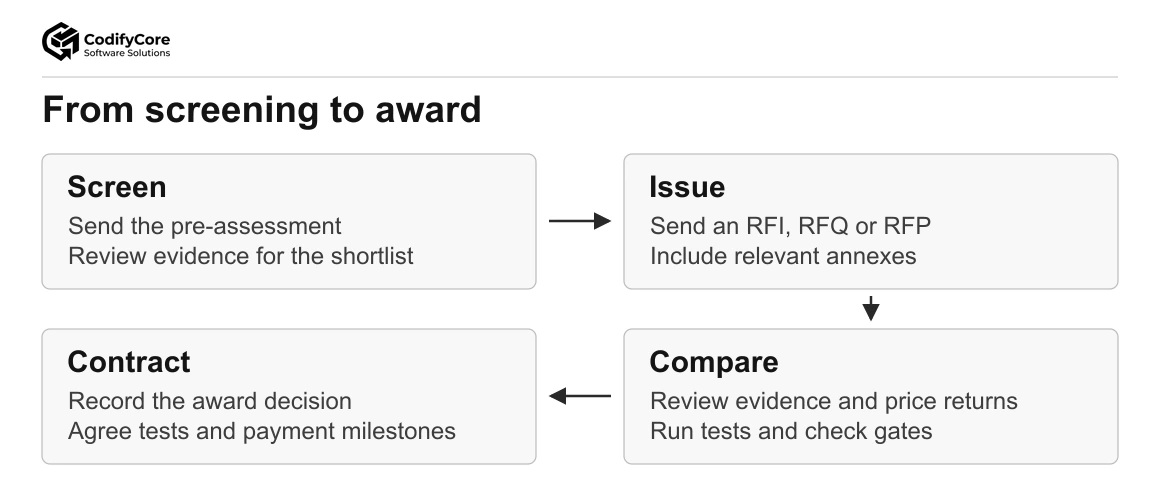
Screen providers and choose a request
Complete the buyer section of the Word or fillable PDF pre-assessment with your products, markets, dates and return channel. The provider completes the remaining fields and cites evidence. Check which entity would deliver the service, what it has operated at comparable scale, and what gaps affect your shortlist. Choose an RFI to explore options, an RFQ to price a defined scope, or an RFP to compare solutions and delivery plans. You can move straight to an RFQ when the requirements and acceptance tests are already fixed.
Build one issue pack for all bidders
For a formal RFP, use its annex checklist to assemble the scope, supplier workbook, selected sector modules, Annex C, Trust and Security Questionnaire and approved test brief. Fill in the workbook’s Scope, Requirements, Data Map and Interfaces tabs. Add the relevant sector or purpose rows, give each a priority and link it to an evidence request or test. Send the same pack to each bidder and issue a dated addendum if you change the baseline.
For an RFQ, issue the fixed scope and acceptance criteria with Annex C and the pricing workbook. For an RFI, share only the scope and questions needed to resolve the uncertainties. Use the buyer workbook and playbook internally, and share the approved demonstration or acceptance schedule with suppliers.
Check what the supplier returns
Ask each bidder to complete its own copy of the supplier workbook and cite evidence IDs. Check which service and release the evidence covers, whether each feature is in production or planned, and what conditions apply. For a formal quote, ask for the completed Annex C and a signed quotation. Reconcile prices, units, volumes, tax and exclusions against the issued baseline before copying the verified total cost into the buyer workbook.
Test, decide and contract
Use the buyer workbook’s Gates, Scores and Tests tabs with the playbook. Run the same demonstration against the same dataset and thresholds. Record the evidence behind each gate and score, who reviewed it and which conditions remain. Carry accepted commitments into contract schedules with an owner, a deadline and an acceptance test. Link milestone payments to the acceptance steps agreed in Annex C.
If you still need candidates, use CodifyCore’s vendor comparison to build a longlist. The market landscape covers sector adoption and infrastructure. Use the 25-question buyer guide to decide which claims to test on your shortlist. Top Digital Product Passport solutions · Digital Product Passport market landscape · How to evaluate a DPP provider
Set the scope before asking for bids
Define the regulated product and the responsible operator. Record the product group, market, legal entity and economic operator role. Name the applicable act and provision, date, identifier granularity, actor access rights and any retention or continuity duty. Assign a buyer-side owner to verify the register. Record contractual duties separately from statutory responsibility.
Under the EU Ecodesign for Sustainable Products Regulation (ESPR), passport requirements are applied through the relevant product-specific rules. The EU Batteries Regulation separately requires battery passports from 18 February 2027 for electric vehicle batteries, light means of transport batteries and industrial batteries above 2 kWh placed on the market or put into service. Check the latest consolidated legislation, Commission guidance and the applicability and timing of individual data requirements. For construction products, check Chapter X of the Construction Products Regulation and the relevant delegated act. For detergents and end-user surfactants, check Articles 21–24 and Annex VI of Regulation (EU) 2026/405 and the applicable dates. ESPR · Batteries Regulation · Commission battery passport FAQ · Construction Products Regulation · Detergents and Surfactants Regulation
Define the operating boundary. List product hierarchies, expected models, batches or items, supplier count, scan and API peaks, and source systems. Identify who controls product identifiers, data carriers, domain and resolver settings, and who supplies and approves the underlying data. Specify buyer, provider, partner and backup responsibilities.
Name each interface and evidence expectation. Where EU DPP Registry interaction applies, specify the operator authority, required data and environment. Ask for accepted and rejected workflows with reconciliation. The Registry holds identifiers and required registration data. Specify separately how the full passport data will be hosted, accessed and maintained. For a standards claim, request the exact edition and implemented sections, together with a test result for your use case. EU DPP Registry implementing regulation · EU harmonised DPP standards references · European Commission DPP resources · Current EU harmonised standards list
Tailor the annexes to the sector and the purpose
The toolkit includes modules for batteries, textiles and footwear, metals and industrial materials, construction products, electronics and durable goods, tyres, and a module for detergents and end-user surfactants. You can add a purpose module for supplier data exchange, traceability, repairs, resale, take-back, authenticity or consumer engagement. Assign each selected requirement an ID, legal or buyer-policy basis, data owner, evidence request and measurable acceptance test. Review proposed measures and pilots before treating them as binding requirements.
Worked examples by industry
These fictional procurements show how to adapt the toolkit. Replace the volumes and pass criteria with your own baseline.
Industrial batteries and an item-level passport rollout
An importer plans a DPP rollout for two models of 5 kWh industrial battery and expects 12,000 new units in the first year. The solution must ingest serial numbers from the importer’s source system, apply the right access rules and handle registration where applicable. The buyer checks its operator role and the battery category and field applicability before writing binding requirements. Batteries Regulation, Article 77 and Annex XIII · Commission battery passport FAQ
- Issue. Screen vendors with the pre-assessment. Send shortlisted providers an RFP with the battery sector annex, supplier workbook, Annex C and Trust and Security Questionnaire. Use BAT-02 for item identity, BAT-03 for restricted data and BAT-04 for the applicable registration workflow.
- Ask for. A field-level data and access map, evidence from a comparable deployment, and quotes covering new issuances, active records and lifecycle events. Require bidders to explain how they count billable activity.
- Decide. Scan two synthetic units of the same model and confirm that each resolves to a distinct record. Check authorised and unauthorised views. Where applicable, check an accepted and a rejected submission and their reconciliation in the agreed Registry test environment. Record the results in the buyer workbook and clear the applicable identity, access and registration gates before scoring.
Apparel supplier data and a traceability pilot
A workwear brand has 30 styles and four factories. Fibre declarations arrive in spreadsheets, and the brand cannot reliably match each supplier record to the correct colour, size and lot. It needs to understand the cost and effort of a data collection pilot. The brand defines its pilot fields as buyer requirements and verifies the separate regulatory position for its products. European Commission textile apparel DPP page
- Issue. Send an RFI with textile and supplier-exchange rows TXT-01 and PUR-04. Share a sample data map and ask how vendors would onboard factories with different systems. Use the responses to settle the pilot design before issuing an RFP or RFQ.
- Ask for. A mapping from style and variant to supplier evidence, a sample rejection and correction log, and indicative costs for onboarding, connectors and supplier support.
- Decide. Give vendors the same 100 synthetic rows, including two deliberate validation errors. Require 98 valid rows to load and two errors to be reported with reasons. After correction, require 100 unique records with provenance retained. Adapt buyer test T-02 and carry its pass criteria into the pilot acceptance schedule.
Construction products and a document distribution RFQ
An insulation panel manufacturer has agreed its publication workflow. It needs quotes for 400 product types across three languages, with linked declarations and stable URLs that distributors can reuse. It verifies which requirements follow from the Construction Products Regulation and which are its own operating requirements. Construction Products Regulation, Chapter X
- Issue. Send an RFQ with BLD-01 and BLD-03, Annex C and the supplier workbook. Specify how often declarations change, who publishes them, and how long access is required after handover.
- Ask for. A signed quote covering migration, localisation, hosting, archive access, export and transition. Put optional BIM integration on a separate line so bidders price the same baseline.
- Decide. Verify that a distributor’s existing link opens the current approved declaration and an authorised reviewer can retrieve the prior version. Export the product-type identifiers and documents, check that a replacement environment can use them, and make that handover test an acceptance milestone.
Refurbished laptops and repair history across partners
A refurbishment business wants to retain serial-level repair history when a laptop changes service partner. It also wants a limited public view for prospective buyers. The buyer defines what each role can see and change.
- Issue. Use the RFP with the electronics and repair or resale modules. Adapt ELC-01 for parts changes and PUR-02 for service roles. Include the Trust and Security Questionnaire and mark public and restricted fields in the supplier workbook.
- Ask for. A sample repair event, evidence that partner access can be revoked, a proposed retention schedule, and prices for additional repair partners and bulk exports.
- Decide. Reassign a synthetic laptop between partners. Verify that the former partner loses access, the new partner can record an authorised repair and the public view exposes only approved fields. Export the event with its source and audit trail. Use the result to set access and portability conditions in the contract.
Ask for assurance that covers the service you are buying
Ask for the actual artifact or a controlled review, together with the provider’s claim and the service boundary it covers. An ISO/IEC 27001 certificate should identify the certified legal entity and information security management system scope. Verify it with the issuer or an appropriate recognised directory, then check whether the offered service, locations and operations fall within that scope. For a SOC 2 Type 2 report, review the system, period, opinion, exceptions, subservices and responsibilities assigned to customers. For a DPP certification or conformity claim, ask for the named scheme or legal basis, product and release, issuer, verification route and exact coverage. ISO/IEC 27001 · AICPA SOC 2 description criteria · ESPR service provider provisions
Use a controlled evidence room or a supervised review for sensitive reports. Give each artifact a stable ID and record the issuer, scope, dates, limitations, reviewer and verification result. When assurance is incomplete or covers a subprocessor only, record which controls still need evidence and who will verify them. Agree terms for incident notification, subprocessors, retention and permitted use of passport data, including restrictions on resale, analytics or AI training where relevant. GDPR including Articles 28 and 33
Compare complete cost over the same term
Issue Annex C Pricing and Commercial Schedule with the supplier workbook when you need a formal quote. Use the annex to set the common volumes, evaluation horizon, tax and currency rules, optional scope, price-change terms, milestone payments and exit charges. Ask bidders to return the completed annex, workbook and signed quotation.
The workbook supports year zero plus one to five operating years. Select which Base, Low and High scenarios bidders must quote. Classify each named line as Included, Excluded or Optional, then check that the included lines have a quantity and effective rate for each evaluated year. Optional prices appear separately. Document pricing tiers, allowances, minimums, indexation, renewals, taxes and overages behind the rates. Check the returned quantities and cost boundary against the issue baseline before comparing bids.
Include implementation, connectors, migration, licences, passport or event usage, storage, scanning, suppliers, carriers, support, and exit. Add buyer-side costs to your evaluation if the selection depends on material internal effort. Capture read-only hosting, archive access, bulk export and transition help explicitly. Use a consistent treatment for those costs across bidders.
For the industrial battery example, suppose the buyer asks for a three-year base quote with 12,000, 18,000 and 24,000 new issuances. If every issued record remains active, that gives 12,000, 30,000 and 54,000 active records at year-end. Set the measurement rule in Annex C. A bidder charging per issuance quotes against the new-unit volumes. A bidder charging per active record quotes against quantities calculated under the agreed measurement rule. Have each bidder show its tier or minimum-charge calculation, then compare the annual charges and repeat for any requested high-volume case.
Run a common proof of concept before making an award
Use one approved dataset with known expected outcomes. Fix the test environment, roles, sample volumes and pass criteria before inviting vendors to demonstrate. Map requirements to tests and evidence. For example, connect an export requirement to a test that moves records, attachments, schemas, history and relevant access metadata into a neutral target and reconciles the result. Link the export test to a cutover exercise that proves old carriers still resolve.
Clear mandatory gates before making a weighted comparison. Record who confirmed each gate and which evidence supports the outcome. The workbook shows the weighted result out of 100 and its equivalent on the buyer guide’s 1–5 scale. If a gate remains open, record the remediation, owner and re-test date. Resolve risks and commercial departures with the appropriate decision owner before award. Transfer accepted claims, timelines and service levels into the signed contract. Define who verifies milestones, what evidence triggers payment and what happens if the provider misses an acceptance condition.
Reuse terms and version history
The original template content is dedicated under CC0 1.0 Universal. Anyone may copy, edit, rebrand, distribute and use it commercially without attribution. The distributed originals carry CodifyCore branding. You may remove or replace it. The dedication leaves trademark and third-party rights unaffected. Keep supplier submissions and third-party assurance evidence under their own confidentiality and use terms. CC0 deed
v1.0.0 · 14 November 2026. Initial toolkit edition. Keep the toolkit version alongside your own solicitation revision. The next time you issue a procurement, check the latest template version, law, Registry guidance and standards references. If requirements change mid-process, record the change and distribute a dated addendum to affected bidders.
Frequently asked questions
Do I need to issue all three sourcing documents?
Choose the document for the stage you are in. An RFI explores the market, an RFQ prices a defined baseline and an RFP compares proposed solutions and delivery models. The pre-assessment is a short, formal screening step you can use before any of them.
Is there a separate pricing annex for an RFP or RFQ?
Yes. Attach Annex C to set the pricing rules and collect signed commercial terms. Use the companion Excel workbook for itemised quotes and like-for-like cost calculations.
Can the same template be used for batteries and textiles?
Use the same procurement structure with different product and purpose annexes. Verify the applicable legal source, operator, field timing and access rules for each product group. Issue one shared set of requirements to providers competing for the same scope.
Can my consultancy modify and share the templates with clients?
Yes. The original template content is under CC0 and can be adapted and shared commercially without attribution. Replace the CodifyCore branding on your issued version if that fits your procurement process.
What should a DPP supplier send with its security questionnaire?
Ask for an evidence index and the relevant actual artifacts or a secure review. This can include an in-scope certificate and schedule, assurance report, testing summary, recovery evidence, subprocessor list or processing agreement. Request exact scope, validity or coverage period, verification route and material exclusions for each claim.