
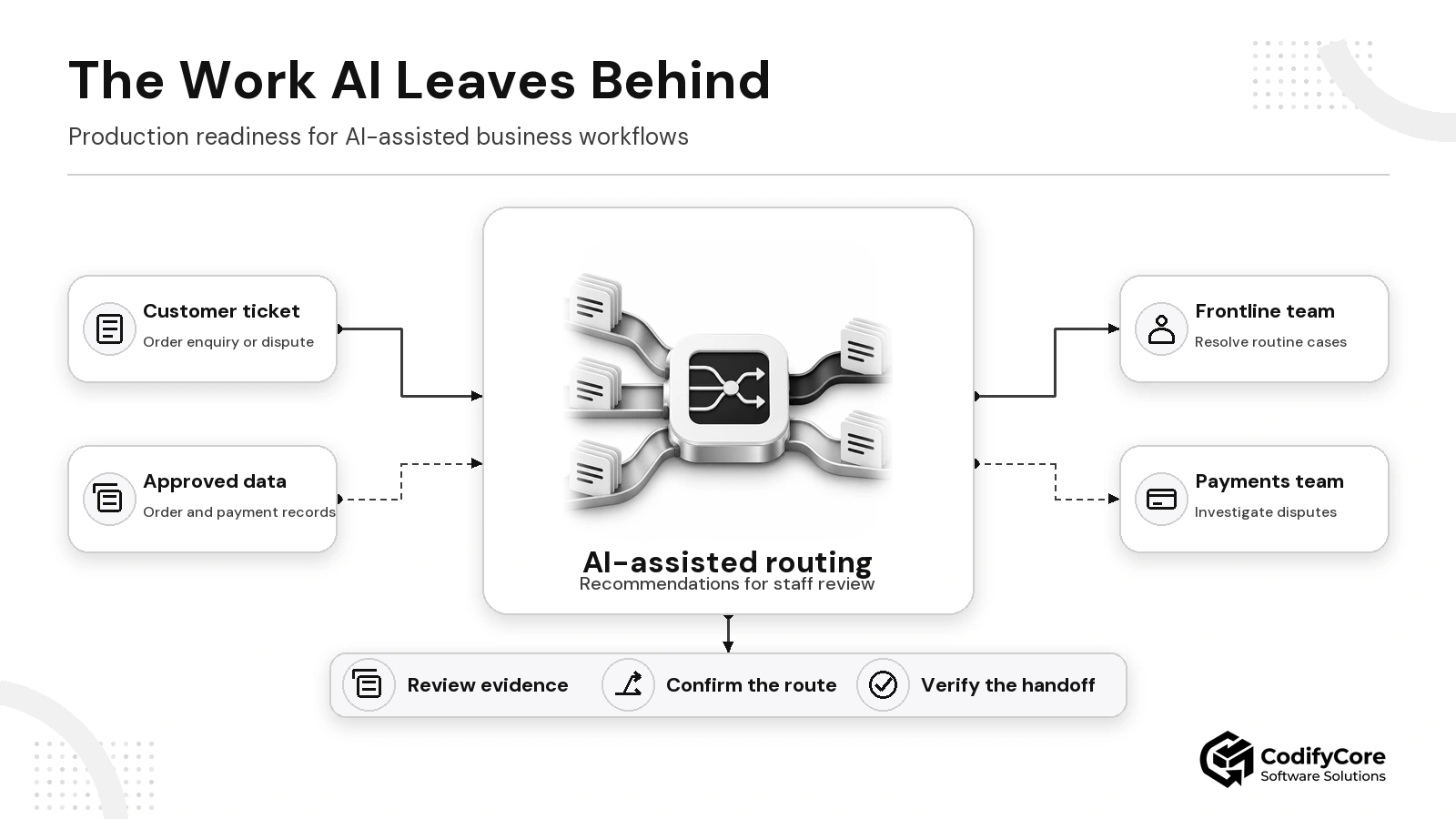
Imagine two reports arriving at the same operations meeting. The first says that an AI assistant has cut the time needed to handle order enquiries. The second comes from the payments team. Its queue is growing, customers are returning with unresolved disputes, and experienced staff are spending more time reconstructing cases that arrived with incomplete evidence. Both reports can be accurate. The first records a saving where the AI was introduced. The second shows where the organisation has absorbed some of the work.
Now consider the executive decision that follows. The frontline team has evidence that its intervention works and a credible case for expanding it. The payments team can explain why its queue is struggling, but its figures sit in a different report with a different owner. If the two results are presented separately, the company can approve the expansion without ever making an explicit decision about who will serve the customers it has just routed differently.
That is the production-readiness problem many AI proposals should be built around. A business should approve an AI workflow only when it can account for the work the system leaves behind, and give the people receiving that work the authority and capacity to handle it. The appropriate unit of approval is a customer or business outcome across the teams that deliver it. A successful demonstration, a good model benchmark and a faster local process each answer narrower questions.
The productivity gain can be real and still tell only part of the story
A field study of 5,172 customer support agents found that access to a generative AI assistant increased issues resolved per hour by 15% on average, with substantial differences in the effects across workers. Its authors, Erik Brynjolfsson, Danielle Li and Lindsey Raymond, measured a result that matters to the operation. Their headline measure was tied to issues resolved, which makes it more informative than a count of drafts generated or suggestions accepted. The result describes the deployment they studied. A team considering a different use case still has to establish what improves in its own operation. Brynjolfsson, Li and Raymond, Generative AI at Work
The distinction matters because the assistant enters an organisation where different people are accountable for different parts of the same outcome. A frontline manager may be rewarded for response times. The payments team may be measured on investigation quality and the age of its backlog. A product team may report adoption. All three can act rationally within their remit while the business loses sight of whether a customer’s issue was resolved with less effort overall.
For a routine order enquiry, a good recommendation may remove a search, shorten a reply and free the reviewer for another case. For a duplicate-charge complaint, the valuable action may be to recognise the issue, assemble the relevant transaction evidence and get it to someone who can investigate. Both cases can start with the same kind of customer message. Their economics diverge once the business asks what a correct outcome requires.
This also changes what counts as an error. An increase in referrals can be an improvement if the previous process left legitimate disputes in the general queue. A falling referral rate can be a warning if the assistant is confidently placing disputes in routine support. An organisation that evaluates the AI on escalation volume alone can reward either mistake. The question is whether the right cases reached the right owner in time, with enough context for that owner to act.
Put a value on the capacity you still need
Take a fictional operation handling 1,000 cases a week. Assume the assistant saves 1.5 minutes on each of 800 routine cases after staff review and correction. That frees 20 frontline staff-hours. Suppose the new workflow also identifies 20 additional cases that appropriately need a payments specialist, and they take an average of 15 minutes each. That adds five specialist-hours. The extra referrals may represent better service. They still need five hours in a particular team, within the time customers can reasonably wait.
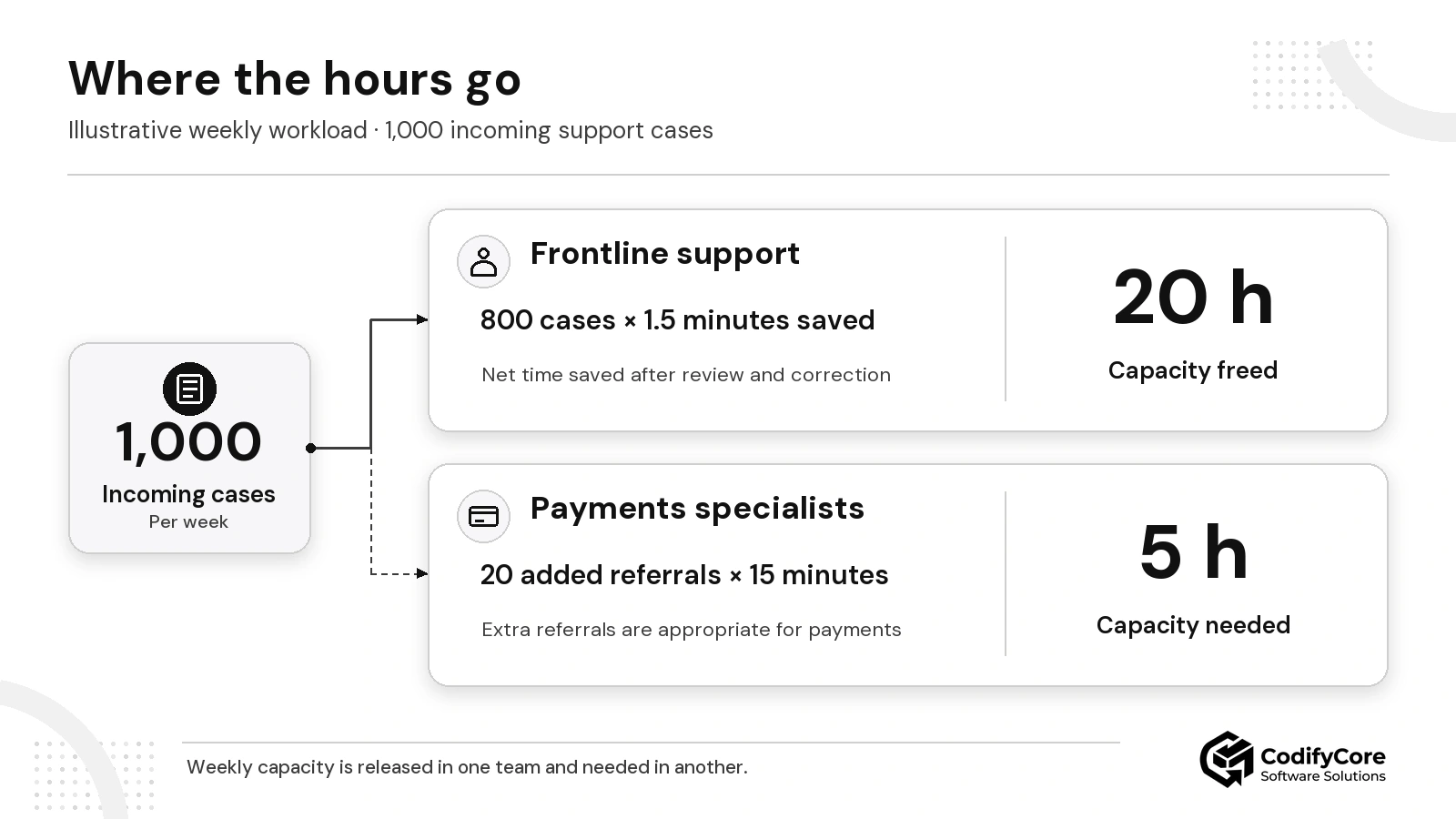
A business case could subtract five from 20 and present 15 hours of net capacity. That arithmetic is valid for the stated time categories. It can still mislead a staffing decision. A frontline hour and a payments investigation hour are interchangeable only when people have the relevant competence, access and authority and can be scheduled where the demand occurs. The same five hours can be easy to absorb across a well-staffed week and disruptive when cases arrive during a busy shift. The illustration also excludes platform costs, ongoing evaluation and downstream rework. It describes an allocation problem before anyone attempts a full return-on-investment calculation.
The practical implication is that the release decision needs an owner on both sides of the handoff. The team gaining the capacity should show how it will use it. The team receiving the additional work should agree what it can absorb and what will trigger a pause or a change in scope. If the projected gain depends on moving work across teams, the business case should also fund that transfer. The choices might include training frontline reviewers to handle a defined category, changing specialist coverage or limiting the rollout to cases the receiving team can support. Each choice changes the economics and needs to be visible to whoever approves the investment.
There is a second capacity question that a spreadsheet can easily miss. When an assistant proposes the route on most ordinary cases, frontline reviewers may have fewer opportunities to make routing decisions unaided. In 1983, Lisanne Bainbridge described a related problem in industrial control. Automation can leave operators responsible for difficult interventions while changing the experience and information they have available to make them. The relevant analogy for a support team is that a fallback needs to preserve the ability to perform the job, including access, training and a real opportunity to practise. Lisanne Bainbridge, Ironies of Automation
A strong average can conceal the result that decides the launch
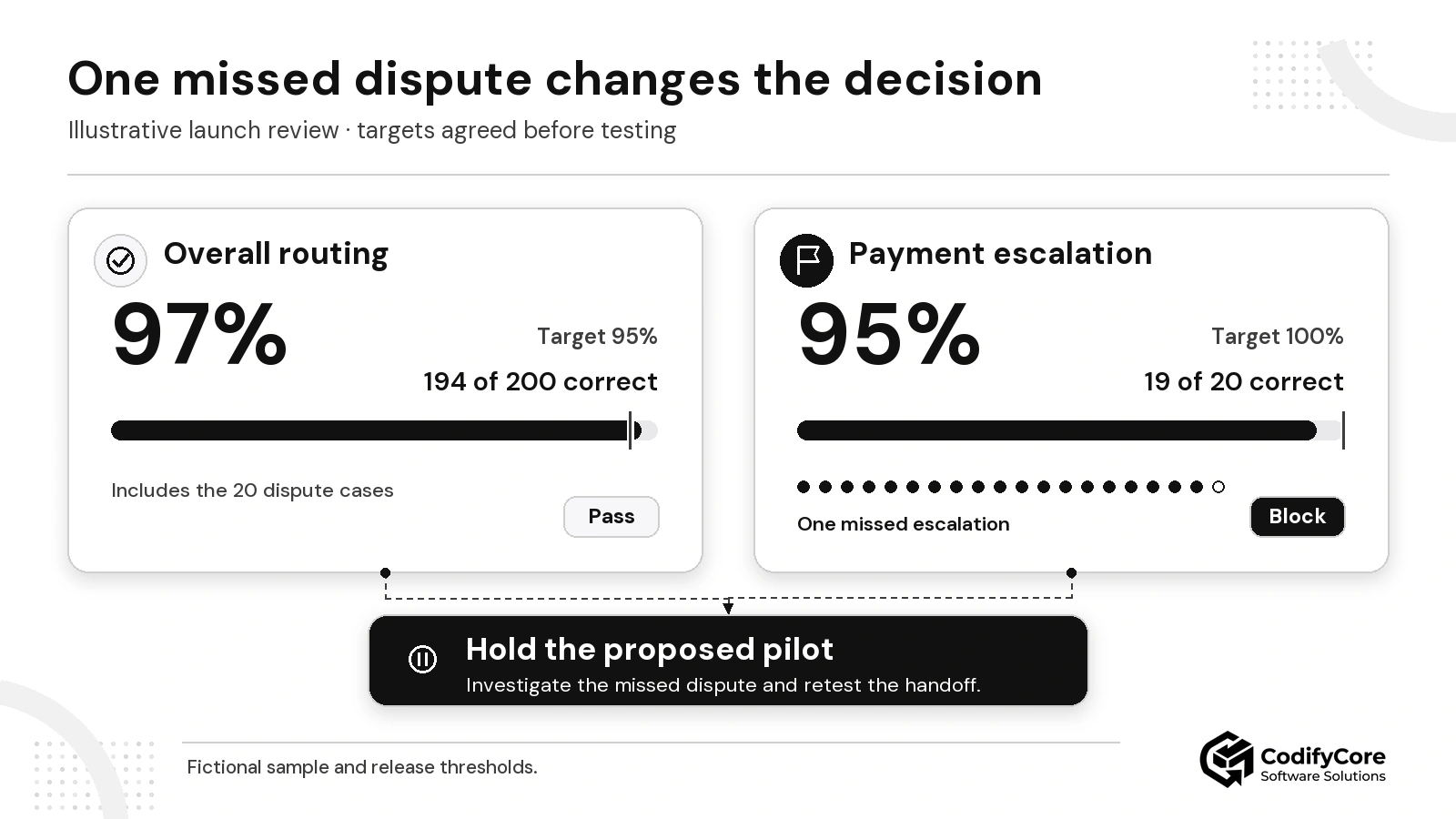
Consider a second fictional example. A retailer tests an assistant that reads approved records, suggests a queue and drafts a reply for a staff member. It can neither send replies nor initiate payments. The evaluation uses 200 tickets, including 20 payment disputes. Before the test, the retailer decides that it can tolerate some ordinary routing errors during a small, staff-reviewed pilot. It also requires all 20 sampled disputes to reach the payments queue. The exception criterion reflects this retailer’s decision about the consequence of delay.
In the test, 194 of 200 cases go to the correct queue. That is 97%, above the 95% overall target. Nineteen of the 20 payment disputes reach the correct queue. That is 95%, short of the separately agreed requirement. One failure changes the release decision because the business gave that failure a consequence before it saw the results.
Some leaders will see this as an argument for a tougher model evaluation. There is also a more structural response. A retailer that can reliably identify eligible order-status enquiries before the AI sees them might approve a narrower pilot while it repairs the payments handoff. Another option is to have the assistant draft while a separate, verified routing process retains control of queue assignment. Which option makes sense depends on where the error arises and who can detect it. The goal is to place the consequential decision where the organisation can test and supervise it most effectively.
These figures are a worked example, and 20 disputes would give limited evidence about how the system behaves across live conditions. A credible evaluation must sample the kinds of cases the business expects to see and deliberately exercise consequential exceptions that ordinary traffic might rarely contain. Keep those results visible as separate counts. An evaluation that deliberately over-represents difficult cases helps probe the workflow, while a representative sample is better suited to estimating how it performs across the expected mix. A single headline score can obscure the purpose and limitations of both. NIST recommends documenting measures under conditions similar to deployment and sharing pre-deployment findings with the people who can authorise release. NIST Generative AI Profile, Measure 2.3 and Measure 2.5
The baseline deserves the same scrutiny. Human teams already misroute work, and a pilot can be valuable if it makes the existing process safer or more effective. Compare like cases, measure the same outcome at the same point in the workflow and include the effort of reviewing and correcting each approach. A business that has never measured its manual handoffs cannot tell from an AI dashboard alone whether the new system changed the number of misses or merely made them easier to see.
A reviewer needs evidence, authority and time
In the duplicate-charge example, an interface could display a well-written draft prominently and show the proposed queue in a small label. A conscientious reviewer might focus on the language because that is what the system has made easiest to inspect. An interface designed for the decision would give the reviewer comparable access to the original complaint, relevant transaction evidence, the suggested route and the means to change it. In research on human–AI interaction, Saleema Amershi and colleagues recommend designing systems so users can efficiently dismiss and correct AI behaviour when it is wrong. In this example, that principle applies as much to a routing recommendation as to the text the assistant writes. Amershi et al., Guidelines for Human-AI Interaction
The person who spots the issue needs a place to send it and enough authority to take a different route. The team receiving it needs access to the relevant records and a way to indicate that it has accepted responsibility. Test those mechanics while reviewers are doing comparable work under ordinary queue pressure. A review step that catches errors when participants are waiting for a single test case may behave differently when staff are expected to process many cases, reconcile records and meet response targets.
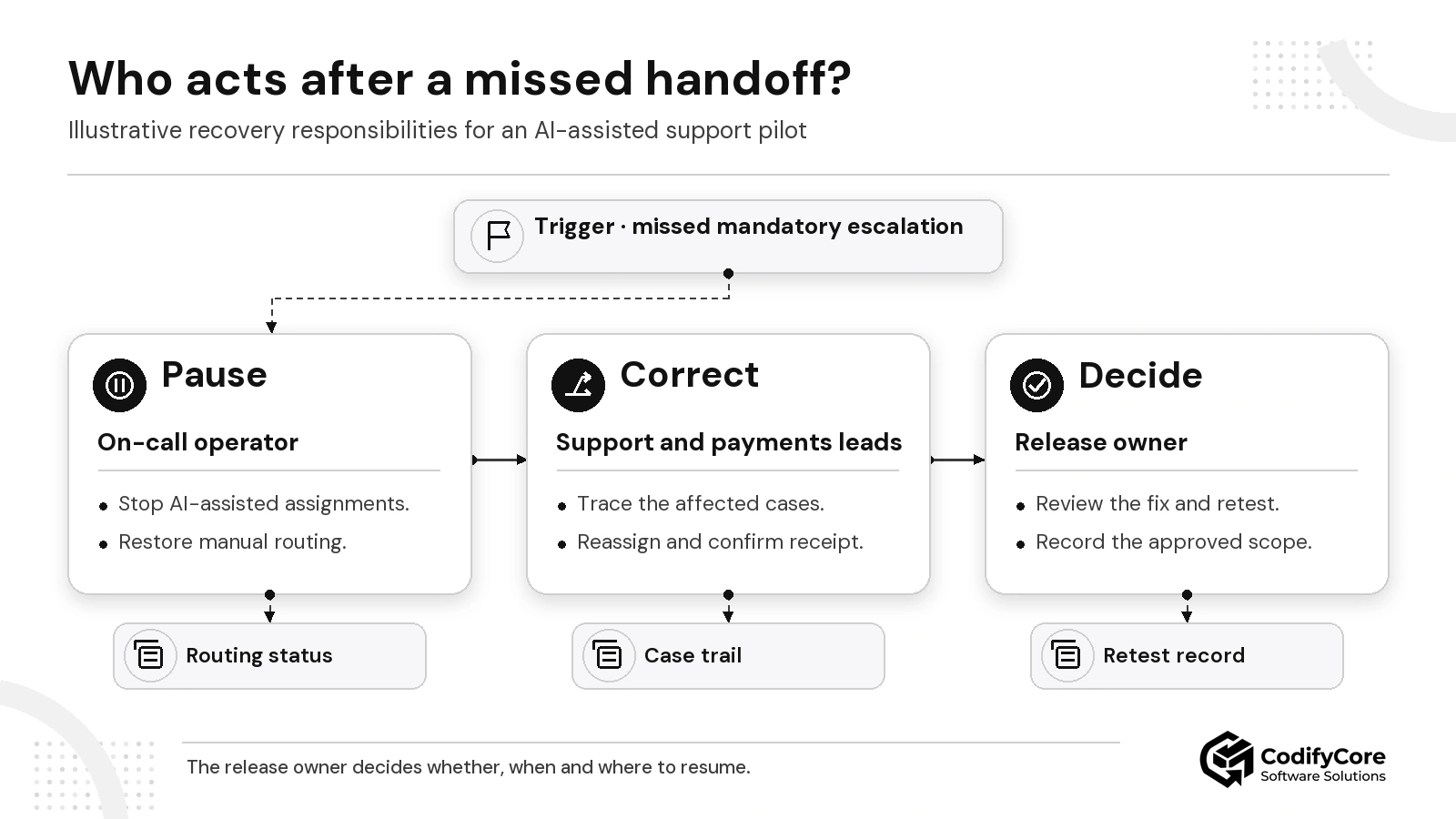
Organisations often describe a workflow as reversible because an operator can turn it off. That describes the next case. The more demanding question is what the business can do about cases the workflow has already touched. If the assistant recommends queues, the team can preserve a record of which tickets received that recommendation, then use it to locate and correct misroutes. If a later version is allowed to send messages or make changes in another system, the recovery work changes with those permissions. A release owner should be able to name the actions that can be undone, the actions that require correction or reconciliation, and the person authorised to do either. CodifyCore’s guide to building agents for real business workflows
What leaders should ask to approve
An effective proposal gives executives a business decision they can make. It states the expected improvement over the current process, the categories that are eligible, how exception demand changes by team and the conditions under which the company will suspend or narrow the release. It also identifies the person responsible for the customer outcome across the team boundary. That owner should have sufficient authority to resolve disagreements over routing, staffing and timing when one team’s gain changes another team’s workload.
The investment decision can follow the same logic. For a small staff-reviewed pilot, fund enough capacity to check outcomes, investigate exceptions and rehearse recovery. Scale funding and permissions as evidence improves. Compare the pilot with the current process on similar cases, and give it enough time and volume to exercise the critical paths for its approved scope. Google’s reliability engineering guidance describes how exposure to a limited portion of production and comparison with a control can support rollout decisions. Applied here, the relevant signals include correct end-to-end resolution, time to accepted handoff, work waiting in the exception queue and missed mandatory escalations. Google SRE Workbook, Canarying Releases
The release decision should be narrow enough for someone on the next shift to use. Approving AI drafting for a named category of order enquiries, with a named exception owner and verified manual routing, gives staff a clear boundary. Approving expansion based on the pilot’s average score gives them far less. As the approved categories expand or as the model, policies or permissions change, the evidence needed to defend the decision changes too.
When the two reports arrive at that operations meeting, the executive should ask for a combined view before authorising scale. How much time did the business actually recover? Where has judgment become more concentrated? Can the people who exercise that judgment keep up, and what happens to customers when they cannot? A credible AI proposal gives those questions the same prominence as the time savings. It gives the organisation a way to take the gains without leaving its hardest work to whoever happens to notice it.