
A Digital Product Passport (DPP) can look convincing in a demonstration. A product is scanned, a page opens, and a collection of materials, environmental data and certificates appears. But the experience behind that page—where the data originates, who can change it, what others can access, and whether it survives a technology migration—is far harder to evaluate.
For a manufacturer, importer, brand or industrial supplier, choosing a DPP provider is therefore not just a software purchase. It can become a long-term decision about product identity, regulatory responsibilities, enterprise integration, supply-chain collaboration, cybersecurity and access to product information throughout its useful life.
The stakes are becoming more immediate in the European Union. The Ecodesign for Sustainable Products Regulation (ESPR), Regulation (EU) 2024/1781, establishes the overarching framework for DPP requirements that will be specified for covered product groups through further acts. Those requirements are not identical for every product, and a general-purpose passport interface does not establish conformity with every future delegated act. The ESPR’s DPP provisions address matters such as product identifiers, interoperability, access rights, data accuracy and availability. (EUR-Lex — Regulation (EU) 2024/1781)
Separately, Article 77 of the EU Batteries Regulation (EU) 2023/1542 specifies battery passports from 18 February 2027 for electric vehicle batteries, light means of transport (LMT) batteries and industrial batteries above 2 kWh that are placed on the market or put into service. Not every battery-passport data field becomes mandatory on that date; applicability and the timing of underlying obligations matter. (EUR-Lex — Batteries Regulation; European Commission — Battery DPP FAQ)
That distinction changes what a buyer should ask a provider. Can the system demonstrate the requirements applicable to our products, today, using reliable evidence? And can it adapt without locking the business into one platform or one supplier’s interpretation of evolving rules?
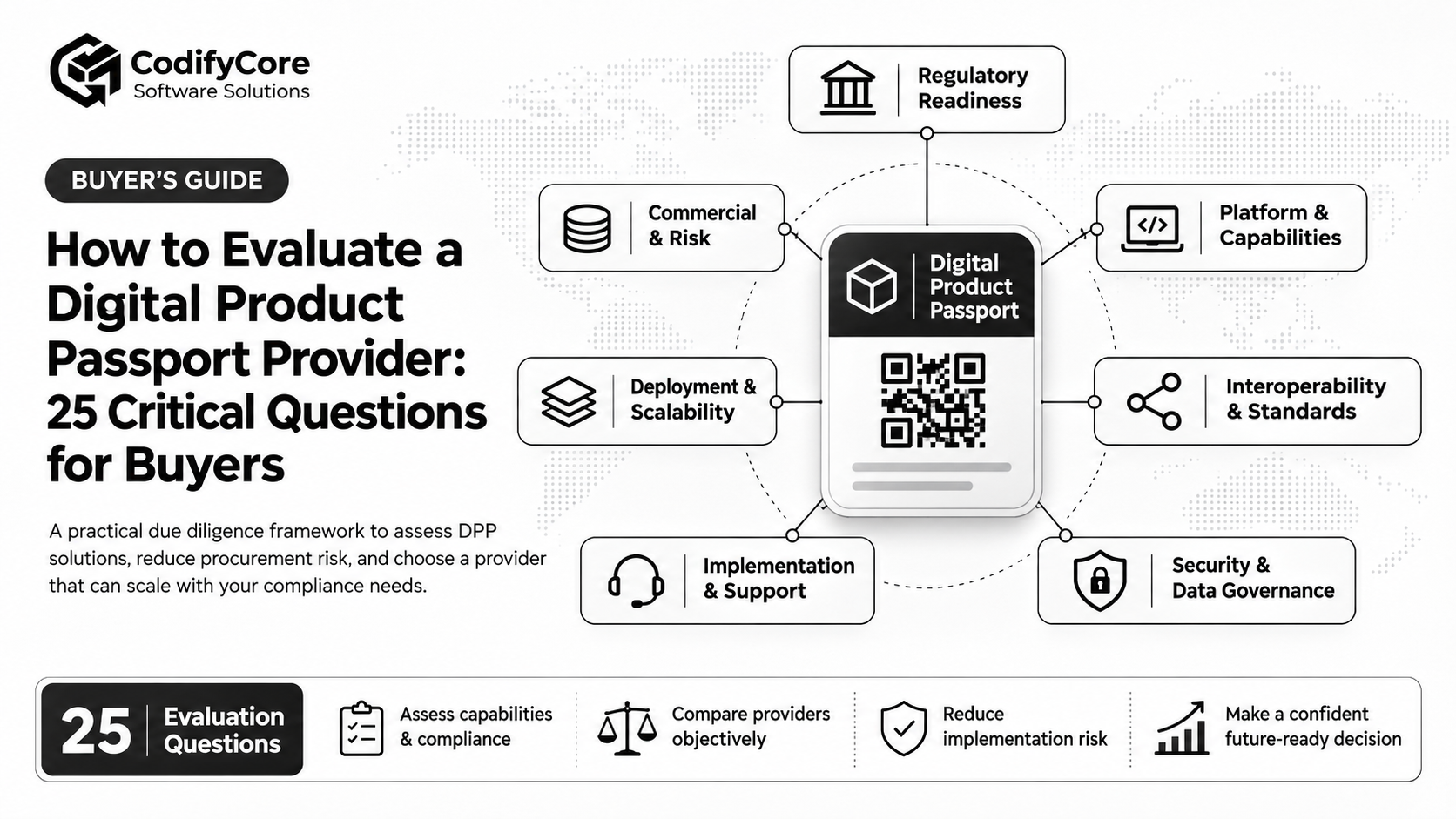
The buying decision: shortlist first, validate second
There are two different questions in DPP procurement:
- Which providers deserve consideration? Market research, verified deployments, specialisations and comparative rankings can help establish an initial shortlist. CodifyCore’s Top 10 Digital Product Passport Solutions in 2026 is one resource for that market-discovery stage.
- Which provider can meet our requirements? That answer depends on your products, applicable laws, existing systems, suppliers, data quality, deployment constraints, budget and tolerance for risk.
This article is designed for the second question. It does not rerank the vendors in CodifyCore’s Top 10 publication, nor does its suggested buyer scorecard replace the editorial methodology used in that ranking. Instead, it provides 25 due-diligence questions, the evidence to request and a repeatable process for comparing your own shortlisted providers.
Before inviting vendors to respond, document four things internally: the product groups in scope, the economic operators and markets involved, the information currently available, and the business systems that will remain systems of record. Without these inputs, even technically strong proposals will be difficult to compare fairly.
Ready to turn the evaluation questions into a procurement pack? Download CodifyCore’s Digital Product Passport procurement templates for a fillable provider pre-assessment, editable RFI, RFQ and RFP documents, a security questionnaire, a pricing annex and evaluation workbooks.
The 25-question evaluation framework
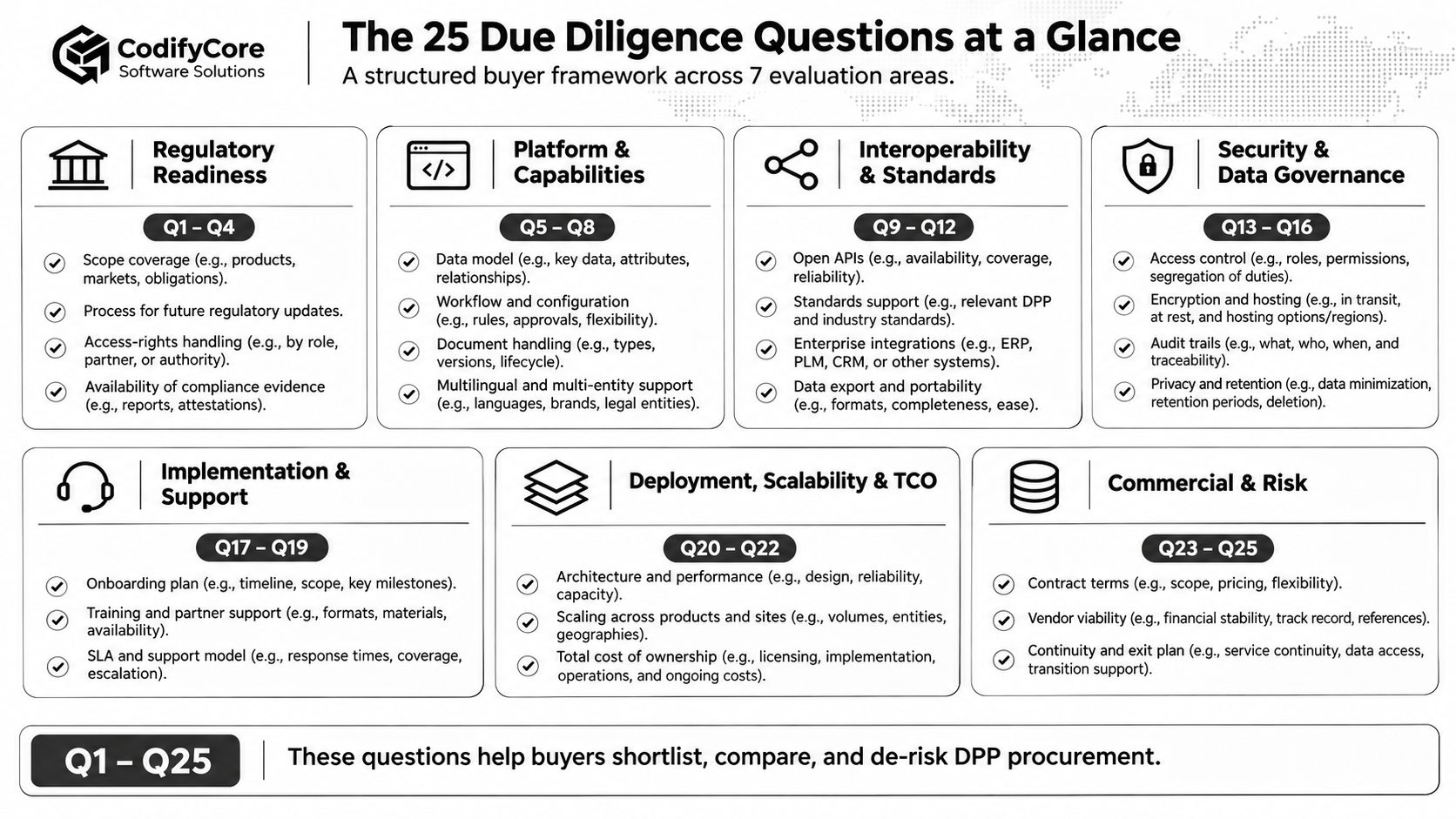
| Evaluation area | Questions | Primary objective |
|---|---|---|
| Regulatory readiness | Q1–Q4 | Establish applicable scope and verify regulatory claims |
| Platform and capabilities | Q5–Q8 | Test identity, data quality, lifecycle and organisational fit |
| Interoperability and standards | Q9–Q12 | Verify integration, standards support and data portability |
| Security and data governance | Q13–Q16 | Protect restricted information and support accountable control |
| Implementation and support | Q17–Q19 | Validate delivery capacity and ongoing operations |
| Deployment, scalability and TCO | Q20–Q22 | Test technical scale, resilience and whole-life cost |
| Commercial and risk | Q23–Q25 | Protect contractual rights and long-term continuity |
How to use this guide: Ask every shortlisted vendor the same core questions. For each answer, request a dated document, product demonstration, relevant test result, customer reference or contractual commitment. Keep existing production functionality, tested functionality, prototype, roadmap item and not supported as separate statuses. They are not interchangeable forms of evidence.
1. Regulatory readiness (Q1–Q4)
Q1. Which regulations, product groups and market obligations does your solution actually cover?
A provider might advertise “ESPR readiness” even when its strongest evidence relates to one sector or one pilot. Ask it to identify the relevant legal instruments, the type of product, the affected economic operator and the obligations already applicable. A battery passport implementation should be evaluated against the Batteries Regulation, not treated as proof of conformity with every possible ESPR product group.
Evidence to request: A version-controlled legal-to-feature applicability matrix showing the exact regulation or provision, product category, implementation status, exclusions and accountable party. Ask for a completed example based on one of your products.
Warning sign: A blanket “EU DPP compliant” claim with no defined product scope or supporting technical/legal mapping.
Q2. How do you turn regulatory data requirements into validated passport fields—and adapt them when the rules change?
The platform must do more than offer a configurable list of sustainability fields. It should distinguish legally required information from useful optional information, conditionally applicable data and fields anticipated under future rules. For batteries in particular, the European Commission’s guidance differentiates information required at introduction from requirements whose underlying application dates arrive later. (European Commission — Battery DPP FAQ)
Evidence to request: A requirement-to-field traceability matrix, examples of validation rules, source ownership, field versioning and a documented change-management process. Ask what happens when a delegated act or interpretation changes after deployment.
Warning sign: A static template presented as a permanent regulatory specification, or automatic changes with no review or impact assessment.
Q3. Can you demonstrate the EU DPP Registry workflow relevant to our products?
On 20 July 2026, the European Commission announced the launch of the DPP Registry together with a testing environment. The Registry is designed around unique identifiers and associated metadata; detailed passport data remains decentralised rather than being stored in full in the Registry. Registry interaction should therefore be evaluated separately from the vendor’s passport hosting and data-governance functions. (European Commission — DPP Registry announcement)
Evidence to request: A permitted demonstration in the relevant environment, covering organisation or operator prerequisites, identifier registration, authentication, metadata validation, error responses, updates and reconciliation. Ask which steps were genuinely tested and which remain planned.
Warning sign: Claims that the Registry stores every passport record, or descriptions of testing-environment access as EU product certification.
Q4. How can you substantiate each regulatory or conformity claim?
Compliance assertions need an identifiable basis. A vendor may provide a standards-conformance report, a verified feature demonstration, a certification with a specific scope, or legal analysis addressing a particular obligation. These are different types of evidence. Likewise, membership in a consortium or participation in an EU-funded project can demonstrate activity and expertise without proving production conformity.
Evidence to request: A claims register that identifies the claim, applicable requirement, supporting document, responsible organisation, date, scope and any limitations. Ask who assumes responsibility for monitoring changes and for resolving identified gaps.
Warning sign: An undifferentiated list of partner logos, standards names or research projects offered in place of testable compliance evidence.
2. Platform and capabilities (Q5–Q8)
Q5. Does the platform support the product identity and granularity our use case requires?
Product data may need to be organised at model, batch or individual-item level, depending on the relevant rules. Industrial products may also require relationships between assemblies, components, serial numbers, revisions and replacement parts. A system designed only to create one QR-linked web page per SKU may not be suitable for the required identity structure.
Evidence to request: A live demonstration with two product models, multiple batches, individual items and parent–component links. Check uniqueness, identifier persistence, duplication controls and what happens when a physical product is repaired, reconfigured or replaced.
Warning sign: No supported distinction between product, model, batch and item identities—or a dependency on manually editing disconnected passport pages.
Q6. How does the system manage product-data changes across the lifecycle?
Product data can change through manufacturing, distribution, maintenance, refurbishment, remanufacturing and end-of-life activities. The right update policy depends on the product and applicable law. Some data should remain historically traceable; other fields may require controlled correction or a new record relationship rather than overwriting an old fact.
Evidence to request: A test involving a corrected material declaration, a versioned technical document, an expired certificate and a product lifecycle event. Verify event dates, who approved changes, whether previous values remain appropriately traceable, and how the platform avoids publishing conflicting states.
Warning sign: Any user can silently overwrite material information without accountability or a meaningful revision history.
Q7. Can suppliers contribute credible data without sacrificing provenance and quality?
Many DPP programmes depend on suppliers that use different ERP systems, languages and levels of digital maturity. A vendor should demonstrate more than an upload button: it should show how supplier information is received, attributed, validated, challenged and kept current. A supplier declaration is not automatically the same as independently verified evidence.
Evidence to request: Supplier portal, spreadsheet and API submission examples; required-field checks; unit validation; document expiry alerts; evidence attribution; approval workflow; and deliberate failure cases such as a missing field or contradictory certificate.
Warning sign: Every imported data item receives the same “verified” label regardless of its source or assurance level.
Q8. Can the platform serve multiple entities, markets, languages and stakeholder workflows?
A group may operate separate legal entities, brands, factories, importers and local-language information channels. Some data is common across products; other information may be market-specific, commercially sensitive or accessible only to defined participants. Buyers should verify which arrangements the platform actually supports rather than relying on a generic “enterprise-ready” claim.
Evidence to request: A demonstration involving two legal entities, different product groups, multiple languages, delegated administration, shared supplier records and distinct access policies. Ask which configurations are included and which require bespoke development.
Warning sign: Expansion to a second entity or product category requires duplicating the entire application or rebuilding the data model.
3. Interoperability and standards (Q9–Q12)
Q9. What open, documented APIs and machine-readable interfaces are available?
DPP information should be usable beyond the vendor’s own interface. Buyers need to understand read and write operations, bulk processing, identity resolution, authentication, pagination, event notifications, error handling and version compatibility. Availability of an API is not equivalent to a usable or stable enterprise integration.
Evidence to request: Current API specifications, example payloads, authentication requirements, rate limits, sandbox access, change policy, error codes and evidence that the integration has been tested end to end.
Warning sign: API access depends on undocumented private endpoints, manual exports or an additional undefined development project.
Q10. Which DPP standards and identifier schemes are implemented—and to what extent?
In July 2026 the EU published references to six harmonised DPP standards through Commission Implementing Decision (EU) 2026/1736, addressing areas including data exchange, identifiers, data carriers, storage, APIs and system interoperability. A provider’s use of GS1 identifiers, EPCIS, Catena-X, W3C credentials or other technologies may also be relevant, but none should be assumed universally compulsory merely because it appears in a technology architecture diagram. (EUR-Lex — Decision (EU) 2026/1736)
Evidence to request: A standards-and-versions applicability table, test results, examples of identifiers and data carriers, documented protocol implementations and a list of proprietary extensions. Distinguish published harmonised standards from related industry specifications.
Warning sign: Treating membership in a standards organisation as proof of conformance to every relevant technical specification.
Q11. How will the DPP connect with ERP, PLM, PIM, MES and other source systems?
The passport platform should not become a disconnected duplicate of authoritative enterprise records. Product composition may originate in PLM, commercial attributes in PIM, production data in MES, lifecycle events in service systems, and supplier claims in dedicated traceability or LCA tools. Integration design must determine which system owns each data element and how synchronisation failures are resolved.
Evidence to request: A proposed integration architecture, connector list, system-of-record map, ownership rules, sample synchronisation, exception handling and implementation estimates for the actual enterprise applications in scope.
Warning sign: Every “integration” turns out to be a one-time CSV upload, with no ownership model for subsequent changes.
Q12. Can we export complete, usable data and move to another provider?
Portability should be established before the contract is signed. Exporting a screen as a PDF is not the same as transferring product records, structured attributes, identifiers, evidence references, relationship data, audit information and necessary metadata in a form another system can use. Migration may also affect URLs, data carriers and stakeholders’ ability to resolve identifiers.
Evidence to request: A documented export specification, a sample complete export, mapping of attachments and access policies, an explanation of how redirects or resolver continuity work, and a migration rehearsal with representative records.
Warning sign: Data export is technically possible only through paid, undocumented custom work or excludes indispensable evidence and relationships.
4. Security and data governance (Q13–Q16)
Q13. How do you enforce public, restricted and role- or purpose-specific access?
Not all DPP information is intended for every audience. For example, the Batteries Regulation identifies information available to the public, information for specified authorities and other bodies, and information accessible to parties with a legitimate interest under defined rules. Buyers must confirm that the platform can enforce the permissions relevant to their obligations. (EUR-Lex — Batteries Regulation, Article 77)
Evidence to request: A role-and-purpose access matrix, tests using public and restricted users, organisation identity checks, revocation, delegated access and logged denial events. Verify that authorisation is enforced by APIs as well as the user interface.
Warning sign: Sensitive supplier information is protected only by hiding an interface element or sharing a difficult-to-guess URL.
Q14. How are data, credentials and infrastructure protected?
DPP environments may hold commercially sensitive bills of materials, technical documents, supplier relationships and personal data. Appropriate protection depends on architecture and contractual responsibilities, not a single badge. Questions should cover encryption in transit and at rest, key and secret management, backups, hosting boundaries, tenant isolation and administrator privileges.
Evidence to request: Security architecture, hosting locations, identity and access controls, encryption design, subcontractor list, tenant-separation model and relevant platform-specific assurance documents. Confirm any data-residency promises contractually.
Warning sign: No explanation of the production hosting environment or the scope of third-party access to client data.
Q15. Can you demonstrate auditable operations and credible security assurance?
An organisation may need to show which person or service created, changed, reviewed or accessed records, and when. Security assurance also requires precision: ISO/IEC 27001 certification or a SOC 2 report is helpful only to the extent that its scope actually covers the service and controls being assessed.
Evidence to request: Tamper-evident audit trails where appropriate, monitoring and incident procedures, current certificates or reports with scope and dates, penetration-test summary, remediation policy and test evidence for privileged actions. Confidential reports can be examined under NDA.
Warning sign: A certificate from an unrelated corporate entity is offered as proof of security for the deployed DPP service.
Q16. Who controls retention, confidentiality, privacy and permitted secondary use?
Buyers need to define what the provider can do with their own data and supplier-submitted data. The same information may be subject to contractual confidentiality, applicable privacy law, product-specific availability duties and retention obligations. A one-size-fits-all deletion or indefinite-storage policy can be problematic.
Evidence to request: Data-processing and confidentiality terms, purpose limitations, retention schedules, deletion or archival workflows, subprocessor disclosures, data-sharing controls, breach procedures and documented customer choices for permitted reuse or analytics.
Warning sign: The provider reserves unrestricted rights to commercially reuse customer or supplier data, or cannot explain its retention and deletion processes.
5. Implementation and support (Q17–Q19)
Q17. What is the actual implementation plan, including dependencies and acceptance criteria?
A reliable proposal should describe the systems, product groups, supplier population, data-cleanup work, identity design, rollout phases and people needed from both organisations. A promise to “go live in four weeks” has little meaning if it excludes integrations or missing upstream evidence.
Evidence to request: Statement of work, RACI or responsibility matrix, realistic project schedule, deliverables, critical dependencies, test cases, implementation team, escalation owner and measurable acceptance criteria.
Warning sign: A polished timeline with no named owners for supplier data, infrastructure decisions or business approval.
Q18. How will internal teams and suppliers be onboarded and trained?
Even a technically capable platform can fail if suppliers cannot provide data or business teams cannot manage corrections. Ask how the provider accommodates technical and non-technical participants, multilingual needs, help content and different levels of access.
Evidence to request: Onboarding materials, training plan, supplier invitation workflow, helpdesk routes, user-administration process, adoption reporting and pricing for additional supplier accounts or training sessions.
Warning sign: Supplier participation depends on every partner purchasing enterprise software or receiving one-off manual support indefinitely.
Q19. What happens after go-live when incidents, standards or requirements change?
DPP programmes require maintenance, monitoring and controlled updates. Buyers should distinguish defect correction, platform upgrades, regulatory interpretation, data-model changes, integration maintenance and paid professional services. Operating responsibilities need to remain clear even when an external consultant implements the initial system.
Evidence to request: Service levels, response and resolution targets, support hours, incident notification, escalation routes, regulatory-update policy, release notes, backwards-compatibility commitments and chargeable-change rules.
Warning sign: Implementation support ends at launch, with future maintenance, regulatory updates and incident response left undefined.
6. Deployment, scalability and total cost of ownership (Q20–Q22)
Q20. Can the architecture perform reliably at our realistic data and transaction volumes?
A platform may generate thousands of demo passports but struggle with serialised products, large evidence files, multiple suppliers, frequent access requests or complex permission checks. Ask about models, batches, item identities, API throughput, storage, user concurrency and resolution latency—not just the advertised total number of identities.
Evidence to request: Architecture overview, load-test methodology, representative performance results, capacity limits, service dependencies, scaling assumptions and production references relevant to your workload.
Warning sign: High aggregate platform-volume claims with no explanation of what was measured or whether the figures refer to regulatory DPPs.
Q21. Which deployment, recovery and continuity arrangements are actually supported?
Some buyers need managed cloud infrastructure; others have stronger needs relating to hosting location, integrations, resilience or operational control. The ESPR includes provisions relating to availability and the backup copy made available by an economic operator through a DPP service provider. Buyers should map those obligations to the applicable product rules and operational arrangements, rather than assuming the vendor’s ordinary database backup resolves everything. (EUR-Lex — ESPR, Article 10)
Evidence to request: Supported hosting configurations, backup and restore design, disaster-recovery test outcomes, recovery-time and recovery-point objectives, dependencies, continuity obligations and treatment of independent backup arrangements where relevant.
Warning sign: Availability claims backed only by an uptime percentage, without a demonstrated restore, recovery or continuity plan.
Q22. What is the total three-to-five-year cost under our expected operating conditions?
The subscription price can be only a portion of the overall cost. Integration, data transformation, supplier onboarding, data carriers, storage, APIs, credentials, verification, consulting, training, transaction limits and exit assistance may materially affect the business case. Ask vendors to price the same scenario and identify assumptions.
Evidence to request: An itemised cost model with setup costs, minimum commitments, unit-based pricing, usage tiers, overage charges, annual increases, support inclusions and at least a base, growth and high-volume scenario.
Warning sign: An attractive headline price that cannot be reconciled with the proposed implementation and projected use.
7. Commercial and risk considerations (Q23–Q25)
Q23. What rights, responsibilities and protections will be written into the contract?
A contract should specify what is being delivered, what is included in the service, who controls records, the use of third-party components and how defects and changes are handled. It should also cover data processing, confidentiality, service levels, fees and appropriate responsibility for subcontractors. Procurement teams should ask counsel to review obligations connected to regulated products and cross-border data.
Evidence to request: Proposed master services agreement, service description, statement of work, data-processing agreement where applicable, service levels, intellectual-property and data-rights clauses, liability terms and acceptance criteria.
Warning sign: Critical rights or deliverables exist only in a sales presentation rather than the enforceable agreement.
Q24. What independent evidence supports the vendor’s operational maturity and viability?
An impressive prototype, research partnership or public announcement may warrant interest, but those facts should not be represented as a successful long-term production deployment. Evaluate customer references, delivery resources, financial and operational resilience, support capacity and dependency on essential subcontractors in proportion to the size and duration of your commitment.
Evidence to request: Relevant customer references, deployment descriptions with appropriately classified evidence, support footprint, continuity policy, key dependencies and reasonable financial or corporate due diligence under confidentiality where necessary.
Warning sign: Pilot participation is described as scaled commercial adoption, or vendor claims cannot be connected to a verifiable customer or project scope.
Q25. If the provider is acquired, closes or we change vendors, how will our passports remain usable?
The exit question should be asked while the relationship is healthy. A business needs to know whether records can be moved, evidence can be preserved, identifiers will still resolve, access policies can be reconstructed and required information will remain available during and after transition. This is both a technical test and a commercial negotiation.
Evidence to request: A written exit and transition plan, export specifications, assistance rates, notice periods, data-retention and deletion arrangements, backup responsibilities, identifier-resolution strategy and a sample migration exercise.
Warning sign: No credible answer to what happens to passports and product identifiers when the commercial contract ends.
Verify the answers with a structured proof of concept
A vendor presentation can establish interest, but a common proof of concept (PoC) establishes comparable evidence. Give each shortlisted provider the same representative product scenario, the same test dataset, the same known errors and the same acceptance criteria. Use anonymised or appropriately protected information where supplier confidentiality or personal data is involved.
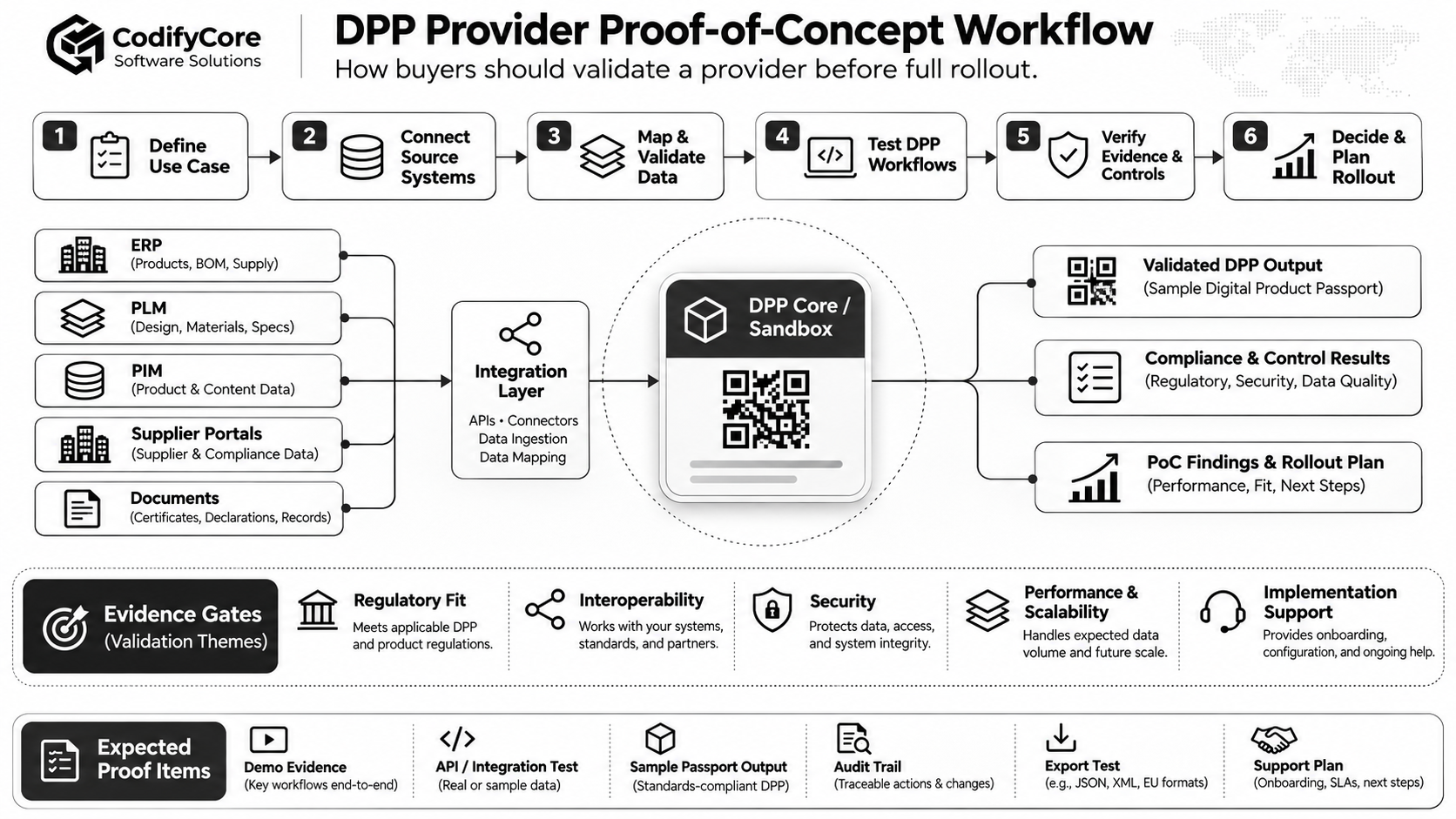
| Test | What the buyer should observe | Evidence to retain |
|---|---|---|
| 1. Product identity | Correct model, batch or item record and persistent identifier | Sample IDs, data model and resolution results |
| 2. Enterprise and supplier data | Import from a source system; recognise a malformed supplier field | Payloads, mapping records and validation errors |
| 3. Passport lifecycle | Create, update and retrieve a passport while retaining appropriate history | Before-and-after data, timestamps and change logs |
| 4. Access permissions | Different stakeholder views, successful authorisation and denied access | Access matrix, API results and denial logs |
| 5. Registry and standards | Relevant Registry testing and standards-based interfaces, where applicable | Test-environment evidence, versioned API/standard mappings |
| 6. Portability and resilience | Export complete records and reproduce them in a different environment | Export bundle, migration notes and restore/recovery results |
Record each test as pass, partial pass, fail or not tested. Require a clear distinction between product functionality that exists, functionality configured for the pilot and features promised on the roadmap. If a criterion is essential, an untested promise should not be recorded as a pass.
The PoC should end with a written gap register: missing capabilities, proposed workarounds, additional costs, responsible owners and dates. That document is more valuable during contract negotiation than an unqualified “successful demo” statement.
How to score DPP providers consistently
The questions above support a buyer-specific scorecard. The illustrative weights below are deliberately different from CodifyCore’s global Top 10 editorial ranking methodology, which evaluates market-wide vendor evidence for a different purpose. Procurement teams may change these weights to reflect their own critical risks—but should agree them before evaluating vendors.
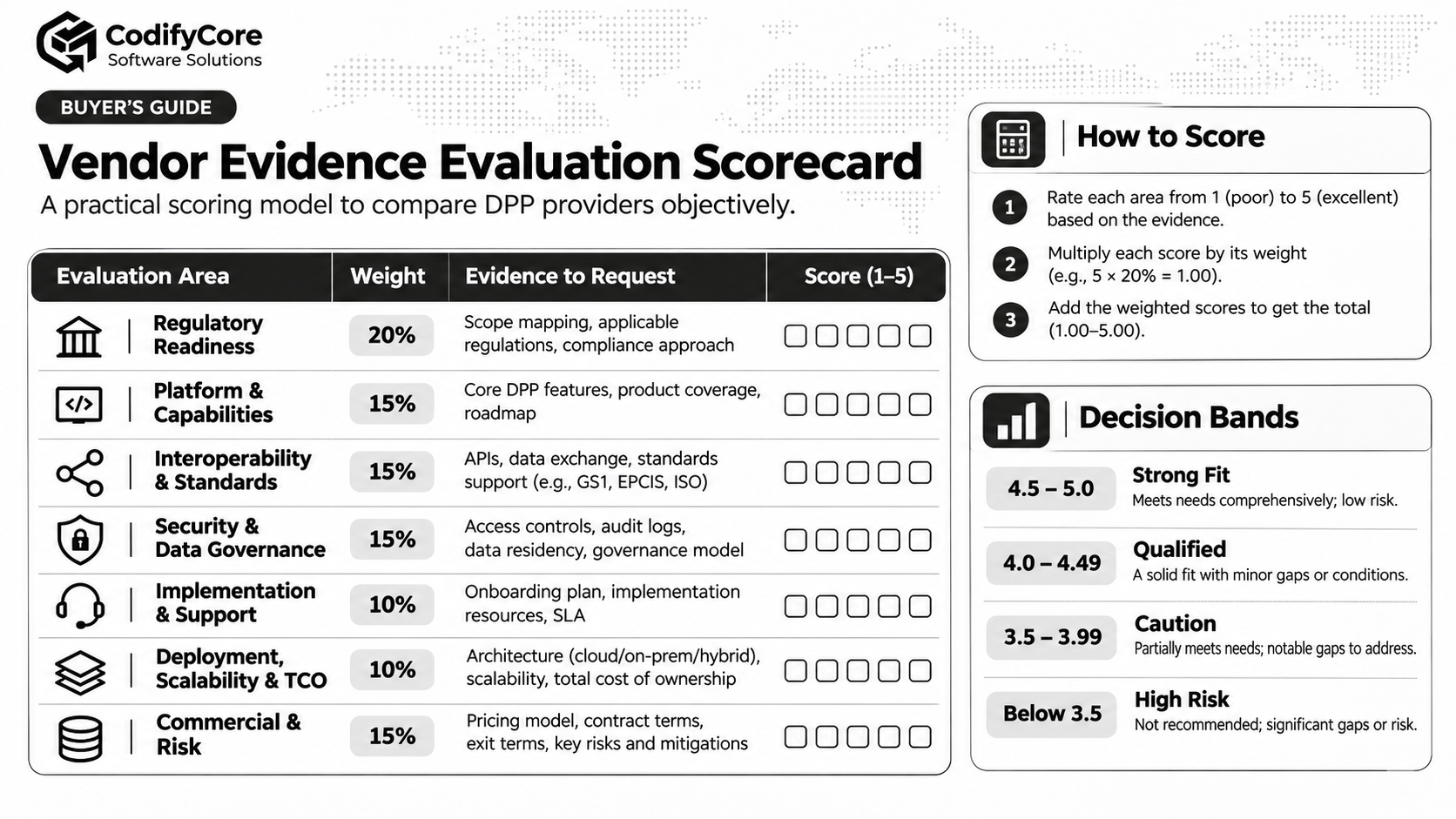
| Evaluation area | Suggested weight | Representative evidence |
|---|---|---|
| Regulatory readiness | 20% | Product-specific mapping, relevant obligations, Registry test evidence |
| Platform and capabilities | 15% | Data model, lifecycle records, supplier evidence workflows |
| Interoperability and standards | 15% | APIs, identifier/standards support, system integration, exports |
| Security and data governance | 15% | Access tests, assurance, auditability, retention controls |
| Implementation and support | 10% | Delivery plan, team, onboarding, SLAs |
| Deployment, scalability and TCO | 10% | Load tests, resilience and priced operating scenarios |
| Commercial and risk | 15% | Contract, references, continuity and exit plan |
| Total | 100% |
Suggested score for each area (1–5):
- 1 — Unsupported or materially inadequate: No credible evidence, a failed essential test or a serious gap.
- 2 — Limited or planned: Partial functionality, prototype or roadmap-based claims with material uncertainty.
- 3 — Demonstrated: The provider completes the agreed test, with identifiable remaining gaps.
- 4 — Well supported: Repeatable capability, strong technical documentation and relevant delivery evidence.
- 5 — Strong verified fit: The capability is proven for the buyer’s scenario and supported by directly relevant operational evidence.
Calculate the weighted score out of 5 as:
Total score = Σ [area score × (area weight ÷ 100)].
For example, a score of 4 in an area weighted at 20% contributes 0.80 points to the total. Use identical evidence requirements and scoring rules for all bidders.
The ranges shown in Figure 4—4.5–5.0 strong fit; 4.0–4.49 qualified; 3.5–3.99 caution; below 3.5 high risk—are illustrative internal decision bands, not independently validated performance thresholds. A vendor is not compliant merely because it scores well.
Apply mandatory gates before the weighted comparison
Certain failures should not be averaged away by strength in less critical areas. Establish pass/fail requirements such as the applicable legal scope, essential access control, a workable data-export route, contractual data rights, security conditions and continuity arrangements. A vendor that fails a mandatory gate should be remediated or excluded regardless of its aggregate score.
This is particularly important when comparing a mature production system with an early-stage research prototype. Both may deserve evaluation, but their evidence maturity should be stated accurately, not blended into a single marketing claim.
Seven common mistakes when evaluating DPP vendors
- Buying the interface instead of the data architecture. A polished QR-linked page says little about data quality, permissions, provenance or portability.
- Treating a framework regulation as one universal checklist. Product-specific obligations and dates must be identified separately.
- Mistaking research participation for live production maturity. Consortium activity, pilots and commercial deployments are different evidence categories.
- Using standards logos as proof of conformance. Ask which version and which requirement have actually been implemented and tested.
- Ignoring supplier-data readiness. Software cannot manufacture missing origin records, certificates or environmental measurements.
- Comparing prices without a common scenario. Low initial licence costs can conceal integrations, onboarding, usage charges and exit costs.
- Deferring the migration question. Long-term control of product records should be established before procurement, not after a provider relationship breaks down.
How this guide complements CodifyCore’s Top 10 DPP ranking
CodifyCore’s global comparison of the Top 10 Digital Product Passport solutions examines the market through its own published editorial criteria, including regulatory readiness, deployment evidence, research contribution, interoperability, enterprise integrations, security and implementation support.
This guide is not an alternative ranking. It is a vendor-neutral process for procurement teams to test the providers they have shortlisted. A platform that scores strongly in a market-wide comparison may not be the best fit for a manufacturer with highly specialised industrial integrations; similarly, a provider with narrower sector coverage may be better aligned to a particular regulated product and supplier network.
The recommended sequence is therefore:
Define obligations and use cases → research the market → shortlist relevant providers → request evidence → run a comparable PoC → negotiate commercial protections → implement and monitor.
This approach lets buyers benefit from market intelligence without allowing an overall rank or a single headline score to replace due diligence.
Frequently asked questions
Is there an official EU certification for every DPP software platform?
Do not assume one exists. A vendor claiming to be “EU-certified” should identify the scheme, issuing body, product or service, applicable standard or requirement and certification scope. Testing in an EU Registry environment, participation in an EU-funded project and conformity assessment of a regulated product are different matters. Buyers should evaluate precisely what evidence supports each claim.
Must every product sold in the EU already have a Digital Product Passport?
No. The ESPR establishes a framework for product-specific rules, while the Batteries Regulation contains explicit passport requirements for specified categories from 18 February 2027. Applicable obligations and implementation dates must be checked by product and legal instrument. (EUR-Lex — ESPR; EUR-Lex — Batteries Regulation)
Is the EU DPP Registry the place where every complete passport is stored?
No. The Commission describes it as an infrastructure for registering unique identifiers and associated metadata. The detailed product information is stored in a decentralised manner. Buyers must still evaluate the provider’s record hosting, availability, access and recovery arrangements. (European Commission — Registry launch)
Must a DPP provider use blockchain, decentralised identifiers or a particular data space?
There is no universal ESPR requirement to use blockchain for every DPP. Such technologies may be valuable for particular trust, identity or multi-party data-exchange requirements. Buyers should assess them against the actual legal obligations, interoperability needs, security model, cost and ongoing operational complexity—not assume that a technology label establishes conformity.
What if the provider’s platform is ready but our supplier information is not?
A pilot can still clarify the gaps. However, the buyer should maintain a data-readiness plan covering required fields, sources, evidence ownership, quality checks, supplier onboarding and remediation dates. A live passport should not be confused with reliable underlying data.
How many providers should we evaluate?
There is no statutory number. A manageable shortlist of approximately three to five credible options can allow meaningful evidence review and comparable tests. The right number depends on procurement scale, specialised product needs, timing and market availability; it is a practical suggestion, not a universal rule.
Is the highest-scoring vendor automatically the correct choice?
No. The weighted score is one input. Mandatory requirements, unacceptable security or continuity gaps, commercial terms, deployment constraints and specific product obligations can outweigh a small difference in aggregate score. Document any final decision that differs from the score order.
Final assessment
The most reliable Digital Product Passport provider is not necessarily the one with the longest feature list, the most elaborate passport interface or the most ambitious roadmap. It is the one whose applicable capabilities, evidence, delivery model, economics and long-term controls can withstand a serious procurement test.
A defensible buying decision answers five questions: What must the system do? How has each important claim been proven? What remains unverified? Who is accountable for delivery and operation? And can the business retain control of its product records over time?
Use the 25 questions as a common evidence framework. Ask for specific demonstrations and documents. Run the same PoC for each shortlisted provider. Establish contractual protections before implementation. That is how a DPP procurement process moves from marketing promises to an informed, auditable technology decision.
Sources and further reading
Primary EU legal and institutional sources
- Regulation (EU) 2024/1781 — Ecodesign for Sustainable Products Regulation, particularly Articles 9–13 on digital product passports.
- Regulation (EU) 2023/1542 — Batteries and waste batteries, including Article 77 and Annex XIII. Consult the current consolidated text and subsequent measures where relevant.
- European Commission — The Digital Product Passport Registry is now live, 20 July 2026.
- Commission Implementing Decision (EU) 2026/1736, published 15 July 2026, concerning harmonised DPP standards.
- European Commission — EU Digital Product Passport FAQ for Batteries, including guidance on applicability, phased information requirements and lifecycle changes.
Related CodifyCore research
- Top 10 Digital Product Passport Solutions in 2026: Global DPP Comparison — vendor landscape and CodifyCore’s separate editorial ranking methodology.
Editorial and methodology note: This guide is a general procurement research framework, not legal advice, an EU-issued certification checklist or a ranking of the vendors named in other CodifyCore publications. The 25 questions, buyer weighting, PoC tests and decision bands are recommended evaluation tools; they should be adapted to the products and binding requirements involved.