
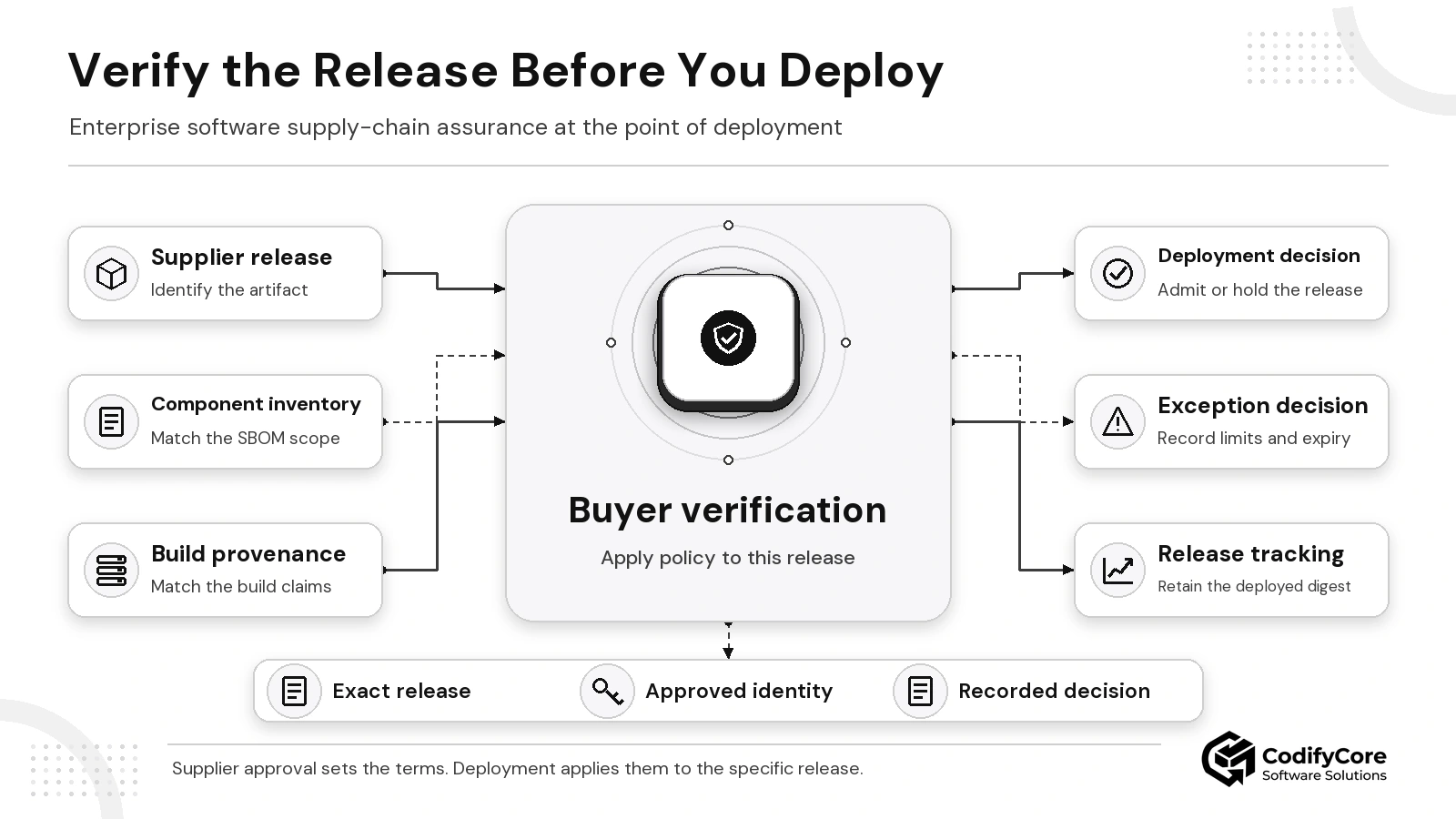
Imagine a payments business buying a reconciliation service that it will run in its own cloud. The supplier has passed due diligence. Procurement has agreed a contract. Engineering has reviewed an image in an isolated environment and demonstrated that it can read the records it needs. A few months later, the supplier publishes an urgent update. Its signature verifies. The accompanying component inventory describes a different release. The timing matters because the update is meant to fix a known problem. Who can decide whether the business deploys it, and what must that person know?
An enterprise can have a good answer about the supplier and a weak answer about the software. That is the gap buyers should close first. Approval to buy software should establish the conditions for accepting future releases. Production should apply those conditions to the specific artifact it is about to run. The company that accepted the contract and the team that operates the deployment both need to see that decision. Otherwise, product approval becomes an implicit grant of authority to future builds, packaging changes and emergency distribution channels the buyer may never have evaluated.
A supplier review approves a relationship
Conventional due diligence serves a purpose. It establishes whether a supplier can support the product, respond to security problems and operate a development process consistent with the buyer’s risk. The assessment often happens before the purchase, and its evidence may describe the supplier as a whole or a product family. Production deployment happens on a different timeline. Over a contract’s life the build service can change, an integration can acquire more access, or a release can bring in a new dependency. A general assessment cannot identify which of those changes arrived in the package an engineer will deploy today.
This distinction matters more when the supplier’s software runs with broad access. A standalone design application that opens non-sensitive local files and a reconciliation service with access to transaction data warrant different scrutiny. So do a hosted service in which the customer consumes only an API and an agent installed inside the customer’s network. Buyers should decide where they need artifact-level acceptance based on the consequences of the software running, the authority it will have and their ability to detect or reverse unwanted effects. NIST describes secure development practices that purchasers and suppliers can use in acquisition discussions. Buyers can turn the relevant parts of that discussion into deployment conditions for the releases that justify it. NIST Secure Software Development Framework, SP 800-218
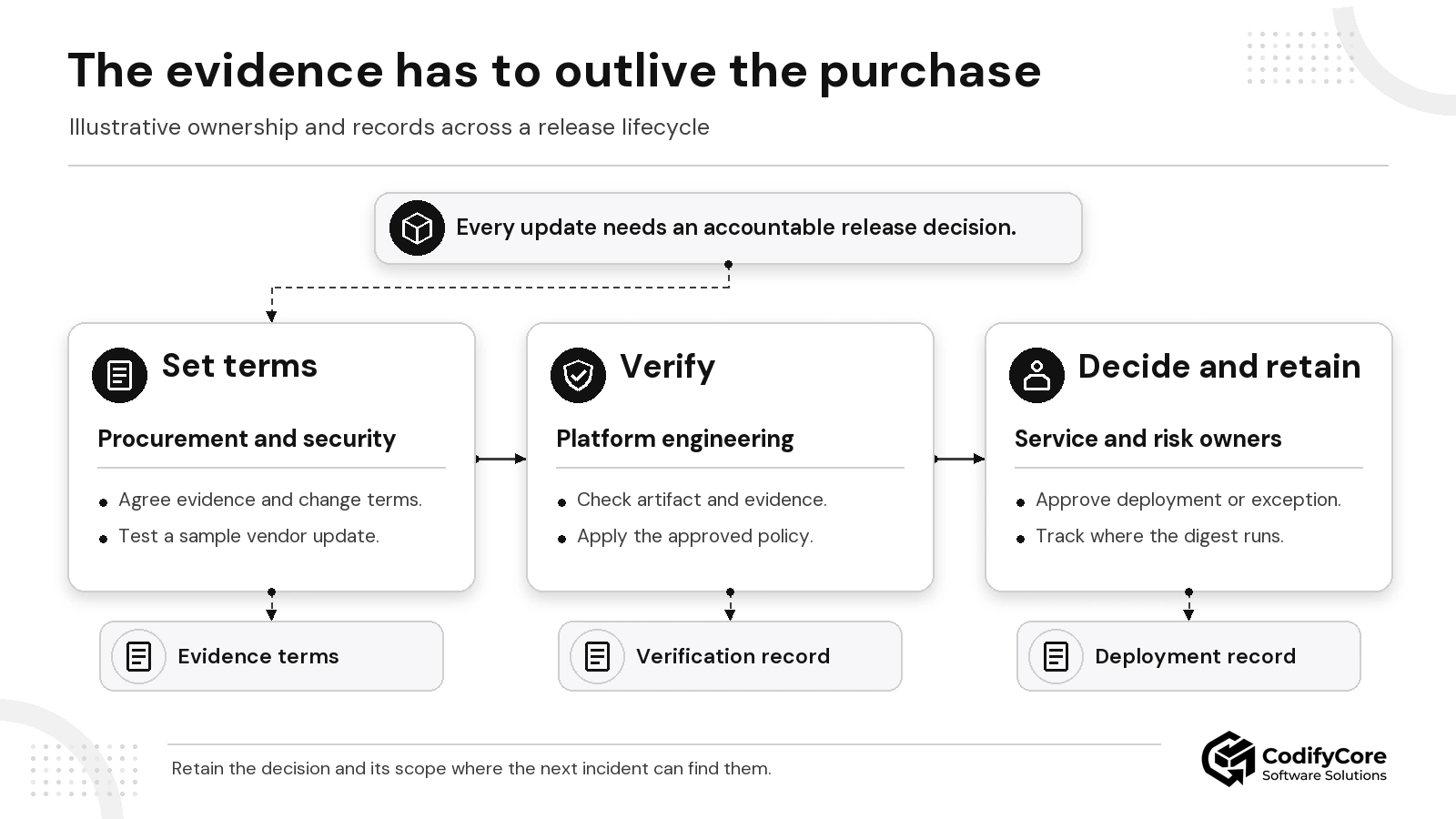
Procurement has leverage before a purchase. It can ask for a sample evidence bundle and a routine update in a trial environment. Engineering can attempt to match that evidence to the update and demonstrate what happens when something is missing. Supplier responses then become measurable. A contract can define what evidence arrives with a release, which changes need advance notice, and how vendor support will resolve a mismatch. The first buyer to ask for these answers during an urgent patch has fewer options and less time.
Ask each piece of evidence a different question
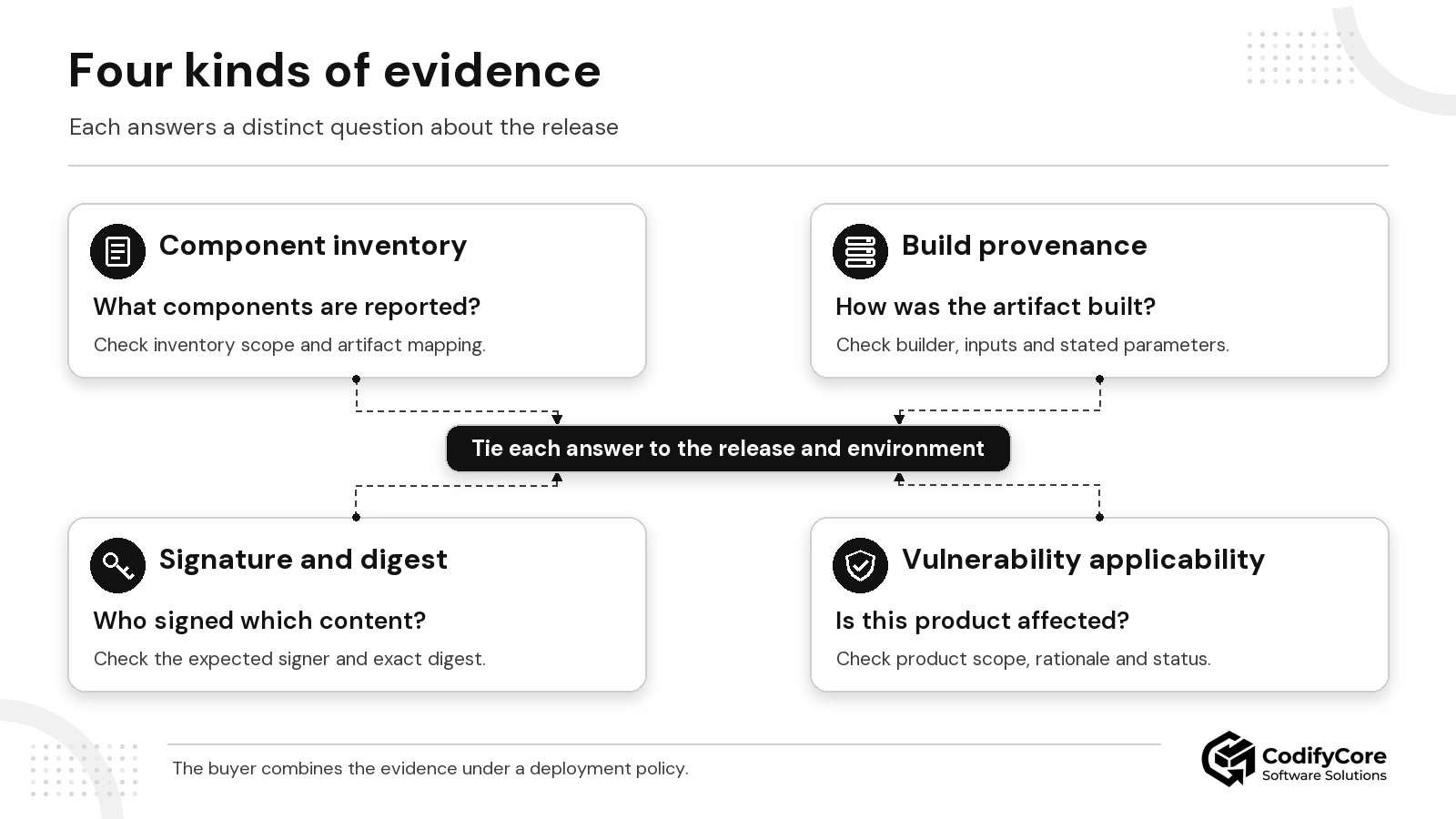
A software bill of materials, or SBOM, is an inventory. It can help the buyer establish what components the producer reports for a release, subject to how the inventory was generated and what it covers. Ask whether it describes the distributed build, a source tree or another view, and whether it includes the dependency depth and packaging formats that matter to your deployment. A version-level inventory has more operational value if the buyer can associate it with the artifact that actually runs. NIST’s acquisition guidance discusses machine-readable inventories, their use across the lifecycle and the limitations of generating them after the fact. NIST software bill of materials guidance
Build provenance answers a different question. It records claims about how an artifact was produced, such as the build platform or process, inputs and parameters, depending on the format and trust level. An attestation can be signed. Its value depends on what the buyer verifies about the signer, the claims, and the subject it describes. For example, SLSA’s artifact verification guidance checks that the subject matches the artifact digest, that the provenance envelope verifies under a configured root of trust and that the build details match the consumer’s expectations. The guidance also explains limits of the guarantees when the build platform itself is compromised. SLSA build provenance · SLSA artifact verification
An artifact digest can identify the exact bytes of the object the digest covers. In a container registry, a tag is a human-readable reference that points to a manifest, while a digest is content-derived. Confirm what object the evidence identifies. A multi-platform image can have an index and separate platform-specific manifests. Treat the selected deployment target and its relationship to the evidence as part of acceptance. A signature from an approved identity can authenticate the signed content under the verification policy. A digest alone identifies content without establishing who authorised it. A valid signature by itself leaves questions about code quality, vulnerability exposure and fitness for a particular environment. OCI Distribution Specification · Sigstore signature verification
Vulnerability information needs the same discipline. An inventory match can tell a team where to investigate. A VEX statement can convey whether a specific product is affected by a particular issue and why, within the statement’s scope. Check its author, product identity, version and rationale against the deployment before relying on it. A customer configuration can matter to applicability, and an investigation still in progress should remain visible as uncertainty. The buyer should retain both the supplier’s status and its own operational decision when the consequences justify it. OASIS CSAF VEX profile
The urgent update is the test of the policy
Return to the fictional reconciliation service. The buyer approved release A for use in a segmented workload with read-only access to specified transaction records. Now the supplier offers release B. Engineering confirms that the B artifact’s signature verifies under the configured supplier identity. Its provenance and SBOM supplied for review both identify A. The records may be valid for their own subject. The buyer lacks matching evidence for B under the agreed acceptance policy. The question is what can safely happen next while the old release’s risk is also being assessed.
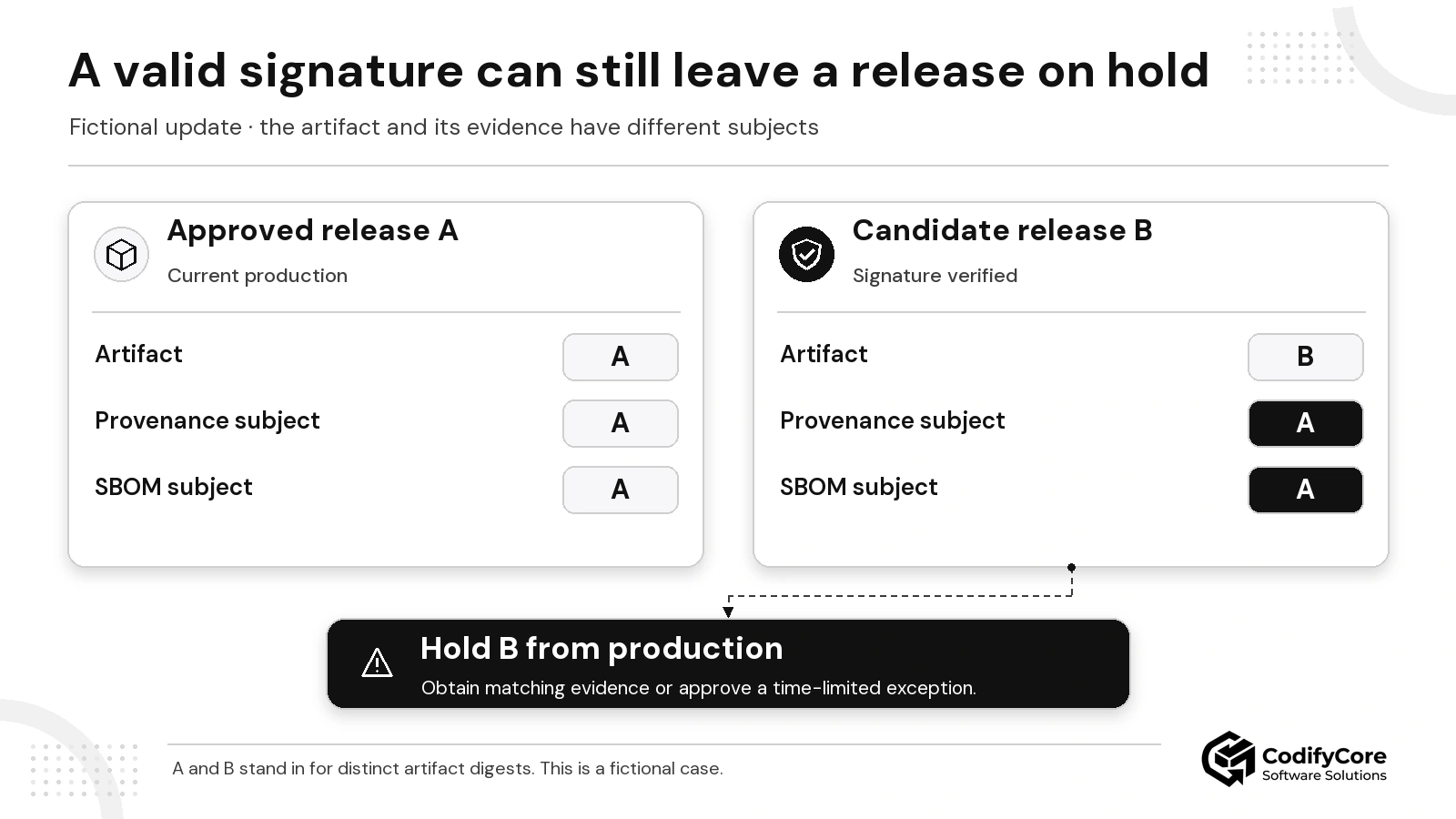
One team may keep A in service under temporary controls while the supplier corrects the evidence. Another may disable or isolate the affected capability if the risk of continuing is higher. A credible emergency procedure can also allow a tightly bounded exception when business harm or exposure justifies it, with a named risk owner, compensating controls, time limit and a written decision about what happens when it expires. Any evaluation of B should take place in an appropriately isolated environment under the buyer’s own rules. These are different risk decisions. Treating them as an instruction to bypass a failing check makes the organisation unable to explain which risk it accepted or for how long.
The emergency procedure is also an opportunity to ask where a verification result is produced. If the package registry is the only place that checks the package, the buyer is relying on that registry to carry out and report the check correctly. Verification at a controlled intake point or deployment boundary gives the buyer its own evidence, subject to its chosen trust anchors and infrastructure. Decide who owns that service and how it behaves when a verification source is temporarily unavailable. Establish access to approved evidence for emergency use where the verification mechanism supports it. An acceptance rule that nobody can operate during an incident will be overridden by someone who needs to restore service. SLSA on placement of provenance verification
Preserve the decision so the next incident can use it
A deployment should leave behind more than a green job. For a release in scope, keep the artifact identifier, the supplier identity and evidence that were checked, the relevant policy version, where it ran and who approved any exception. The record can be created automatically where the tooling supports it. Its purpose is to answer a later question quickly. If a supplier announces a compromised signing identity or a vulnerable release, the business should be able to identify affected deployments on the evidence it recorded. The person handling the incident should be able to find the approved replacement or determine whether it is safe to remove the affected product from service.
Evidence retention must be usable. The version number in a procurement spreadsheet and the digest used by a deployment system need a reliable relationship. A business with multiple clusters, sites or tenants must know where the artifact actually ran, particularly where a rollout stopped partway or versions differ by platform. That can require recording the result at the deployment boundary and reconciling it with the approved release. For a highly privileged component, exercising an advisory against that record can show how quickly the organisation can find every deployment and name the next action.
Administration creates new responsibilities too. If an authorised build service or signing identity changes, someone must be empowered to review and approve the new expectation. An attacker, a supplier mistake or a new vendor process can all look like “the evidence changed” from the buyer’s perspective. Changes to the definition of trusted evidence need their own accountable approval. The policy should also have a way to revoke trust and to find which prior decisions depended on it. The producer can publish new material, but responsibility for what the buyer trusts remains with the buyer.
Match the assurance to what the buyer controls
The policy cannot look identical for every product. Where the buyer runs a container, package or installed agent, it can often control intake and deployment. That makes the artifact, its evidence and its runtime permissions natural points for enforcement. In a multitenant SaaS service, the buyer often has no equivalent ability to retain or verify individual production artifacts. The useful purchasing questions change. Ask what the supplier can attest about releases and privileged components, how it communicates changes and incidents, and what the customer can actually observe or revoke. A browser extension, desktop helper or privately hosted connector may still require artifact-level treatment even if the main product is SaaS.
Assurance can also be introduced in stages. A buyer with an existing estate can begin by identifying the products that run closest to sensitive operations, collecting the evidence suppliers already publish and observing how often it ties to what is deployed. When the process is stable, raise enforcement for the products where a mismatch has meaningful consequences. Ownership, meaningful exceptions and a viable update path matter more than implementing a uniform control on paper. CodifyCore’s DPP procurement guide makes a related point in another domain. Buyers get a stronger answer when they ask providers to demonstrate a specific capability with usable evidence. CodifyCore’s provider evaluation guide
Make the cost of verification visible in the purchase
Two otherwise comparable suppliers can impose very different costs after the contract is signed. One distributes evidence alongside each approved release in a form the buyer’s systems can verify. Another will assemble documents when an account manager receives a request. Both may have a credible development process. The second arrangement asks the buyer to spend staff time resolving delays and exceptions on every urgent change. A procurement comparison should account for that recurring work alongside licence and support costs.
Engineering can help estimate it during the trial. Measure how long a routine update takes from receipt to an evidenced decision. Then repeat the exercise with an incomplete bundle and ask the supplier to resolve it through the channel the contract will actually provide. The result will reveal where both parties need to invest. Some products may justify a more expensive integration with better evidence. In others, the rational choice may be to limit the software’s access or its place in the operation so the required assurance is cheaper to obtain.
The best outcome is a supplier that can deliver security updates promptly and a buyer that can accept them promptly. If a control routinely keeps approved patches out of production, measure the delay and fix the evidence path. The procurement review should make that operational expectation part of the relationship from the beginning.
The most revealing question in a supplier demo may be about the next release. Show us the real artifact, what identifies it, which evidence applies to it and what our teams would see if the evidence stopped matching. That is where a procurement requirement becomes an operating control. When the urgent update arrives months later, the buyer can make a fast decision grounded in what it has verified, what remains uncertain and who is authorised to accept that uncertainty.