
Imagine a retailer late in the day after a checkout outage. One customer has a card charge and no order confirmation. Another sees an order marked paid while the provider’s captured transaction report shows no matching entry for the period. The checkout team can show a stream of webhook requests it acknowledged successfully. The warehouse has to decide what it can ship. Customer support has to answer people who can see a charge on their side. Finance wants to know which records it can rely on.
The immediate question is what happened to each customer. The longer-term question is why the business needs a crisis to find out. A payment integration should be approved for production only when the merchant can independently compare what its systems say with what the provider records, and has someone authorised to act on the difference. Reconciliation is part of the operating model for payments. The product team should budget for it when it decides what the checkout can promise and when it will release an order.
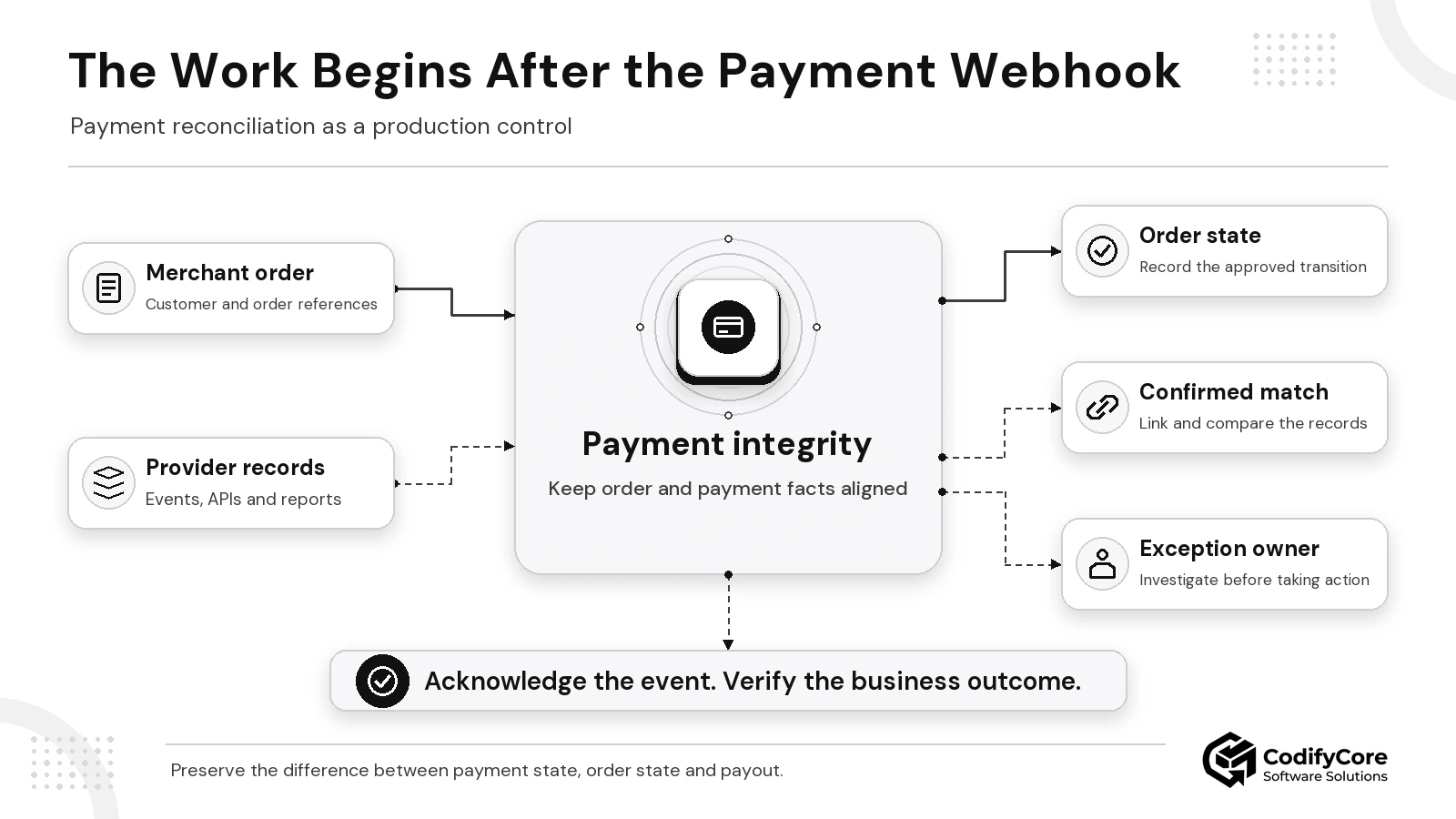
The customer experiences one payment and the business records several events
A checkout workflow can involve an authorisation, a capture, an order state change, a fulfilment instruction and later a settlement or payout. These events describe different facts. An authorisation may reserve funds, depending on the payment method and provider. Capture is a separate action in payment flows that support manual capture. Settlement and payout can occur later. A refund or dispute can bring new events after the customer received their order. Providers also have asynchronous states and variation across payment methods. A sound integration defines which provider state and merchant checks allow each business action. Stripe PaymentIntent lifecycle · Adyen reports and the payments lifecycle
The distinction is important when somebody uses the word “paid.” The storefront may mean the customer can see an accepted order. The warehouse may mean the order is safe to release under the merchant’s policy. Finance may be looking at whether an amount was included in a payout. One status flag cannot answer all three questions. Preserve the facts the merchant needs to make each decision and name the record that establishes each fact. The order system owns what the merchant promised. The provider records what happened to the payment within that provider’s scope. The bank statement records the deposit that reached the bank account.
That does not mean inspecting every purchase by hand. The purpose of a well-designed comparison is to let the ordinary cases move quickly and surface the small set whose differences have consequences. This requires agreement on what counts as a match. An order reference is useful, but a matching reference with the wrong amount or currency is a different case from a match that agrees on all relevant attributes. The matching criteria also need to account for genuine one-to-many relationships, such as a second attempt after a failed payment or a purchase split into multiple captures under an approved flow.
The webhook should move work forward. Reconciliation should find work that fell behind.
A webhook gives the merchant a timely signal from the provider. It can trigger a durable record of the event and queue the work needed to update the order. A verified event helps establish what was delivered to the endpoint. Receiving and acknowledging it still leaves open whether the order change committed, whether fulfilment received the intended instruction or whether a dependent action failed after the endpoint responded. The opposite can happen too. A provider can record a completed operation while a merchant is waiting for an event it has yet to process.
Stripe, for example, documents that event delivery order is not guaranteed and that an endpoint can receive the same event more than once. The application should authenticate events, record a stable identity for the inbound event and process retries safely. Where fulfilment has its own state and retry behaviour, the business operation needs a separate way to prevent a repeated delivery from producing a repeated shipment. Deduplicating an incoming event is useful at the message level. Preventing a repeated business effect requires an identity and state that match the business operation. Stripe webhook delivery and handling guidance
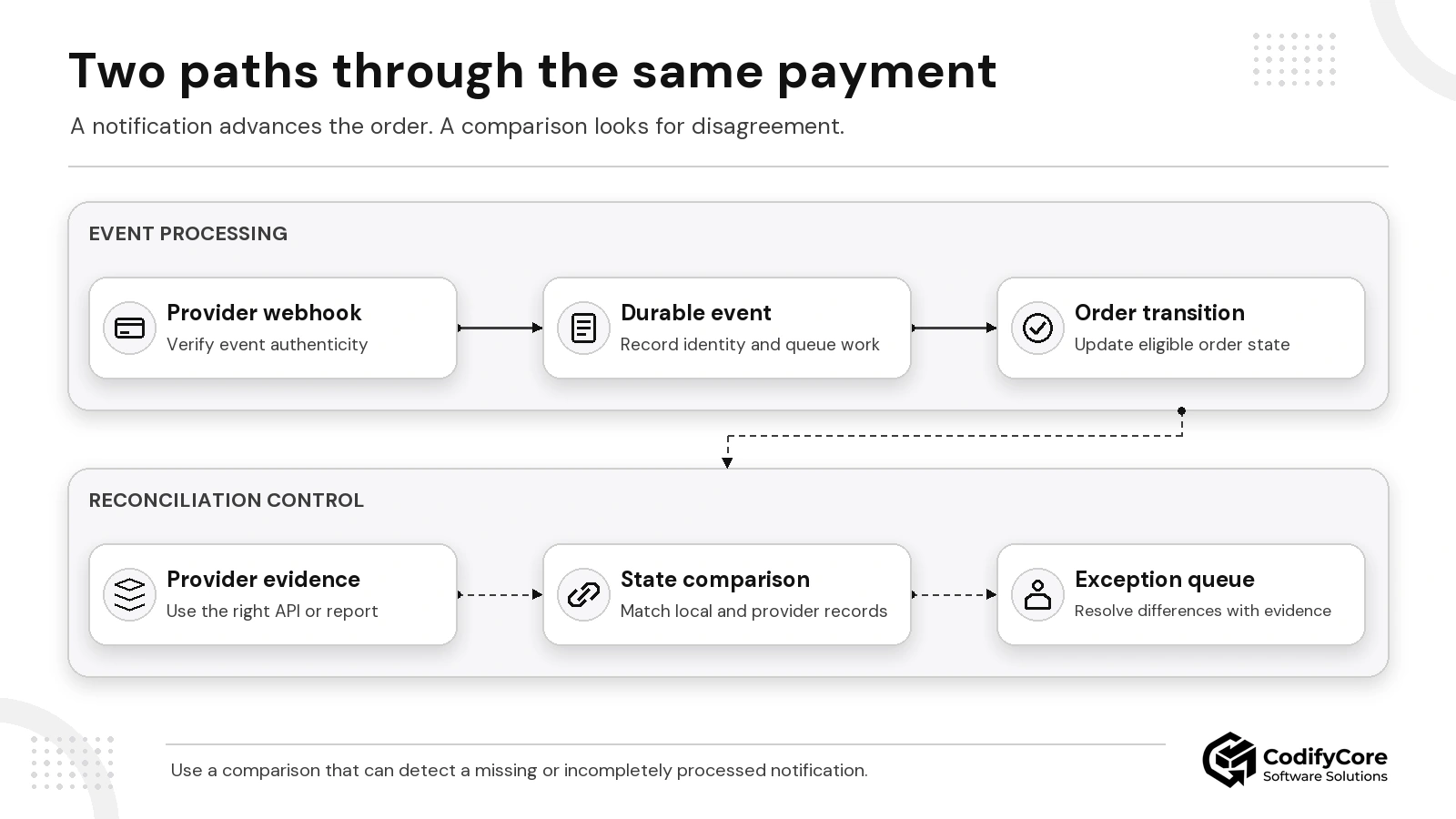
The control path can use a provider API or suitable report on a schedule and compare that evidence with local state. The cadence should be chosen around the decision it protects. If an unmatched capture could leave a customer without an order, a team may need to discover it sooner than its ordinary finance close. If matching a payout, the team may have to wait until the provider’s required reporting data and the bank reference are available. Use the appropriate source for each purpose and show how far the comparison has progressed. A gap while a report is expected but unavailable is different from a completed comparison that found no exceptions.
An ambiguous timeout is a business state
Consider a customer submitting a payment request when the application loses its connection to the provider. The application sees a timeout, which establishes that it did not receive a usable response. The provider may have accepted the request or may never have acted on it. If the merchant silently treats an ambiguous outcome as a failure and creates a new attempt whenever the customer reloads the page, it can risk requesting another payment for the same purchase. The safer business action is to preserve the original attempt and resolve the uncertainty with the provider’s supported mechanisms before deciding whether a new payment is appropriate.
Request idempotency can help when the merchant retries the same operation within the provider’s defined conditions. For example, Stripe and Adyen document idempotency for supported requests, with their own rules about scope, response behaviour and reuse. The merchant should retain a stable reference for the operation, read the provider’s policy for that endpoint and store enough state to distinguish a retry of the original attempt from a genuinely new purchase attempt. A provider request key does not by itself guarantee the merchant’s local record was updated or its warehouse instruction executed only once. Stripe idempotent requests · Adyen API idempotency
An explicit pending state also improves the customer experience. A checkout can tell the customer that confirmation is being checked and retain a reference support can use. The message should set an expectation consistent with what the business can actually deliver. A support agent should be able to find the attempt, see why the merchant’s record is uncertain and route the customer to the team that can establish what happened. A generic error page may be easier to implement, but it leaves the customer to decide whether trying again will solve the problem or charge them twice.
Reconcile counts, references and the meaning of the mismatch
Consider a fictional retailer running a completed comparison for a single currency and time window. The example assumes one relevant capture per paid order and compares unique references on each side. The provider data contains 100 captures. The merchant has 99 local orders marked paid. Matching across the two sources gives 98 confirmed pairs, two captures without a corresponding locally paid order and one locally paid order without a capture in the compared data. The difference between the headline totals is one. The work queue has three items.
| Result | Count | What the team knows at this stage |
|---|---|---|
| Matched pairs | 98 | Both sources have the expected reference and compared attributes |
| Provider only | 2 | A provider capture exists without a corresponding locally paid record in scope |
| Merchant only | 1 | A local paid record has no corresponding capture in the compared provider data |
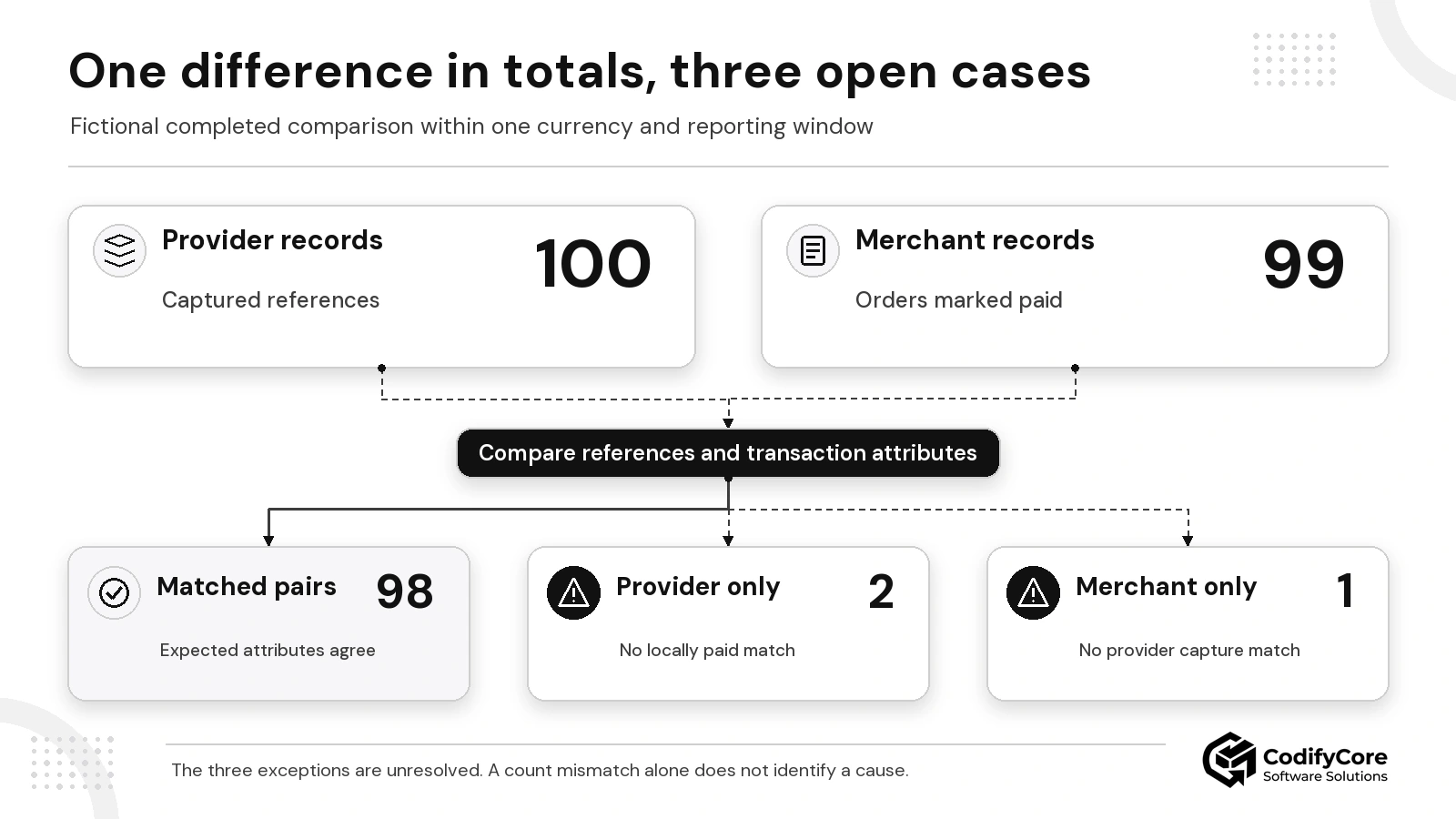
Begin the investigation by checking scope. Do the records belong to the same merchant account and currency? Did the comparison use comparable timestamps, and did all expected data arrive? Does an apparent exception fall within an understood delay window? Do transaction identifiers still link to the original merchant reference? An item can be legitimate and still need follow-up. If a provider-only item belongs to an order the merchant can recover, the responsible team may be able to correct the order state with documented evidence. If it cannot prove what the customer bought, there may be a different resolution. For the merchant-only item, the order may need to be held from fulfilment until the provider status is confirmed. The team should record which action it authorised and what happened afterward.
This comparison concerns operational payment and order state. Payout reconciliation answers a further question about what reached the bank and which transactions, fees, refunds or other adjustments contributed to it. Stripe’s payout reconciliation report describes its availability for automatic payouts and directs other use cases to different reporting approaches. Adyen’s settlement details report provides transaction-level entries and references for its supported reconciliation flow. The merchant should select reports based on its own product, account configuration and settlement arrangement, with knowledge of when the data becomes available. A clean comparison on one layer provides evidence about that layer. Stripe payout reconciliation · Adyen settlement details
Give the exception queue the authority to finish the job
The business should define who can hold a shipment, correct the order record, authorise a refund or lift a transaction hold. Some actions require separate approval because they move money or create an external commitment. A payment operator reviewing an exception needs access to the relevant evidence, a clear decision path and a way to record the result. A finance team needs to be able to explain how outstanding items were treated. Engineering needs a way to see patterns such as a particular state transition failing repeatedly. Giving these teams useful views of the same unresolved cases is an operating decision, not just a dashboard project.
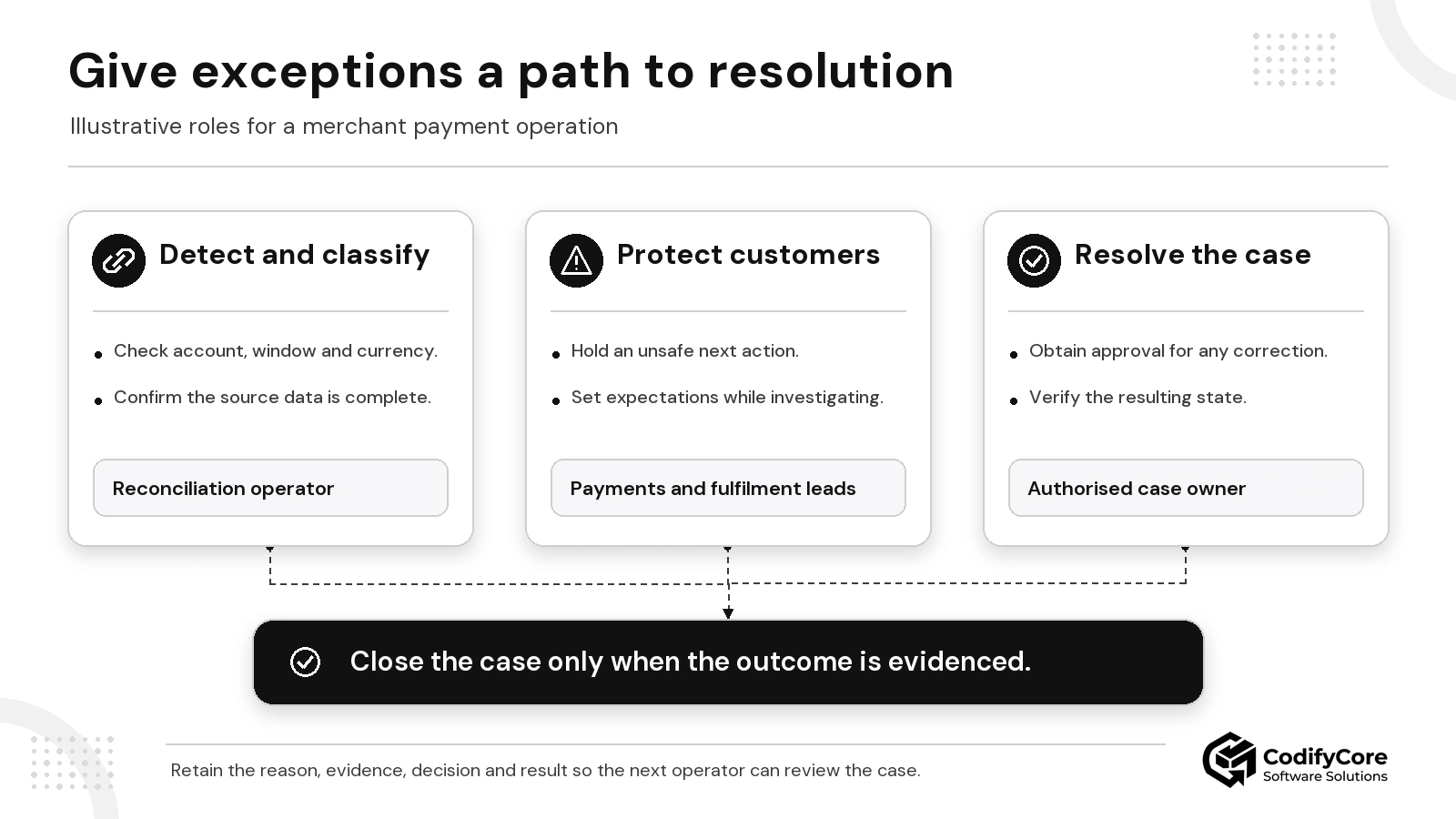
There is a temptation to automate cleanup as soon as a pattern appears. Automated correction can be valuable for well-understood mismatches when the prerequisites are known and replay is safe. A general rule that force-matches records on approximate dates or amounts can quietly attach the wrong payment to an order. Keep ambiguous cases visible. Design any repair so it can be attempted again without repeating a customer-facing financial or fulfilment effect. For example, re-running a report should update the existing exception when the same difference remains, rather than create a new case every time the job runs.
The status of the control should be visible as well as the status of orders. An empty exception queue is reassuring only if the comparison ran, covered the expected period and received the expected source data. Record the most recent successful comparison and publish unresolved counts and age, segmented by severity or customer impact. A leadership review can ask how long mismatches persist, what causes repeat exceptions and whether the teams can resolve them within the time promised to customers. Those measures are more revealing than a single match percentage during a period of high transaction volume.
Design the evidence view around the person who needs to take the next action. An operations agent can often start with the merchant order reference, provider reference, amount, currency and state history. A finance reviewer may need the report batch and adjustment details. A service owner reviewing a trend can usually work with counts and ages. Give each role the information and permissions its work requires. A shared exception record can link to controlled evidence without copying every provider payload into a chat or case note. That keeps the case understandable without turning the reconciliation workspace into a second, poorly governed store of payment data.
Buy and launch the integration for the day it disagrees with itself
Ask a prospective provider and integrator to show what happens when a request times out, a notification arrives twice, a local write fails and the report lands late. The demonstration should include the order, the provider reference, the visible exception and the authorised repair. Select the scenarios that matter to the business. A shop that fulfils immediately faces different consequences from one that manually releases orders the next day. A marketplace may have a more complex route through seller balances, adjustments and payouts. In each case, someone must be able to explain how the system detects and corrects a disagreement before it harms the customer or the business.
Treat the first week after launch as part of acceptance. Compare real volumes and states within an agreed scope, inspect the exception queue and confirm that whoever owns it can access the records and act. If the team needs to hold a fulfilment flow for a particular payment method, it should know who can make that decision and how customers will be informed. That capability is easier to agree on while the team is preparing the release than during the first incident where speed and customer trust are both at stake.
The customer who sees a charge without an order should not have to become the monitoring system for the payment integration. The business should find the discrepancy itself, preserve the evidence and be able to explain the next action. That is the standard a payment architecture should meet before the first live transaction.