
The Digital Product Passport (DPP) market is entering a more demanding phase. For years, much of the conversation focused on concepts: product transparency, QR codes, blockchain, sustainability records and the eventual arrival of European rules. In 2026, several foundations became operational or more clearly defined. In 2027, the first major product-specific passport obligation arrives for specified batteries, while other industries continue preparing for a staged introduction.
That does not mean every manufacturer needs a DPP in 2027, that every pilot is a production deployment, or that the market has converged on one technical architecture. It means the evidence available to assess the market has changed.
The central market shift is from showing a digital passport to proving that a passport can be operated reliably—with accurate supplier data, persistent product identity, machine-readable interfaces, appropriate access rights, integration with systems of record, registration where applicable, and continuity throughout the product lifecycle.
This CodifyCore market intelligence report examines what changed in 2026, which technology capabilities matter, where industry pilots provide useful adoption signals, what can reasonably be expected during 2027, and what businesses should measure before committing to a multi-year DPP programme. It is an assessment of the market and its infrastructure, not a ranking of software vendors. For a separately researched supplier shortlist, see CodifyCore’s Top 10 Digital Product Passport Solutions; this market landscape focuses instead on infrastructure, technology and sector adoption.
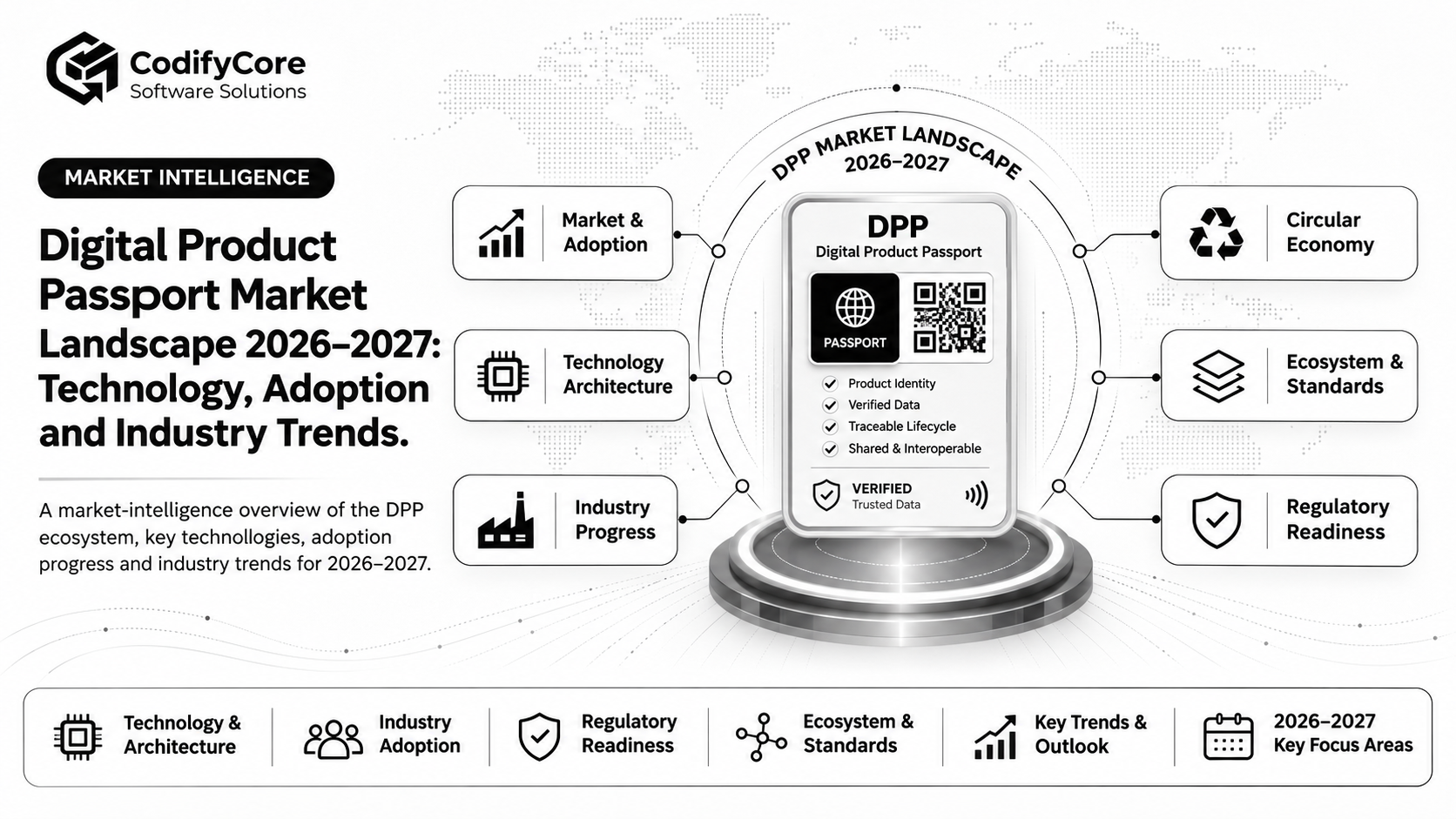
Quick answer: What is the Digital Product Passport market landscape in 2026–2027?
The Digital Product Passport market is moving from early demonstrations toward sector-specific implementation and more operational testing. In July 2026, the European Commission launched the EU DPP Registry and published references to six interoperability-related standards. From 18 February 2027, passport requirements apply to specified battery categories under the EU Batteries Regulation. Other sectors remain on separate, phased regulatory pathways.
For technology buyers, the practical question is no longer just whether a provider can display product information behind a QR code. It is whether the platform can govern product identifiers, retrieve trustworthy supply-chain information, enforce access rights, interoperate with existing systems, and maintain data throughout the product lifecycle. Publicly documented pilot activity does not, by itself, establish a market-wide adoption rate.
Key takeaways: six evidence-based findings
- European market infrastructure is no longer hypothetical. The European Commission launched the DPP Registry and its testing environment on 20 July 2026. The Registry registers unique product identifiers and associated mandatory metadata; the full product dataset is intended to remain decentralised. This is a practical milestone, not a blanket certification of every vendor or product. (European Commission, July 2026)
- The core technical framework is becoming more concrete. Commission Implementing Decision (EU) 2026/1736 published references to six European DPP standards covering exchange protocols, identifiers, data carriers, storage, APIs and interoperability. Implementation claims should identify the exact standard, edition, applicable parts and evidence—not simply say “standards-compliant.” (Official Journal — Decision 2026/1736)
- Batteries provide the clearest near-term regulatory demand signal. From 18 February 2027, Article 77 of the Batteries Regulation requires a battery passport for specified electric-vehicle batteries, light-means-of-transport (LMT) batteries and industrial batteries above 2 kWh placed on the market or put into service. Not every Annex XIII data field becomes mandatory at the same time. (Regulation (EU) 2023/1542, Article 77; Commission Battery DPP FAQ)
- For other priority sectors, an expected delegated-act year is not the date every product must already carry a passport. The Commission’s indicative schedule includes iron and steel during 2026, textiles, aluminium and tyres during 2027, furniture in 2028, and other product groups later. For ESPR measures, application dates depend on the final legal acts and transition periods. (European Commission DPP timeline)
- There is visible experimentation beyond batteries, but no defensible single global adoption rate. CIRPASS-2 is supporting 13 lighthouse pilots in textiles, electrical and electronic equipment, construction products and tyres; industry battery initiatives have also tested multi-company data collection and assurance. These demonstrate activity and learning, not the share of all companies that have fully deployed compliant passports. (CIRPASS-2 lighthouse pilots; Global Battery Alliance operational trials)
- Enterprise integration and data governance are emerging as more useful maturity indicators than the passport interface itself. The ability to resolve product identities, collect and validate upstream data, segregate access, propagate updates, and export records should determine whether a DPP system is considered ready for scale. This is CodifyCore’s market interpretation, not a quantified industry adoption result.
1. What actually changed in 2026?
A market should be evaluated through observable changes, not the volume of vendor announcements. Four developments are particularly important.
1.1 The EU DPP Registry moved into operation
On 20 July 2026, the Commission announced the launch of the Registry and its testing environment. The preceding Commission Implementing Regulation (EU) 2026/1778 sets out practical arrangements for the Registry under the Ecodesign for Sustainable Products Regulation (ESPR), Regulation (EU) 2024/1781. Registration can be performed through a user interface or an API, subject to applicable requirements. (Commission announcement; Implementing Regulation 2026/1778)
This matters because companies and platform providers can now test concrete workflows: operator onboarding, identifying products, registering required metadata, handling validation errors and reconciling records. The Registry is not the central repository of every passport’s materials, emissions, manufacturing and service history. The underlying data is decentralised, with storage and access responsibilities managed outside the Registry.
Market interpretation: Buyers will increasingly expect demonstrable Registry workflows where those workflows apply. A live Registry environment does not, by itself, prove that a software platform satisfies the rules for a particular product group.
1.2 Six DPP technical standards were formally referenced
In July 2026, the Commission published the following references in the Official Journal through Decision (EU) 2026/1736:
| Standard | Subject |
|---|---|
| EN 18216:2026 | Data exchange protocols |
| EN 18219:2026 | Unique identifiers |
| EN 18220:2026 | Data carriers |
| EN 18221:2026 | Data storage, archiving and persistence |
| EN 18222:2026 | APIs for product-passport lifecycle management and searchability |
| EN 18223:2026 | System interoperability |
Source: Commission Implementing Decision (EU) 2026/1736, Annex.
These references make it easier for technical teams to specify and test interoperability. They should not be confused with a blanket certification programme for software suppliers. Some technical requirements depend on the applicable legal instrument and the relevant provisions and versions of standards. The Commission’s published DPP timeline anticipates further standards-related action in 2026; organisations should verify the adopted texts rather than assuming expected measures have already taken effect. (Commission timeline)
1.3 Battery passport guidance became more implementable
The Commission published additional guidance in August 2026 and subsequently updated its battery data-point material. Its guidance organizes 71 data points, identifies applicability by covered battery category and distinguishes information that is mandatory at the February 2027 start from information required later or only in certain circumstances. The Commission explicitly notes that this guidance should be read with the legislation and does not create new legal obligations. (Commission guidance announcement, 21 August 2026; Battery sector page, October 2026 update)
For the market, the distinction between a field appearing in a template and a field becoming legally mandatory is important. Platforms need applicability logic, versioning and a traceable mapping from regulations to data—not merely a long list of predefined fields.
1.4 Demonstrators increasingly test operational questions
Two examples illustrate different kinds of evidence:
- BatteryPass-Ready announced a testing environment in June 2026 with eleven test scenarios designed to help manufacturers and suppliers validate battery-passport data and interoperability. The existence of a test environment demonstrates an opportunity to test; it does not establish that all participating companies have passed every scenario. (Fraunhofer IPK, 24 June 2026)
- CIRPASS-2 supports 13 lighthouse pilots across four value chains—textiles, electrical and electronic equipment, construction products and tyres—with goals that include real-world operation and cross-pilot interoperability. A pilot is meaningful evidence of work in a sector but must be assessed for its scope, scale and production status. (CIRPASS-2)
The key distinction: completed demonstrations, operating pilots and verified production deployments are different levels of maturity. An organisation that cannot reliably distinguish among them risks overstating the market’s readiness.
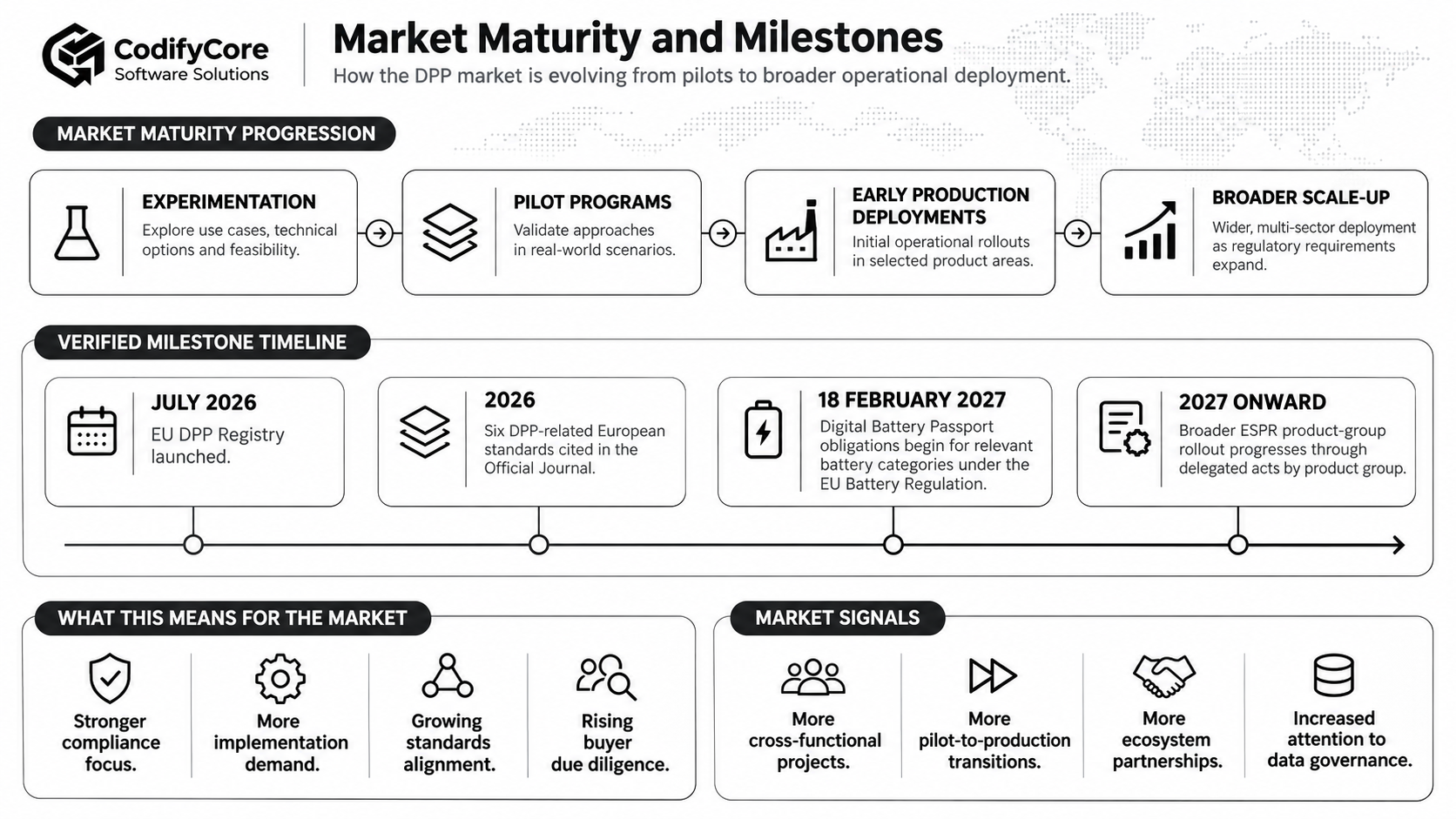
2. The regulatory timetable: hard obligations versus planning signals
The DPP market is not governed by one universal deadline. The ESPR creates a framework, but detailed information requirements for many product categories are set through subsequent product-specific delegated acts. Other legislation, notably the Batteries Regulation and the Construction Products Regulation, follows separate legal pathways. (ESPR — Regulation 2024/1781; Commission DPP overview)
| Product or milestone | Public position as of 9 November 2026 | How to interpret it |
|---|---|---|
| EU DPP Registry | Operational since 20 July 2026, with a testing environment | Infrastructure milestone, not proof that all products already require registration |
| Specified EV, LMT and industrial batteries above 2 kWh | Article 77 passport obligation begins 18 February 2027 for covered batteries placed on the market or put into service | Binding sector-specific date; exact fields and other obligations are phased |
| Iron and steel | Commission’s indicative schedule targets a product-specific ESPR delegated act in Q4 2026 | Expected rulemaking, not a universal 2026 passport-compliance deadline |
| Textile apparel, aluminium and tyres | Indicative ESPR delegated-act schedule in Q3–Q4 2027 | Expected rulemaking; final application dates depend on published acts and transition periods |
| Construction products | A dedicated digital-passport system is envisaged under the revised CPR; Commission indicative milestones point to 2027 rulemaking | Separate legislative pathway; no blanket claim that all construction products need passports in 2027 |
| Furniture | Commission indicative delegated-act timing: 2028 | Preparation market; not a confirmed 2028 obligation for every furniture item |
| Mattresses and ICT products | Commission indicative delegated-act timing: 2029 | Longer planning horizon; check subsequent legislation |
Sources: Commission DPP timeline; Batteries Regulation, Article 77; Commission’s revised CPR overview. Commission planning dates are indicative and can change.
For ESPR product-specific measures, the Commission explains that economic operators have a transition period of at least 18 months after adoption of a delegated act. It is therefore misleading to turn a planned act-adoption year into an automatic market-compliance year. Particular obligations and their application dates must be read from the final published acts. (Commission DPP overview)
This distinction also matters outside the EU. Exporters in Asia, the Americas and elsewhere can be affected when their products are placed on the EU market, even though the manufacturing operations themselves take place in another jurisdiction. The responsible economic operator and precise legal obligations must be identified for each supply chain. (Commission guidance for economic operators)
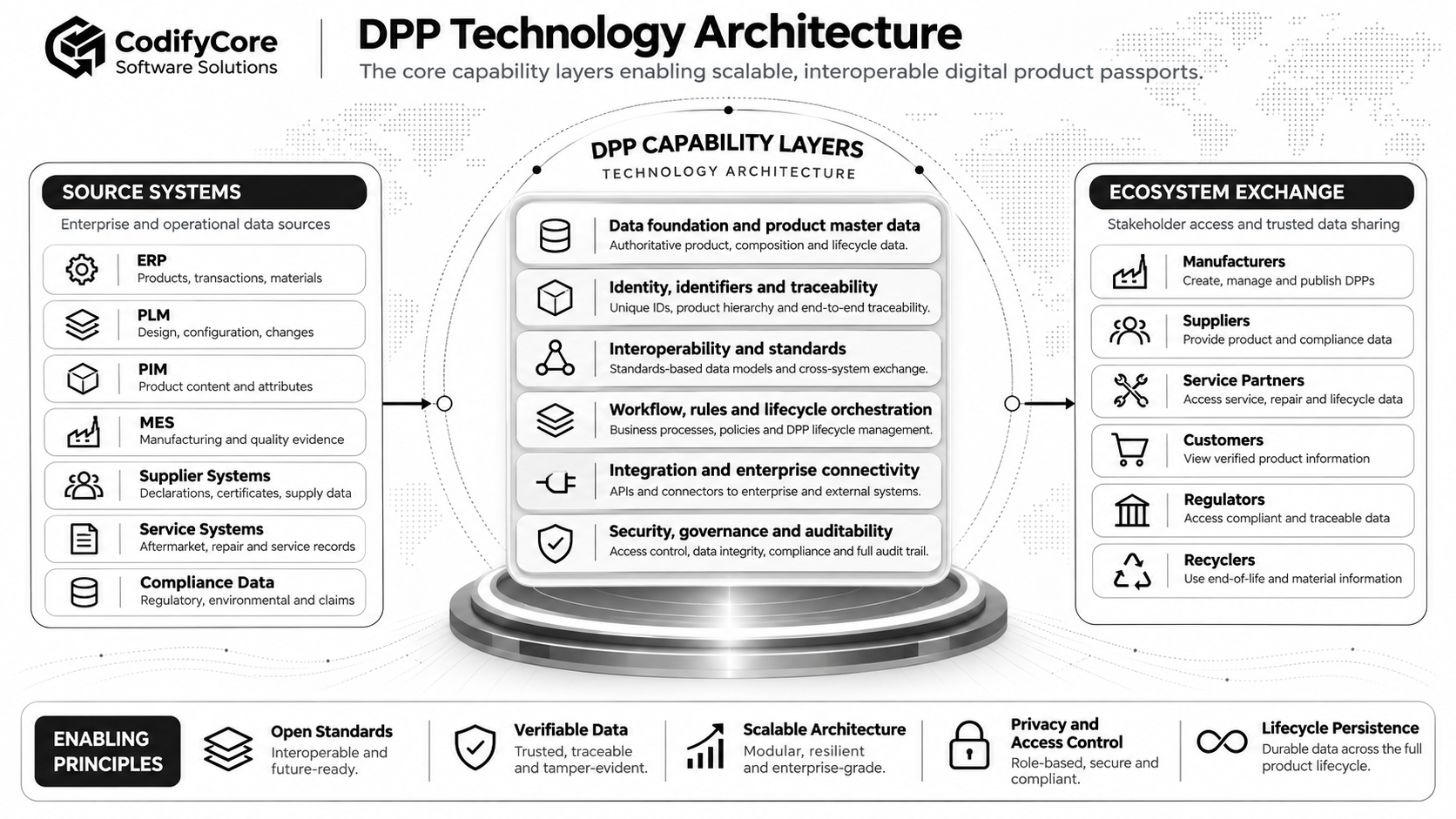
3. How the DPP technology market is structured
There is no single standard DPP software product or universally mandated software stack. The market spans overlapping categories of capabilities that different providers combine in different ways.
| Capability cluster | Core function | Typical buyer question |
|---|---|---|
| Product identity and access | Connects physical products to persistent digital identifiers and controlled retrieval | Can an item be resolved reliably over its lifecycle? |
| Enterprise product-data orchestration | Collects, maps and versions data from ERP, PLM, PIM, MES, LCA and related systems | Which system remains the source of truth? |
| Supply-chain data exchange and traceability | Collects provenance and evidence across organisations | Can suppliers share required information without exposing everything? |
| Regulatory information management | Maps requirements to fields, applicability rules and retained evidence | How are changes to obligations managed? |
| Lifecycle and circularity services | Supports repair, use, refurbishment, reuse and end-of-life records | Who updates data after the original sale? |
| Passport infrastructure and operations | Provides hosting, APIs, access control, monitoring, persistence and relevant Registry workflows | Can the system remain available, portable and secure at scale? |
A company may need several clusters at once. A sophisticated product-identity platform might still rely on external environmental data tools. An enterprise software suite might excel at master-data governance but need supplier-network onboarding capability. A traceability specialist might handle upstream provenance well while depending on other services for downstream service or consumer interaction.
These are functional market segments, not a new ranking or a declaration that any one model is superior. For named providers and separately assessed market positions, readers can consult CodifyCore’s Top 10 Digital Product Passport Solutions in 2026. The ranking’s editorial criteria are different from the market-wide observations in this article.
What an operating DPP architecture actually connects
A practical deployment often combines the following components:
- Data sources: product master records, bills of material, manufacturing records, environmental assessments, certificates, upstream supplier declarations, and applicable service or usage information.
- Data quality and governance: mapping, validation, version history, responsible data owners, provenance of claims and exception handling.
- Identity and lifecycle management: unique identifiers, relationships among product models, batches and individual items, updates over time and links where successor passports are required.
- Access and exchange services: public and restricted views, API interfaces, permissions, identity verification, logging and organisational rules.
- Passport publication and infrastructure: machine-readable output, appropriate data carriers, reliable hosting, retrieval and preservation, plus EU Registry interaction when required.
The DPP Registry belongs to the identity-and-registration infrastructure, not to the role of a universal central store for all commercial and technical product information. (Commission Registry announcement)
A technology decision that should not be predetermined
Blockchain, distributed ledgers, decentralised identifiers, verifiable credentials, data spaces, GS1 identifiers, EPCIS and cloud or hybrid hosting are relevant technologies and patterns in some implementations. None should be assumed mandatory for every DPP simply because it is associated with traceability. The correct choice depends on legal requirements, trust boundaries, data exchange needs, economic cost, system operability and the standards applicable to the product.
The strongest technical claim is usually not “we use blockchain” or “we use AI.” It is a repeatable demonstration that the system can exchange appropriately governed product information with the participants and systems that need it.
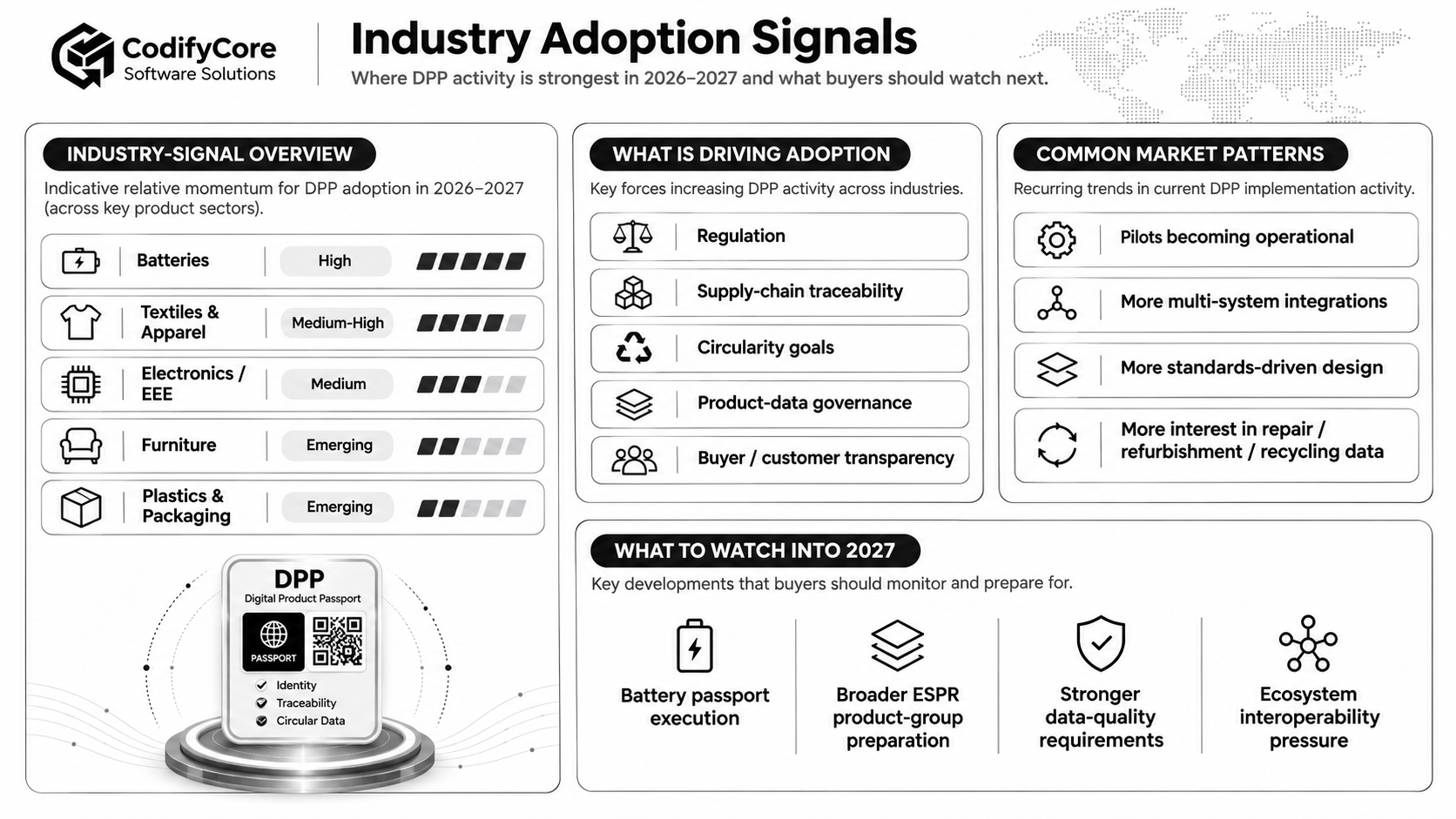
4. Sector adoption: where the evidence is strongest
Adoption must be discussed in terms of observable signals, not imagined percentages. A funded pilot, an open testing environment, an announced deployment and a legal obligation are all important—but they do not measure the same thing.
Batteries: the strongest near-term compliance signal
Batteries have a fixed EU passport date for the specified categories. Implementation attention therefore extends to battery identity, operator responsibilities, data-field applicability, supplier data, controlled access and lifecycle updates.
The Global Battery Alliance’s 2026 operational trials demonstrate participation by battery value-chain companies in testing shared sustainability-data methodologies and independent assurance. The GBA notes that the methodologies are developmental and its published trial information must not be used to rank the sustainability performance of participants. Likewise, participation in a trial is not evidence that a company has deployed passports for every relevant battery. (GBA Operational Trials)
CodifyCore assessment: In 2027, the decisive distinction will be between organisations that can show controlled, product-applicable, operational passport workflows and those that can only demonstrate isolated example records.
Textiles and apparel: high interest, staged obligations
Textile brands and exporters have good reasons to build product-data foundations before the final DPP rules take effect: complex supplier networks, item or batch identities, material-composition information and resale, repair or recycling use cases. CIRPASS-2 includes textile-sector lighthouse pilots, providing evidence of experimentation with digital passports and circular business models. (CIRPASS-2)
However, 2027 is not a blanket textile DPP deadline. The Commission’s published timeline identifies 2027 as an indicative period for the textile delegated act, with application following the legal transition provisions. Buyers should avoid procurement claims that confuse these steps. (Commission timeline)
Iron, steel and aluminium: upstream material information matters
These sectors create a different data challenge: material properties, sourcing, processing history, product hierarchy and evidence that can accompany materials into downstream manufacturing. Iron and steel feature earlier in the Commission’s indicative rulemaking schedule; aluminium follows under the 2027 planning horizon. (Commission DPP overview)
For upstream-material use cases, the market may place greater value on connecting supplier and material records than on a consumer-facing QR experience. This is a functional observation; it does not imply that every metals supplier already operates a DPP.
Construction products: a separate legal route and a long data lifecycle
The recast Construction Products Regulation (EU) 2024/3110 envisages a construction-product DPP system with machine-readable product information and links to performance and conformity documentation. Commission materials describe this system as forthcoming. (Commission CPR overview; Regulation 2024/3110)
The practical challenge includes associating evidence and declarations with product families, variants and long-lived assets. CIRPASS-2 construction pilots are useful evidence of experimentation, not proof that all construction products have a current passport obligation. (CIRPASS-2 pilots)
Electronics, tyres and other priority products: early learning, not uniform readiness
CIRPASS-2 also addresses electrical/electronic equipment and tyres. These pilots give early implementation teams experience with identifiers, reuse and repair data, supplier coordination and interoperability. Tyres appear in the Commission’s 2027 ESPR planning horizon, while ICT products are listed later. Electrical and electronic equipment should not be treated as a single category with one universal 2027 DPP deadline. (CIRPASS-2; Commission DPP timeline)
Furniture, packaging, plastics and other cross-sector areas may have valuable voluntary traceability or circularity initiatives, but a use case, a funded pilot and a binding DPP obligation must be evaluated separately. Never infer a specific legal deadline from the existence of a demonstration or a vendor template.
5. Seven technology and market trends to watch in 2027
The following are analytical trends drawn from 2026 regulatory milestones, standardisation and published implementation projects. They are not survey-measured growth rates.
Trend 1 — From presentable passports to verifiable operating processes
Generating a passport page is increasingly the easiest part of a demonstration. Operational maturity requires stable product identifiers, source validation, relevant Registry steps, lifecycle updating, access enforcement and exception handling. In the market, the evidence behind the passport should matter more than its appearance.
Signal to monitor: tested end-to-end flows using real product records and documented failure handling, rather than a single demonstration URL.
Trend 2 — Interoperability becomes a buying requirement, not a brochure feature
The July 2026 standards references give procurement and engineering teams a more concrete basis for asking which protocols, identifiers, data carriers, APIs and portability mechanisms are supported. Standardised interfaces do not remove all integration challenges, but they can reduce dependence on platform-specific formats. (Decision (EU) 2026/1736)
Signal to monitor: API documentation, tested import/export, external-client compatibility and version-management practices.
Trend 3 — Supplier-data readiness becomes a constraint on rollout
A platform may be technically capable of generating a passport while the company lacks reliable information from upstream suppliers. Batteries and complex textiles both illustrate why supplier cooperation, source attribution, exception management and commercial confidentiality matter.
Signal to monitor: proportion of required applicable data fields with a named source, owner, validation rule and evidence; supplier response and remediation performance.
Trend 4 — Restricted-data access and identity governance move to the centre
Different audiences may have different rights to read or update passport information. Public visibility cannot be treated as a default for commercially sensitive or legally restricted data. Battery-passport access arrangements and sector rules continue to develop, increasing the value of policy-driven access models. (Batteries Regulation, Article 77; Commission Battery DPP FAQ)
Signal to monitor: role- and purpose-based access tests, audit records, authorised organisational identities and controlled sharing across companies.
Trend 5 — Integration with existing enterprise systems becomes decisive
Enterprise data already lives in ERP, PLM, PIM, MES, quality, compliance and environmental platforms. Creating a second ungoverned copy of all those records is unlikely to be sustainable. Systems with strong mapping, validation, event handling and ownership of source data have an operational advantage.
Signal to monitor: number of tested production integrations, data reconciliation quality and measurable effort required to onboard another plant or product family.
Trend 6 — Lifecycle continuity and portability become commercial concerns
A passport may need to remain accessible beyond the original sale and even beyond a vendor contract. Buyers should consider portability, long-term persistence, data export, archival arrangements and responsibility changes associated with repair, repurposing or remanufacturing. Under the Batteries Regulation, some lifecycle events can require a new linked passport. (Batteries Regulation, Article 77; Commission Battery DPP FAQ)
Signal to monitor: successful exit simulations, complete data export, resolver continuity and documented support for identity and lifecycle links.
Trend 7 — Market claims face higher evidence expectations
As actual regulatory infrastructure and testing programmes become available, broad claims such as “EU-certified DPP,” “fully compliant for all industries” or “millions of live passports” deserve more exact scrutiny. Buyers should ask what has been certified, who tested it, which product categories are covered and whether deployment figures refer to operational records rather than demonstrations.
Signal to monitor: independently checkable evidence and a clear distinction among planned, piloted, contracted and live capabilities.
6. Why reliable DPP market-size and adoption figures remain difficult
The sector has no single universally accepted definition of a “DPP vendor,” “deployed passport” or “adopting company.” Reported figures may combine product-identity labels, traceability records, supplier documents, pilot passports, full production passports and forecasts for products not yet subject to final requirements.
A global market-size estimate is therefore not comparable across sources unless it discloses the revenue definition, geography, included services, sampling method, time period and distinction between forecasts and observed sales. Similarly, a company’s announcement of “one million digital IDs” does not demonstrate one million passports that meet a particular EU regulation.
CodifyCore does not publish a new revenue CAGR, global passport adoption percentage or sector-by-sector market share in this report because we did not verify a consistent dataset capable of supporting those numbers. This is a methodological choice, not a claim that useful market research cannot be conducted.
A more defensible adoption measurement model
For future research, the following indicators would help distinguish activity from actual deployment:
| Indicator | What it measures | Important limitation |
|---|---|---|
| Legally covered products | Products subject to an applicable DPP obligation | A planned act is not an applicable obligation |
| Verified production passports | Passports maintained in live business operations | Requires a consistent definition and auditable scope |
| Successful identity/Registry operations | Registration and lifecycle workflows where required | Registry testing is not conformity certification |
| Integrated enterprise systems | Operational links to systems of record | Counting connectors alone says little about data quality |
| Supplier information completeness | Required applicable fields supported by sources/evidence | Must distinguish mandatory, optional and later-phase fields |
| Interoperability test results | Successful cross-system exchange under documented conditions | Results depend on standard, version and test case |
| Lifecycle update and continuity performance | Update timeliness, availability, export and recovery | Requires observation over time |
Publishing these definitions alongside future survey or deployment findings would produce more valuable evidence than an unsupported “market is growing by X%” statement.
7. Three scenarios for 2027
Scenarios are planning frameworks, not forecasts with probabilities.
| Scenario | What could happen | Implication for companies |
|---|---|---|
| Baseline — phased implementation | Specified battery passports become an operational priority; other sectors continue standardisation, delegated-act preparation and pilots | Fund battery readiness where relevant; build reusable data foundations elsewhere |
| Faster operational convergence | More shared testing, reference implementations and enterprise integrations become demonstrable | Increase investment in integration, supplier onboarding and cross-platform testing |
| Implementation friction | Data quality, supplier participation, identity verification or technical/legal changes delay some individual projects | Maintain contingency plans, clarify dependencies and avoid relying on roadmap promises |
Across all three scenarios, a durable approach remains the same: understand applicability, identify data owners, preserve source-system integrity, test interfaces, and make clear commercial arrangements for continuity and portability.
8. What manufacturers, exporters and technology buyers should do now
Companies should not all follow the same implementation calendar. A useful sequence is:
- Map legal applicability by product. Record product category, role of the economic operator, destination markets, current obligations, planned delegated acts and any transition dates. Have legal counsel validate where necessary.
- Inventory existing product information. Identify master-data sources, supplier records, certificates, materials data, environmental evidence and maintenance history. Separate missing information from information that exists but is difficult to retrieve.
- Define identity and access models. Decide at what level data must be tied to a model, batch or individual item, and which organisations or roles may read or write each class of data.
- Test one representative end-to-end workflow. Use actual product hierarchy and at least one real enterprise-system integration. Test correction, data export, evidence retrieval, recovery and exceptional cases.
- Require traceable evidence from providers. Distinguish live production, verified pilot, sandbox capability, development roadmap and unsupported claims.
- Plan scalability and continuity. Evaluate cost per product or record, supplier onboarding effort, change management, APIs, service levels, contractual exit rights and long-term record availability.
For teams moving from broad market research into vendor selection, CodifyCore’s Top 10 DPP Solutions comparison supports initial discovery. A procurement team should then apply its own technical, legal, security and commercial tests. The global ranking and this market landscape serve deliberately different purposes.
9. Indicators CodifyCore will monitor for future updates
To keep this publication useful without converting it into a second ranking, future revisions should concentrate on verifiable changes rather than vendor positions:
- Regulatory: adoption and application dates of product-specific rules; battery implementing or delegated acts; service-provider requirements; changes to the DPP Registry framework.
- Technical: new standards references, implementation guidance, Registry interface changes and independently described interoperability tests.
- Industry: published pilot outcomes, publicly documented production use cases, consortium testing and evidence of lifecycle operation.
- Commercial: sufficiently documented pricing models, procurement practices, supplier-onboarding constraints and portability mechanisms.
- Methodological: consistent definitions of live passports, covered products, supplier participation and tested interoperability before introducing quantified adoption figures.
A six-month editorial review is sensible for this market intelligence report, with interim factual corrections when a material legal or infrastructure change occurs. This cadence is independent of CodifyCore’s review schedule for its Top 10 publication.
Frequently asked questions
Is the Digital Product Passport market already mature in 2026?
Some foundations are operational and some projects have advanced beyond initial demonstrations, but maturity varies by sector and use case. An operational Registry, published standards and functioning pilots do not prove that every industry has widespread compliant production deployment. The most defensible answer is uneven, sector-dependent maturity.
What is the most important DPP market event in 2027?
The clearest fixed near-term passport obligation is 18 February 2027 for covered EV batteries, LMT batteries and industrial batteries above 2 kWh under Article 77 of the Batteries Regulation. Other sector-specific acts and implementation measures also matter, but their timelines should be stated separately. (Regulation 2023/1542)
Will textile products all need DPPs in 2027?
No such universal date has been established. The Commission lists a 2027 indicative delegated-act timeline for textiles; actual application dates depend on the adopted measure and transition periods. (Commission overview)
Is the EU DPP Registry the same as a DPP software platform?
No. The Registry is a shared EU registration infrastructure for identifiers and required metadata. A DPP software platform can additionally manage data from systems of record, publication, access controls, evidence, lifecycle changes and enterprise integrations. (Commission, 20 July 2026)
Which DPP technologies are most important?
Persistent identifiers, machine-readable exchange, governed product records, interoperable APIs, data quality, access control and lifecycle continuity are broadly important. Blockchain, verifiable credentials and data-space components may solve specific trust or exchange requirements; they are not interchangeable with evidence of regulatory conformity.
Are DPP pilots equivalent to commercial adoption?
No. Pilots can demonstrate technical feasibility and generate valuable deployment lessons, but commercial adoption should be supported by evidence about production operations, real customers or operators, volume definitions, service levels and ongoing data management.
How large is the global DPP market in 2026?
Different studies use different product and revenue definitions, so a single reliable figure cannot be stated without selecting and auditing a specific methodology. This article intentionally avoids an unverified market-size or growth-rate claim.
Does a DPP provider need to be on CodifyCore’s Top 10 to be relevant?
No. The ranking is a separate editorial comparison with its own evaluation framework. This article describes market drivers, infrastructure and adoption evidence. A buyer should shortlist providers based on its own legal scope, systems, supplier network, operational requirements and procurement constraints.
Conclusion: 2027 will test execution, not just ambition
The DPP market now has real infrastructure, increasingly concrete standards and public programmes testing how passports can operate across suppliers and product lifecycles. Batteries have the clearest near-term EU passport date. Other industries are progressing through a mixture of staged regulation, funded pilots and voluntary implementation.
The next competitive distinction will be evidence-backed operational capability: usable standards, interoperable architecture, validated supplier information, reliable identities, controlled access, auditable changes and long-term continuity. These are harder to demonstrate than a QR code and more valuable to a manufacturer that must rely on a passport for years.
For decision-makers, the right question is no longer only whether DPPs will become important. It is which obligations apply, what level of readiness can actually be verified, and which investments will remain useful as the rules and technical ecosystem mature.
Sources and further reading
Primary legislation and European Commission sources
- Regulation (EU) 2024/1781 — Ecodesign for Sustainable Products Regulation, including Articles 9–13.
- Regulation (EU) 2023/1542 — Batteries and waste batteries, including Article 77 and Annex XIII.
- European Commission — Digital Product Passport overview and indicative timeline.
- European Commission — Digital Product Passport Registry is now live, 20 July 2026.
- Commission Implementing Regulation (EU) 2026/1778, Registry implementation arrangements.
- Commission Implementing Decision (EU) 2026/1736, DPP technical standard references.
- European Commission — Guidance to support preparations for the Digital Batteries Passport, 21 August 2026.
- European Commission — EU Digital Product Passport FAQ for Batteries.
- European Commission — Construction Products Regulation 2024 revision and Regulation (EU) 2024/3110.
- European Commission — Guidance for economic operators.
Industry implementation and pilot sources
- CIRPASS-2 — Lighthouse Pilots (13 pilots across four value chains).
- Fraunhofer IPK — BatteryPass-Ready testing environment, 24 June 2026.
- Global Battery Alliance — 2026 Battery Passport Operational Trials, including methodological limitations.
Related CodifyCore publication
Research methodology and editorial disclosure
Evidence reviewed: EU legislation, Commission announcements and technical decisions, Commission guidance, public descriptions of funded pilots and testing initiatives, and the separate CodifyCore vendor-ranking publication. Legal provisions have greater authority than indicative planning calendars; project announcements establish project activity but do not automatically establish market-wide adoption. Market observations and scenarios are explicitly marked as CodifyCore assessments. Market survey, global vendor census, revenue estimate and verified global deployment-volume dataset was used for this article. This publication is independent of the Top 10 ranking and does not modify, recalculate or endorse specific vendor positions.
This publication is general research, not legal advice or an EU conformity assessment. Product requirements, acts, technical references and implementation schedules may change; check the current authoritative versions before making compliance decisions.