
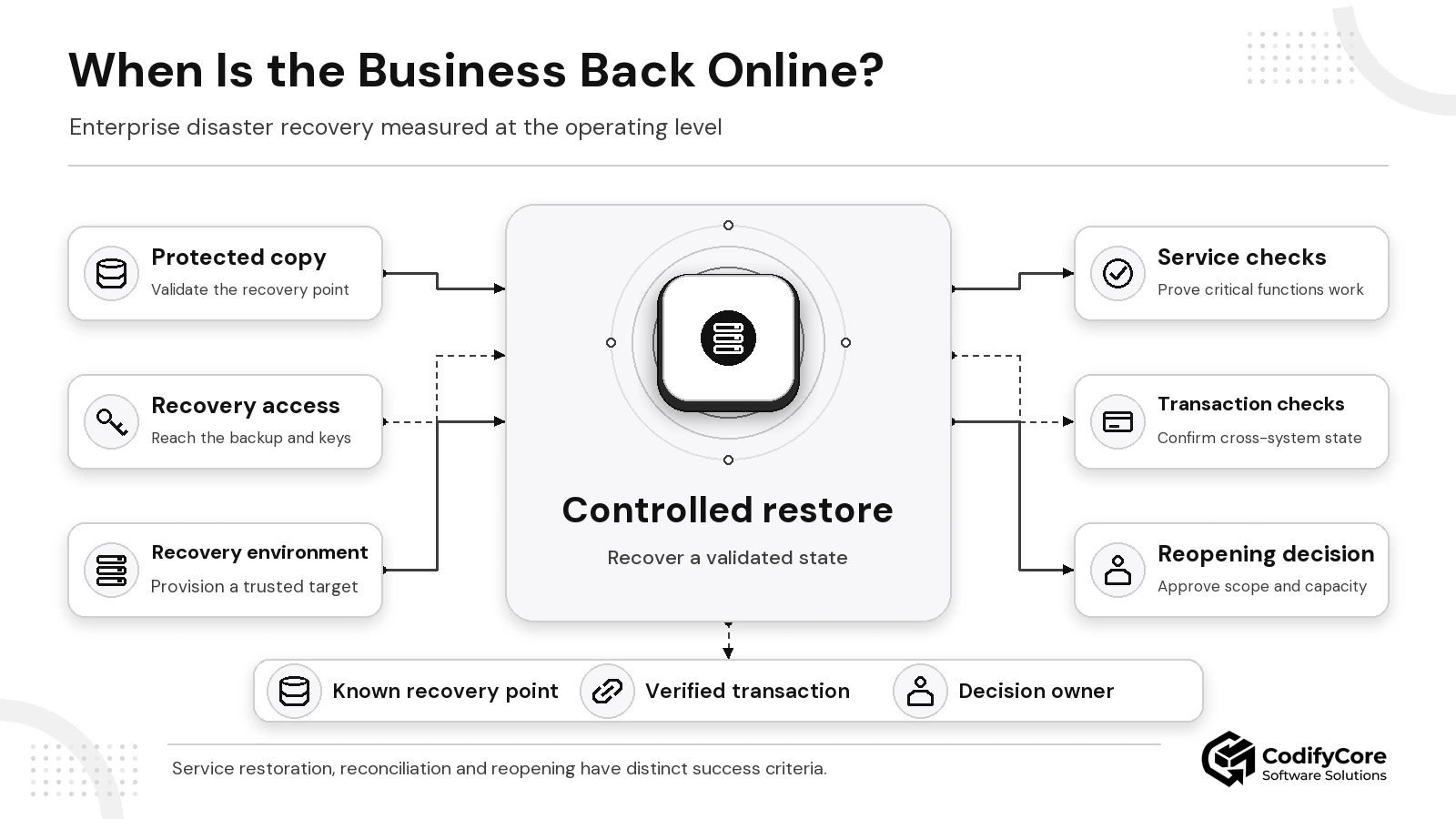
Imagine a retailer whose ordering system fails at eight in the morning. By 08:42, its database has been restored. The infrastructure team can connect to it, read the expected tables and see the application responding. An executive asks whether the business is back online. The answer depends on who is in the room. Engineering has a running system. Customer support still cannot tell which orders survived. The payments team has to establish whether charges accepted before the outage match the orders in the restored database. Fulfilment needs to know whether it can release a shipment without sending the same order twice.
The retailer can report a successful restore at 08:42 and still be unable to trade safely. That difference exposes a decision enterprises often leave to the middle of an incident. What must be true before someone can say the business has recovered, and who has the authority to say it?
Recovery targets should be owned by the people accountable for the operation and measured at the point where it can safely resume. Infrastructure milestones matter because they explain where time goes. They become misleading when they are used as a substitute for the customer outcome. An executive who funds a faster database restore may improve one milestone while leaving the longest or riskiest part of the recovery untouched.
Put the clock where the customer feels the outage
A recovery time objective, or RTO, expresses a target for restoring a capability after disruption. A recovery point objective, or RPO, expresses how far back data may have to be recovered, often stated as the amount of time of data loss the organisation can tolerate. Both are objectives. A backup schedule, a monitoring dashboard or a supplier’s service commitment can inform them. The evidence of actual recovery comes from a test or incident with clear start and end points. NIST’s contingency planning guide relates those objectives to business impact. AWS’s reliability guidance recommends restoring data periodically and checking both time and data integrity against the workload’s objectives. NIST contingency planning guide · AWS guidance on recovery testing
The useful question for a service owner is what capability the target actually buys. “Restore the orders database in 45 minutes” is an engineering objective. “Resume taking and recording new orders safely within 90 minutes” is an operating objective. The latter implies a working journey from accepting a customer request to recording a valid order and producing evidence that downstream teams can act on. The people approving that definition need to agree how much functionality and capacity they will accept at first reopening. They also need a separate expectation for when they will handle the backlog and resume normal throughput.
Here is how the fictional retailer might report the exercise. The ordering service becomes unavailable at 08:00. The latest validated restore point is 07:48, a twelve-minute gap. The database is available at 08:42. The first end-to-end test passes at 09:18. A limited group of customers can place new orders safely at 09:34, following a separate check of payment and fulfilment state. The recovery time to that limited service is 94 minutes. It misses the 90-minute target by four minutes. Backlog clearance at 11:00 is a separate milestone, three hours after the disruption began.
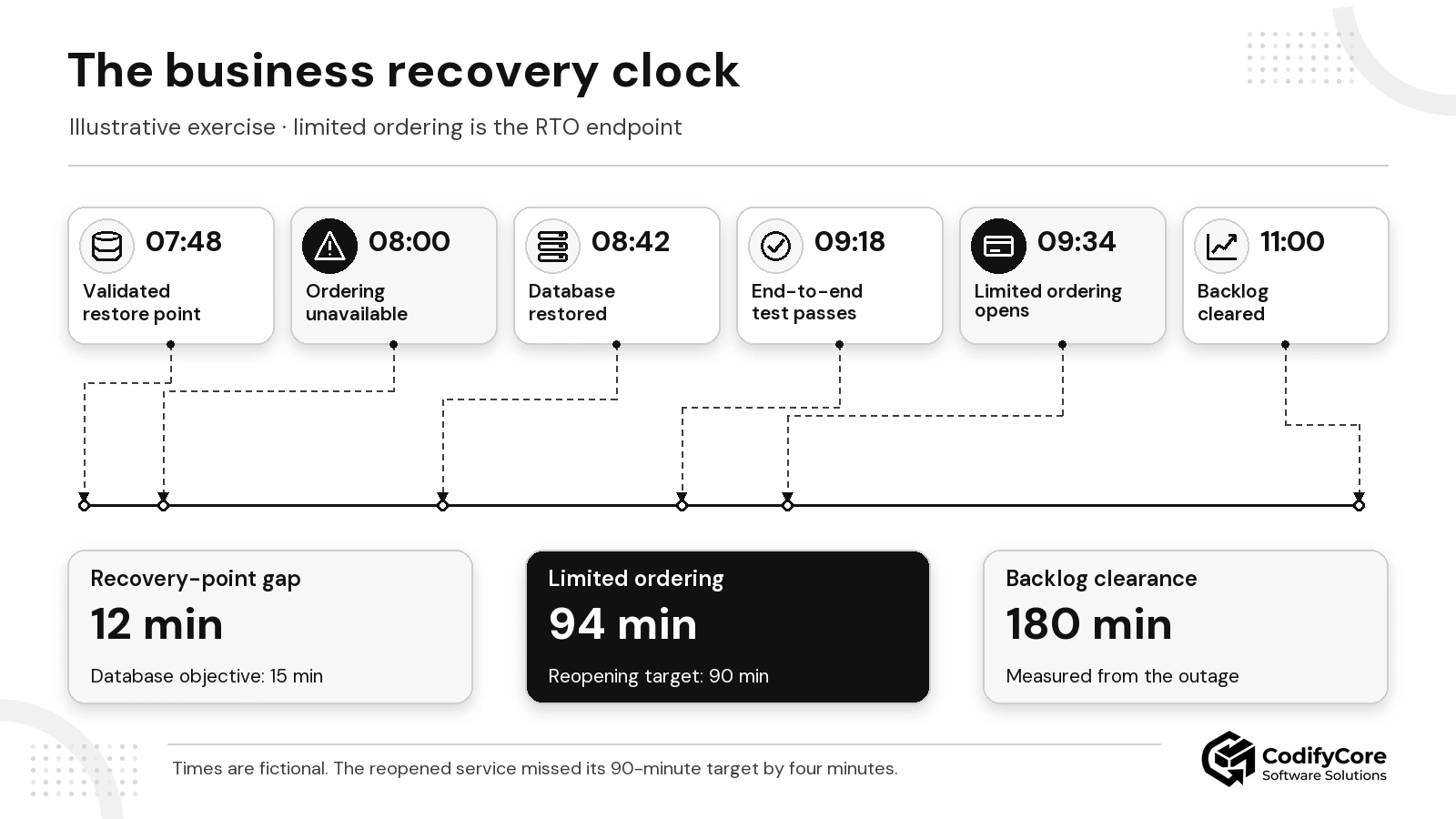
These are useful numbers precisely because they describe different things. The database restore took 42 minutes from the outage. The following 52 minutes made the difference between a running database and safe trading. The age of the validated restore point fell within a fictional 15-minute RPO for the database. That says nothing by itself about how many customer orders, captured payments or shipment events are missing. A twelve-minute window in a quiet period might contain very little. The same window during a busy sale can contain transactions across several systems, each with a different record of what happened.
Recovery has an architecture of its own
Production diagrams tend to show what happens when normal dependencies are available. A recovery exercise should establish what happens when some of those dependencies are part of the failure. A protected backup is useful only if the response team can authenticate, obtain decryption material where needed, reach a suitable recovery environment and run the restore with the tools then available. If the production identity provider is unavailable, relying on it to open the backup console is a circular dependency. If the same administrative privileges can change production data and destroy all usable copies, moving copies to a different storage location alone leaves a significant common failure mode. Joint ransomware guidance recommends maintaining offline, encrypted copies of critical data and testing availability and integrity through recovery exercises. Joint CISA and MS-ISAC ransomware guide
A useful dependency map starts with the smallest customer operation the business wants back first. Work backwards from a test order. The checkout must authenticate where appropriate, call the payment provider, create an order record and publish or hold the relevant fulfilment event. Each of those decisions has a dependency and a person who can say whether it works. The data team can verify that a restore completed. It may take a different team to confirm that the application has the right configuration, a payment reference maps to the correct order and downstream systems will not pick up an earlier instruction twice.
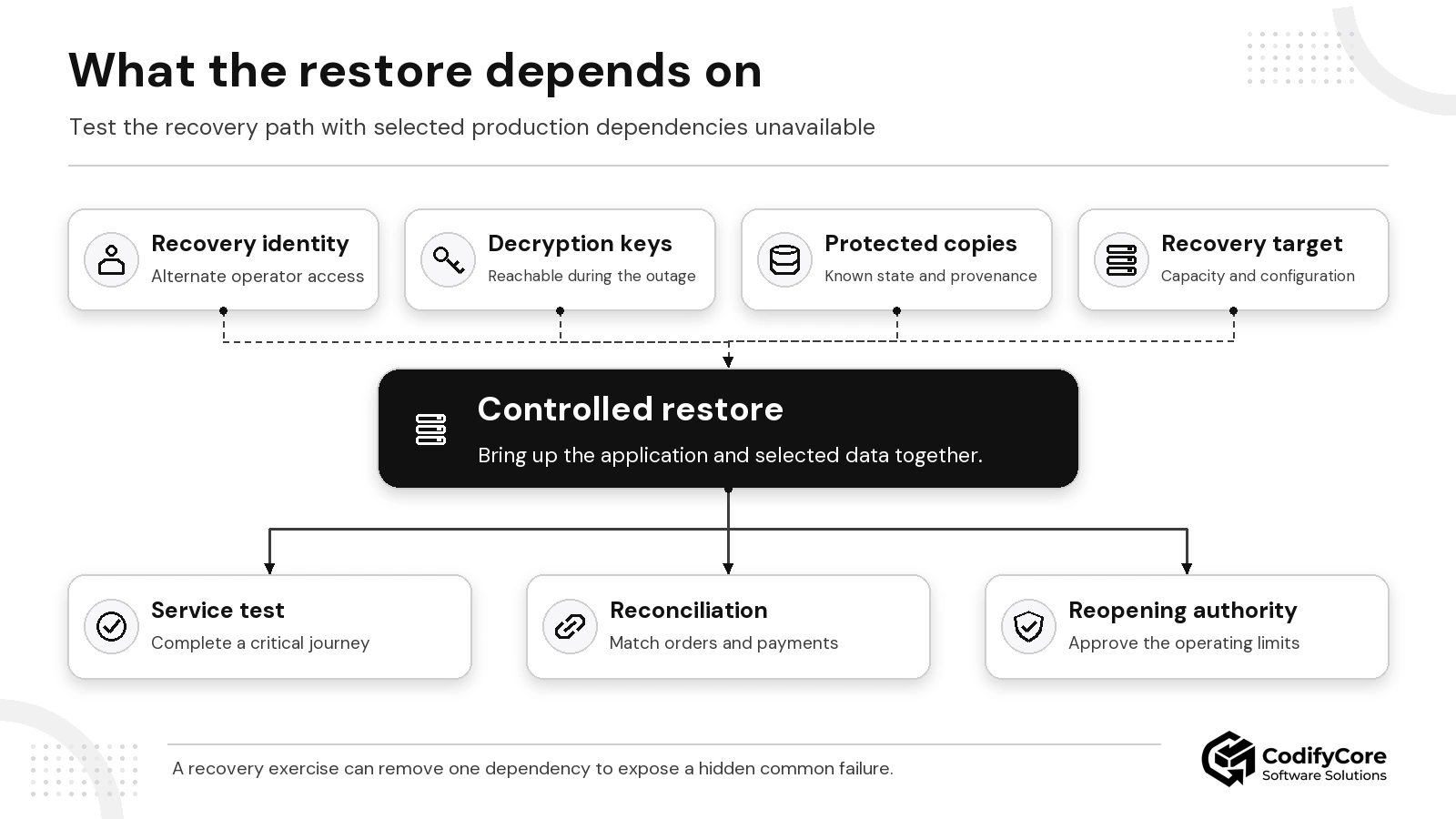
One productive question at a recovery review is which dependency would invalidate the plan if it were unavailable. An emergency administrator account can fail if nobody can access its credentials. Runbooks can be inaccessible when the collaboration platform depends on the identity system being restored. A separate environment can lack the capacity, connectivity or current configuration to run a realistic workload. These failures rarely appear on a backup status screen. An exercise that removes a preselected dependency can make the hidden reliance visible without affecting live traffic. Google’s account of its reliability exercises describes a test that also impaired access to tools and services responders relied on, reinforcing the value of alternate access and out-of-band communications. Google SRE on emergency response
Decide which record can answer which question
Once the order database is running again, the business still has to determine what actually happened. A customer may have received a payment confirmation for an order that is missing from the restored database. A fulfilment partner may already have received a shipment instruction that the restored application thinks it has yet to publish. A responsible reopening process treats those mismatches as business decisions with owners and evidence.
The order system can tell the team whether an order is present. Payment provider records can tell it what that provider authorised or captured. The fulfilment system can tell it which instruction was accepted or processed on its side. Each record has a defined scope. The operations team needs an approved way to connect them using stable references where they exist, preserve items that cannot be matched and distinguish a known duplicate from a new transaction. For example, Stripe documents that webhook events can arrive out of order or more than once. Any recovery plan that relies on events from a payment provider should establish that provider’s behaviour and confirm that retries or replay cannot repeat a payment or fulfilment side effect. Stripe webhook delivery documentation
This is where the distinction between RPO and reconciliation becomes material. The restored database in the exercise starts from 07:48. External systems may hold evidence about transactions after that time. Conversely, finding a charge at the provider does not recreate the whole order or show what a customer was promised about delivery. A recovery report should describe what was restored, what the team reconstructed from other evidence and what remains unresolved. For certain exceptions the safe choice may be to preserve the case for manual review before making any irreversible change.
Data integrity also affects the choice of restore point itself. The newest available copy may include the same corruption or bad change that caused the incident. A team may choose an older validated copy, then reconstruct transactions from independent evidence where safe and feasible. Google’s account of data recovery makes the operational point that recovery dependencies can fail silently until they are exercised. It also describes cases where restoring data successfully required more than bringing back a copy. Google SRE on data integrity
Reopening should have explicit operating limits
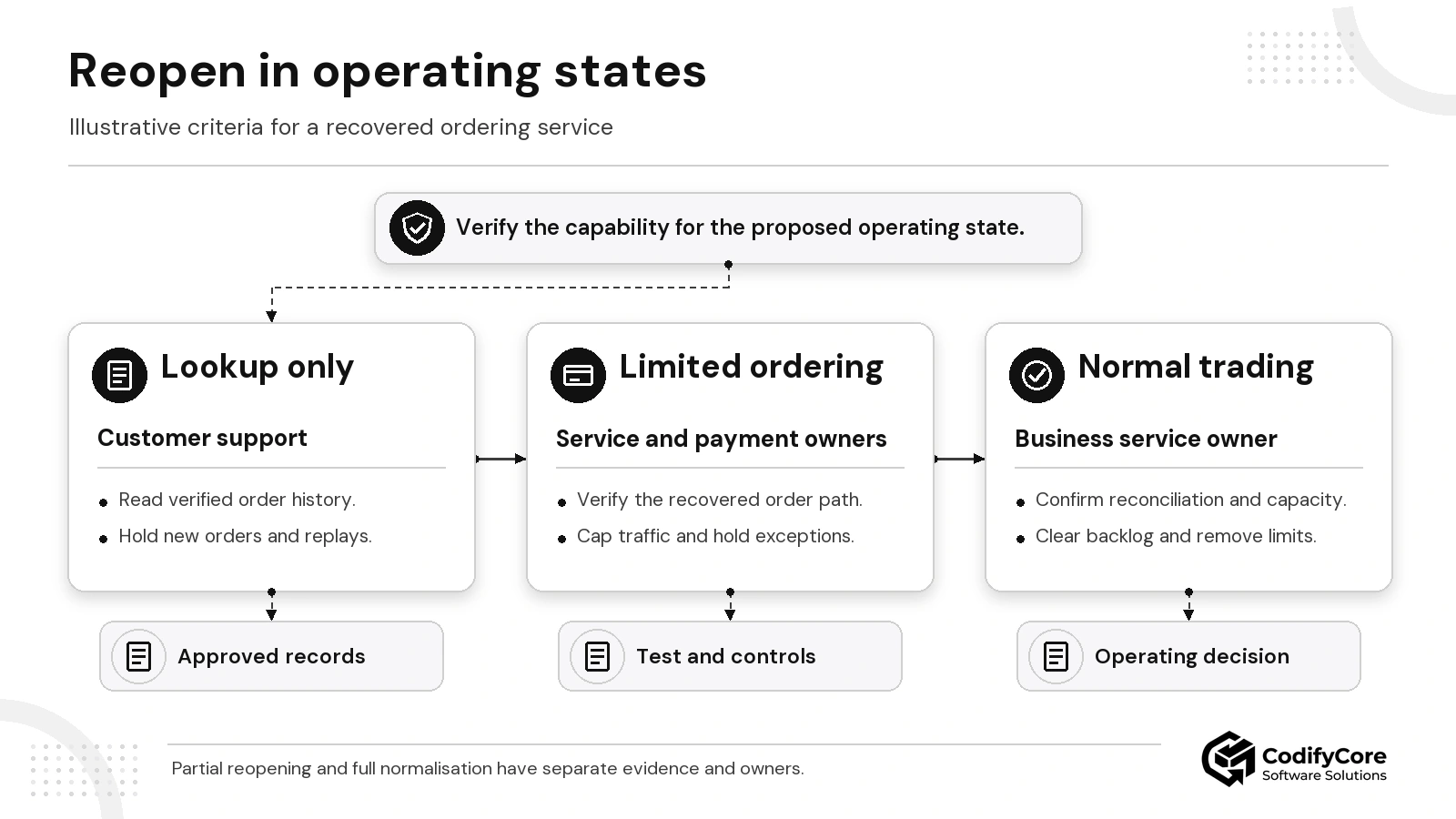
The pressure to turn everything on is understandable. Customer support has questions it cannot answer. Lost trading time hurts. Partners are waiting for instructions. Treating reopening as an incremental decision can relieve some of that pressure. The retailer may be able to restore order lookups for orders whose records it trusts, followed by limited acceptance of new orders. It can continue holding transactions from the uncertain period for reconciliation. That approach works only if the boundaries are visible and enforceable. A partly restored service that appears normal can invite customers and staff to rely on capabilities that are still compromised.
For a destructive mistake with a known cause, engineering may be able to show quickly why the restored environment is suitable. Where compromise is suspected, the security decision changes. The organisation must decide what evidence is needed before trusting the recovery environment and the credentials used to operate it. In that situation, pressure to meet the RTO should be visible in the incident decision, alongside the possibility of reintroducing compromised configuration or reopening access before containment. The people responsible for security, the business operation and infrastructure need a way to make and record that decision together. NIST places recovery alongside detection and response in its incident response guidance and treats recovery planning, tests and improvements as ongoing work. NIST incident response guidance · NIST guide for cybersecurity event recovery
What counts as enough evidence will vary with the business. For the fictional retailer, it includes a verified transaction through the recovered journey, an authorised decision on unresolved payment states and evidence that the team can prevent duplicate fulfilment. The limit on initial traffic must match the capacity of people and systems to verify exceptions. Another organisation might prioritise an entirely different first capability. What matters is agreeing on the operating state before the outage so it can be tested, communicated and defended when time is short.
Buy down the delay the exercise exposes
The first decision after the drill is where to invest. In the fictional timeline, bringing the database back ten minutes sooner would help only if the next stages could start sooner or use the time saved. Suppose the 52 minutes after the database restore were spent waiting for access to payment records, establishing an incident boundary and deciding who could reopen. The better investment might be an independently accessible report, a controlled reconciliation procedure and a clear authority to reopen. If the real constraint is database size or restore throughput, engineering investment may be the answer. A measured exercise identifies which constraint the next investment should address.
A useful recovery report shows the last verified recoverable state, when the customer-facing capability actually returned, the period that needs reconstruction and the dependency that delayed progress. It names who accepted any temporary limits on service. It also makes clear what the exercise did not simulate. A carefully staged restore with normal identity, advance warning and a single test order is worth doing. Its result supports that scenario. A business whose plan depends on running during a holiday spike or recovering while a supplier is unavailable needs additional evidence about those conditions.
Leaders can make the same requirement part of a supplier discussion. Ask what the provider’s objective covers, how the evidence was obtained and which dependencies it expects your team to supply. Then test your own journey with those boundaries in mind. A provider can deliver its contracted recovery capability while customer service, identity or reconciliation still prevents your operation from resuming. The responsibility for bringing those pieces together sits with whoever owns the business outcome.
When someone asks whether the business is back online, answer with the operation the team has verified, the capacity at which it can run, and the work still being held. That answer is more useful than a green infrastructure dashboard and more honest than a single recovery number. It gives the next decision-maker something concrete to fund, test or change before the organisation needs the same plan again.