
Feature-first development treats the product roadmap as a queue of things to build.
A customer requests a dashboard, so the team builds a dashboard. A competitor launches an integration, so another integration is added. Sales needs a different approval process, so a new workflow is developed. One market requires additional verification, so another set of conditions is embedded into the application.
Each request may be reasonable on its own.
The problem emerges when every feature introduces its own data model, rules, permissions, interfaces and integration logic. The product becomes larger without becoming more adaptable.
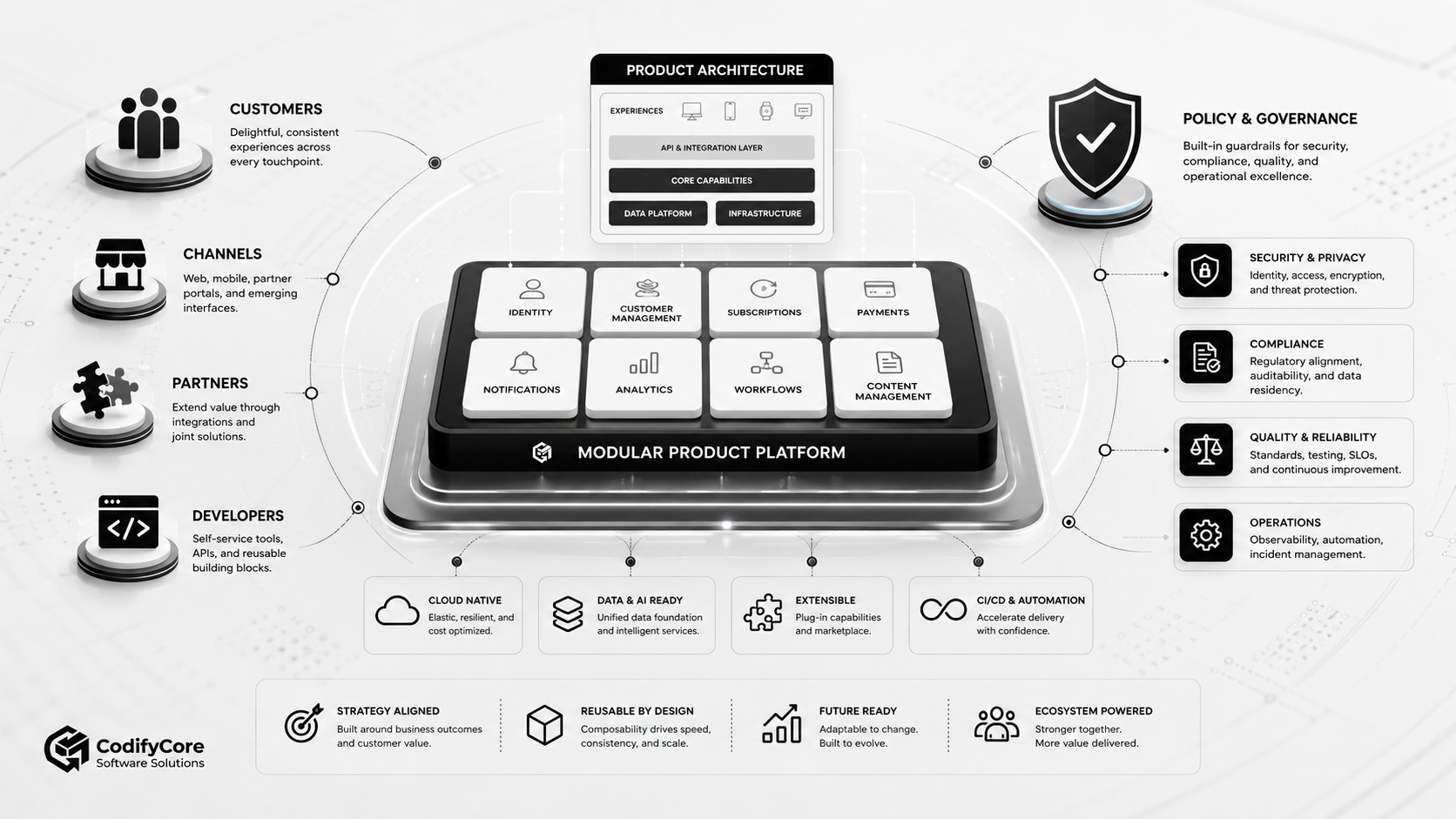
Future-ready products use a different organising model:
- Capabilities define what the product can reliably do.
- Policies determine how, when and for whom those capabilities operate.
- Ecosystems allow those capabilities to create value across channels, partners, developers, applications and AI agents.
Features still exist. Customers still interact with dashboards, forms, automations and workflows.
But features become compositions of reusable capabilities, rather than isolated additions permanently attached to one interface.
This is the difference between a product that accumulates functionality and a product that develops leverage.
Quick answer: What replaces feature-first development?
Feature-first development is replaced by an outcome-led, capability-oriented product model.
Instead of asking only, “Which feature should we build next?”, product teams ask:
- What customer or business outcome are we trying to improve?
- Which durable capability is required to achieve that outcome?
- Which policies should control its behaviour?
- Which products, channels and ecosystem participants should be able to use it?
- How can the capability be reused without forcing every experience to work identically?
A feature solves a visible use case.
A capability creates a reusable ability.
A policy governs how that ability behaves.
An ecosystem expands where and by whom that ability can be used.
The practical shift is:
Stop treating every request as a separate feature. Build governed capabilities that can be composed into many experiences.
Key takeaways
- Feature-first development is not the same as customer-centred development. A large backlog can contain many requested features without addressing the most important customer outcomes.
- Capabilities are durable abilities such as identity verification, payment collection, content publishing or workflow approval. Features combine these abilities into particular user experiences.
- A capability does not have to be a microservice. It is first a product and architectural boundary; its deployment model should follow operational needs.
- Policies should be separated from duplicated feature logic where decisions must remain consistent across products, channels or jurisdictions.
- Ecosystems include customers, partners, APIs, developers, marketplaces, internal teams, data providers and AI agents—not only third-party integrations.
- Platform teams should treat reusable capabilities as products with users, service expectations, documentation and measurable outcomes.
- Capability-first architecture does not mean building a universal platform before delivering customer value. It should emerge incrementally from proven product needs.
- The objective is not maximum reuse. The objective is faster adaptation, safer change and higher cumulative value.
What is feature-first development?
Feature-first development is a planning and delivery model in which success is primarily organised around producing individual functions.
Typical roadmap items might include:
- Add advanced search
- Build a reporting dashboard
- Add another payment method
- Create a partner portal
- Add role-based access
- Launch an AI assistant
- Develop a mobile application
- Integrate another CRM
- Add configurable approvals
The feature is often treated as the principal unit of:
- Planning
- Estimation
- Team assignment
- Architecture
- Delivery
- Reporting
- Success measurement
A request enters the backlog, receives a priority, is assigned to a team and is declared complete when the functionality ships.
This model can work for small products and early experiments. It becomes dangerous when it turns into the permanent operating system of a growing platform.
The hidden problem
Each new feature can silently create:
- A new representation of the customer
- Another permission model
- Separate notification logic
- Different approval rules
- Another integration adapter
- A duplicated reporting pipeline
- A new configuration system
- An inconsistent user experience
- Additional operational responsibility
The feature may be finished, while the product becomes harder to change.
Why feature-first development is so attractive
Feature-first development feels productive because features are visible.
They can be:
- Demonstrated
- Counted
- Estimated
- Sold
- Announced
- Compared with competitors
- Marked as complete
Capabilities, policy systems, data foundations and reusable services are less visible.
A reusable entitlement service does not create the same immediate excitement as a new dashboard. A consistent event model is harder to sell than an AI-powered button. A shared approval engine may not appear in a marketing release at all.
This creates a structural bias toward visible output.
The organisation starts asking:
- How many features did the team release?
- How much of the roadmap is complete?
- How many requests did engineering deliver?
- Which competitor features are still missing?
It asks less frequently:
- Did customer time-to-value improve?
- Can the new functionality be reused?
- Did operating cost decrease?
- Is the product easier to extend?
- Can policies be changed without modifying five applications?
- Can partners safely build on the platform?
- Can a new market be supported without a major rewrite?
Product operating models attempt to shift teams from delivering predetermined outputs toward solving customer problems and producing measurable business outcomes. [1]
Features are not the enemy
The argument against feature-first development is not an argument against features.
Users experience products through features.
A recruiter needs to publish a job. A buyer needs to complete payment. A customer needs to view a report. An administrator needs to approve an account.
The problem is allowing the visible feature to become the deepest architectural boundary.
Consider a feature called:
Automatically schedule an interview after a candidate is shortlisted.
That experience may require:
- Candidate identity
- Employer permissions
- Application status
- Interview availability
- Calendar integration
- Notification delivery
- Time-zone handling
- Consent
- Audit logging
- Rescheduling rules
A feature-first implementation may build all that logic inside one interview module.
A capability-oriented implementation composes existing capabilities:
Candidate management
Application workflow
Scheduling
Calendar integration
Notifications
Consent
Audit
The user receives the same feature.
The product gains a collection of abilities that can support many future features.
What is a capability?
A capability is a durable ability that the product or organisation can perform.
Examples include:
- Authenticate an identity
- Verify an organisation
- Publish content
- Calculate a price
- Collect a payment
- Manage a subscription
- Search information
- Send a notification
- Execute an approval
- Schedule an appointment
- Generate a report
- Evaluate eligibility
- Store a document
- Exchange data with a partner
The Open Group’s architecture guidance describes building blocks as packages of functionality designed to meet business needs and uses capability-based planning to connect strategic requirements with architecture and investment. [2]
A useful capability definition
For product architecture, a capability should answer:
What stable ability must the product provide, regardless of the current screen, channel or implementation?
“Add a shortlist button” is a feature.
“Manage candidate selection status” is a capability.
“Create a downloadable invoice” is a feature.
“Generate and manage billing documents” is a capability.
“Show recommended products on the homepage” is a feature.
“Generate contextual product recommendations” is a capability.
Three capability levels
1. Business capabilities
These describe what the business must be able to do.
Examples:
- Manage customers
- Bill subscribers
- Onboard suppliers
- Process applications
- Manage fulfilment
- Demonstrate compliance
2. Product or domain capabilities
These are abilities directly available to product experiences.
Examples:
- Verify an email address
- Publish a vacancy
- Score an application
- Create an interview
- Generate an invoice
- Request approval
3. Platform capabilities
These support several product or domain capabilities.
Examples:
- Identity and access
- Notifications
- Search
- File storage
- Workflow orchestration
- Observability
- Feature evaluation
- API management
- Event delivery
A good capability map links these levels without turning every helper function into a strategic capability.
Feature versus capability
| Question | Feature | Capability |
|---|---|---|
| What does it represent? | A particular user-facing function | A reusable ability |
| Typical lifetime | May change with the experience | Usually longer-lived |
| Primary orientation | Screen, journey or request | Outcome and domain responsibility |
| Reuse | Often built for one context | Designed for multiple compositions |
| Policy | Frequently embedded | Explicitly governed |
| Channels | Commonly channel-specific | Can support several channels |
| Ownership | May end after release | Requires ongoing stewardship |
| Interface | UI or application-specific | APIs, events, services and components |
| Success measure | Shipped and adopted | Reliable outcomes across consumers |
| Example | “Schedule interview” button | Scheduling and availability management |
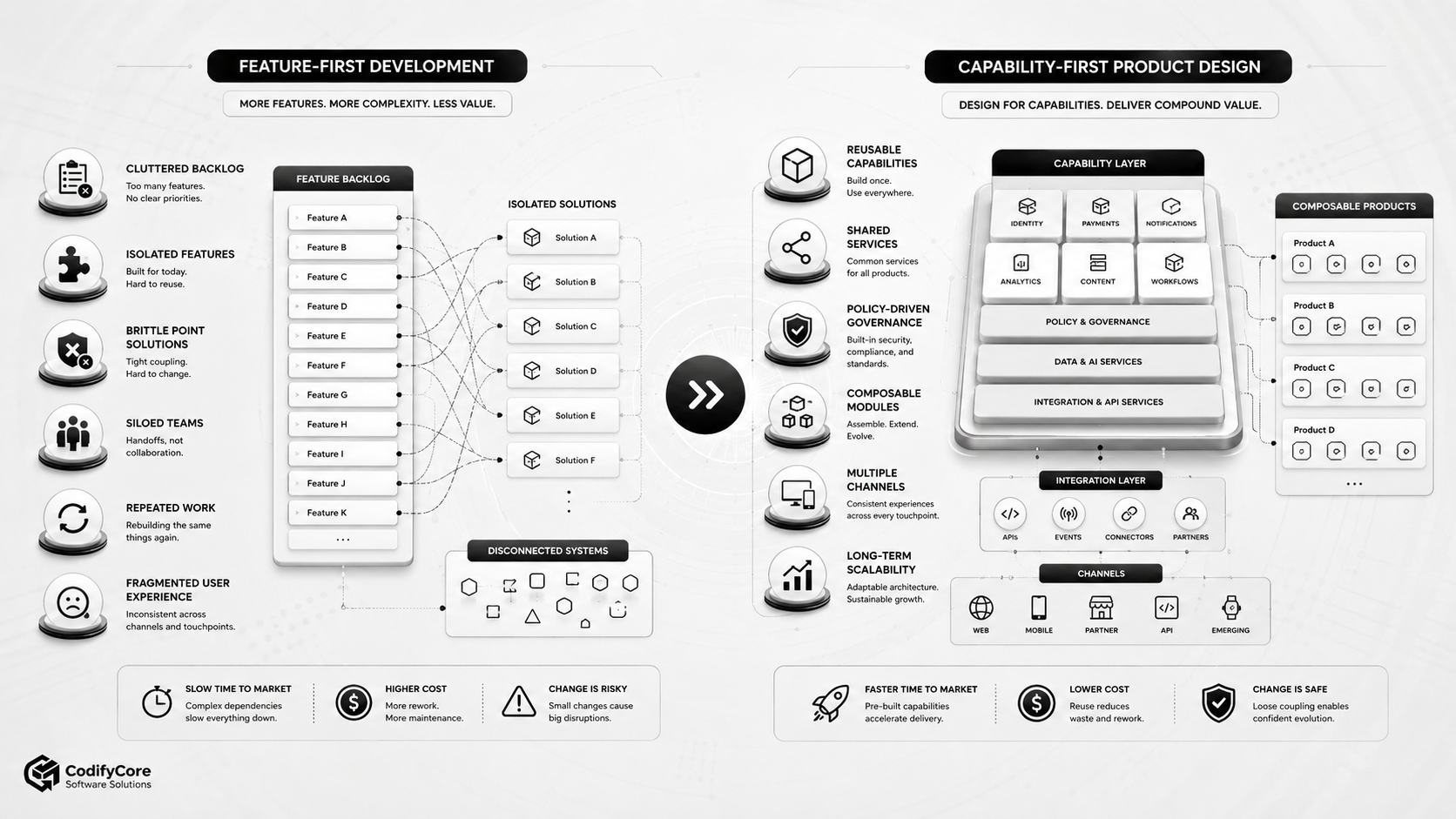
Why feature-first products become difficult to change
1. The same problem is solved repeatedly
Separate teams build their own:
- Customer lookup
- Permission checks
- Notification rules
- Search interfaces
- File handling
- Approval workflows
- Audit logs
- Integration retries
Each implementation is slightly different.
The organisation pays repeatedly to build, secure, test, monitor and maintain the same fundamental ability.
2. The roadmap becomes an architectural blueprint
Roadmaps should communicate product strategy and outcomes.
In feature-first organisations, the backlog accidentally defines the architecture.
Features are implemented in the order requested, using the team and codebase that appear most convenient at the time. Long-term boundaries emerge from short-term delivery decisions.
3. Business rules become scattered
Pricing rules may exist in:
- The checkout application
- The billing service
- The partner portal
- A spreadsheet
- A CRM automation
- Customer support instructions
Access policies may be duplicated in the web application, mobile app, API gateway and database.
The organisation cannot confidently answer which rule is authoritative.
4. Every channel becomes a separate product
Web, mobile, partner portals, embedded widgets and APIs begin with similar needs.
Feature-first development can cause each channel to implement its own:
- Validation
- Workflows
- Permissions
- Pricing
- Notifications
- Data transformations
Customers receive inconsistent behaviour depending on where they interact.
5. Teams optimise locally
A team is rewarded for delivering its feature.
It is not necessarily rewarded for:
- Improving a shared capability
- Eliminating duplicate logic
- Supporting another team
- Creating extension points
- Producing documentation
- Reducing organisational complexity
The local delivery metric can work against the quality of the wider product.
6. Change becomes high risk
When one feature owns its own copy of identity, pricing, workflow and notification logic, a small policy change can require modifications across many components.
The change itself may be simple.
Discovering every place that implements it is not.
7. AI increases the exposure of weak boundaries
An AI agent needs clear, structured and governable capabilities.
It cannot safely operate through an application whose business logic is spread across screens, hidden database triggers, manual steps and undocumented integrations.
AI does not remove architecture.
It makes ambiguous architecture easier to expose.
What is capability-first product development?
Capability-first product development organises the product around stable domain abilities that can be reused across experiences.
It combines four ideas:
- Outcome-led product management
- Capability-oriented architecture
- Explicit policy and governance
- Ecosystem-ready interfaces
A product team still begins with a customer problem.
It does not begin by constructing an abstract platform.
The team identifies the capability needed to solve that problem, builds the smallest useful version and creates a boundary that can evolve as additional use cases emerge.
The capability-first sequence
A feature-first sequence often looks like:
Request
→ feature
→ implementation
→ release
→ next request
A capability-first sequence looks like:
Outcome
→ required capability
→ governing policies
→ experience composition
→ reusable interfaces
→ measurement
→ evolution
The result is not necessarily slower.
Once the capability exists, later experiences can be assembled much faster.
What makes a capability product-ready?
A box on an architecture diagram is not a capability.
A useful capability requires a contract.
Capability purpose
What business or customer ability does it provide?
Consumers
Which products, teams, partners, applications or agents use it?
Inputs and outputs
What information does it require and return?
State ownership
Which data is authoritative, and which data is only referenced?
Policies
Which rules govern availability, permissions, pricing, compliance and behaviour?
Interfaces
Is it available through:
- API
- Event
- SDK
- User-interface component
- Workflow action
- AI tool
- Internal library
Service expectations
What are its:
- Availability targets
- Latency expectations
- Capacity limits
- Recovery objectives
- Support arrangements
Versioning
How can it change without breaking consumers?
Observability
Can operators understand:
- Usage
- Errors
- Performance
- Policy decisions
- Downstream dependencies
Ownership
Which durable team owns its reliability, roadmap and documentation?
Without these characteristics, a “shared capability” can become an undocumented dependency that slows every consumer.
Capabilities do not have to be microservices
Capability-first architecture is a logical design approach, not a mandatory deployment topology.
One capability could be implemented as:
- A module inside a modular monolith
- A package or library
- A service
- Several coordinated services
- A managed SaaS platform
- A workflow definition
- A data product
- A human-assisted process
Splitting every capability into a network service can introduce unnecessary:
- Latency
- Failure modes
- Infrastructure
- Deployment coordination
- Data consistency challenges
- Operational cost
The correct sequence is:
- Define the domain and capability boundary.
- Establish ownership and interfaces.
- Select the simplest deployment model that satisfies operational requirements.
- Extract or distribute it only when scale, autonomy, risk or lifecycle differences justify it.
A modular monolith with clear capability boundaries is often more future-ready than a fragmented collection of tightly coupled microservices.
What are product policies?
Policies are the rules that determine how capabilities behave.
They include far more than security permissions.
Access policies
- Who may invoke a capability?
- Which data may they access?
- What level of authentication is required?
Entitlement policies
- Which subscription plans include the capability?
- Which usage limits apply?
- Which modules are enabled for a tenant?
Pricing policies
- Which price applies?
- Which discount is valid?
- Which currency or tax rule should be used?
Workflow policies
- Does this action require approval?
- How many approvals are required?
- Which roles may approve it?
- What happens after rejection?
Compliance policies
- In which region may data be stored?
- How long must evidence be retained?
- Which verification level is required?
- Which records must be auditable?
Risk policies
- When should an action be blocked?
- When is additional verification required?
- Which transaction requires human review?
Experience policies
- Which variant is shown?
- Which capability is available in a channel?
- Which rollout percentage applies?
- Which experiment is active?
Quality policies
- Which service level is required?
- Which validation rules must pass?
- Which release conditions must be satisfied?
Why policies should be separated from features
Assume a platform allows employers to publish jobs.
The rules may differ according to:
- Employer verification status
- Subscription plan
- Jurisdiction
- Job type
- Risk level
- Manual approval settings
- Industry
- Posting volume
If those conditions are hard-coded inside the web posting form, the mobile application, partner API and bulk import service will behave differently.
A policy-oriented design separates:
- The capability: Publish a job.
- The request context: Employer, plan, location, job and channel.
- The policy decision: Allow, deny, require approval or impose conditions.
- The enforcement point: Web app, API, workflow engine or import service.
NIST’s zero-trust architecture similarly distinguishes policy decision points from policy enforcement points for access decisions. Policy engines such as Open Policy Agent provide declarative policy-as-code mechanisms that can separate decision logic from application code. [5][6]
Policy as code
Policy as code can make selected policies:
- Version controlled
- Testable
- Reviewable
- Deployable
- Auditable
- Consistent across services
A simplified entitlement policy could express:
Allow advanced analytics when:
- the account is active,
- the subscription includes analytics,
- the user holds an approved role,
- the tenant has not exceeded its usage quota.
The feature does not decide the rule independently.
It asks the relevant policy service or library for a decision.
Not every rule belongs in a central policy engine
Centralising all decisions can create:
- A bottleneck
- Excessive coupling
- Poor performance
- A policy language nobody understands
- A single operational failure point
- A team that must approve every product change
Keep rules local when they are:
- Specific to one bounded context
- Closely tied to domain invariants
- Not reused elsewhere
- Better understood as core business logic
Externalise policies when consistent decisions are needed across:
- Channels
- Products
- Services
- Regions
- Tenants
- Partner interfaces
The objective is not one global policy engine.
It is clear decision ownership and consistent enforcement.
The capability, policy and ecosystem architecture
A future-ready product can be understood through several interacting layers.
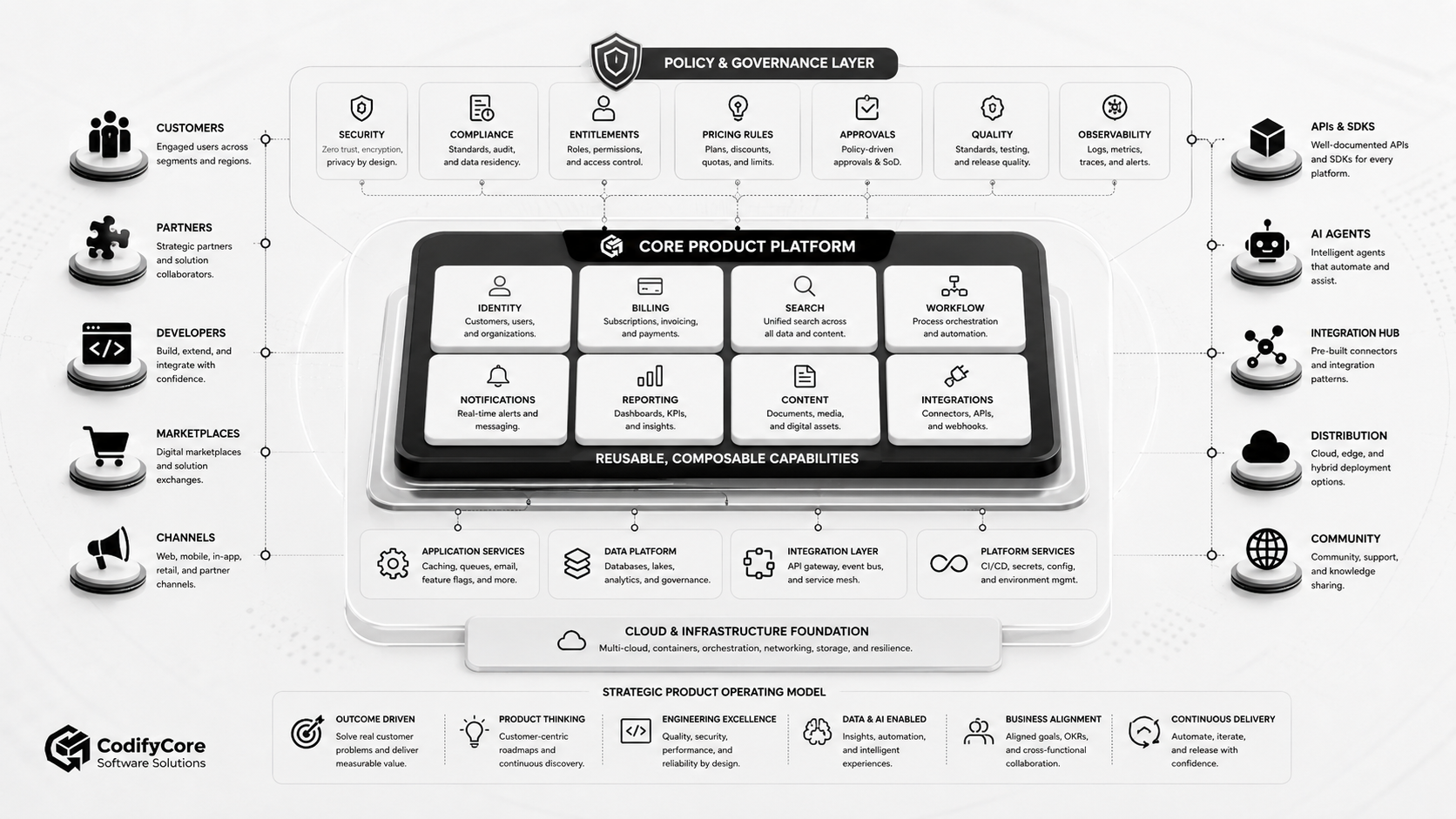
1. Experience and channel layer
This is where users interact with the product:
- Web applications
- Mobile applications
- Administrative interfaces
- Partner portals
- Embedded components
- Voice interfaces
- AI assistants
- Physical touchpoints
The experience layer should compose capabilities rather than reimplement their rules.
2. Composition and orchestration layer
This layer coordinates several capabilities into journeys.
It can handle:
- User workflows
- Process orchestration
- Long-running transactions
- Human approvals
- Compensation
- Task assignment
- Cross-capability journeys
A capability should not need to understand the entire customer journey in which it participates.
3. Domain capability layer
This includes the abilities that define the product:
- Customer management
- Product management
- Job publishing
- Application processing
- Order management
- Subscription management
- Document verification
- Case management
These are differentiated capabilities closely connected to the product’s value proposition.
4. Shared platform capability layer
These capabilities support several domains:
- Identity
- Notifications
- Search
- Reporting
- Payments
- Content
- File storage
- Feature evaluation
- Audit
- Integration management
CNCF’s platform guidance defines platforms as integrated collections of capabilities presented according to users’ needs. It also recommends treating platforms as products that prioritise common, high-value use cases rather than forcing every team into a centrally dictated solution. [3]
5. Policy and governance layer
This governs:
- Identity and access
- Entitlements
- Pricing
- Compliance
- Approval
- Quality
- Risk
- Privacy
- Data residency
- Operational limits
Policy is often a cross-cutting plane rather than one technical service.
6. Data and intelligence layer
This provides:
- Authoritative data models
- Data products
- Event history
- Search indexes
- Analytics
- Machine-learning features
- Recommendations
- Knowledge retrieval
- Audit evidence
Capabilities should not all invent separate representations of the same core entities.
7. Integration and event layer
This includes:
- APIs
- Webhooks
- Events
- Connectors
- Message streams
- Partner adapters
- Data exchange
- AI-oriented tools
OpenAPI provides a formal standard for describing HTTP interfaces, while AsyncAPI provides a machine-readable specification for message-driven APIs and event architectures. [8]
8. Infrastructure and operational layer
This supports:
- Deployment
- Networking
- Secrets
- Configuration
- Observability
- Resilience
- Recovery
- Continuous delivery
- Cost management
It should provide safe defaults without forcing product teams to understand every infrastructure detail.
Why ecosystems matter
A future-ready product is rarely one application used by one audience through one interface.
It may be consumed by:
- Customers
- Administrators
- Partners
- Developers
- Agencies
- Suppliers
- Marketplaces
- Internal teams
- API consumers
- Data providers
- AI assistants
- Other products
The ecosystem is not an outer marketing layer added after the product is complete.
It changes how the product should be designed.
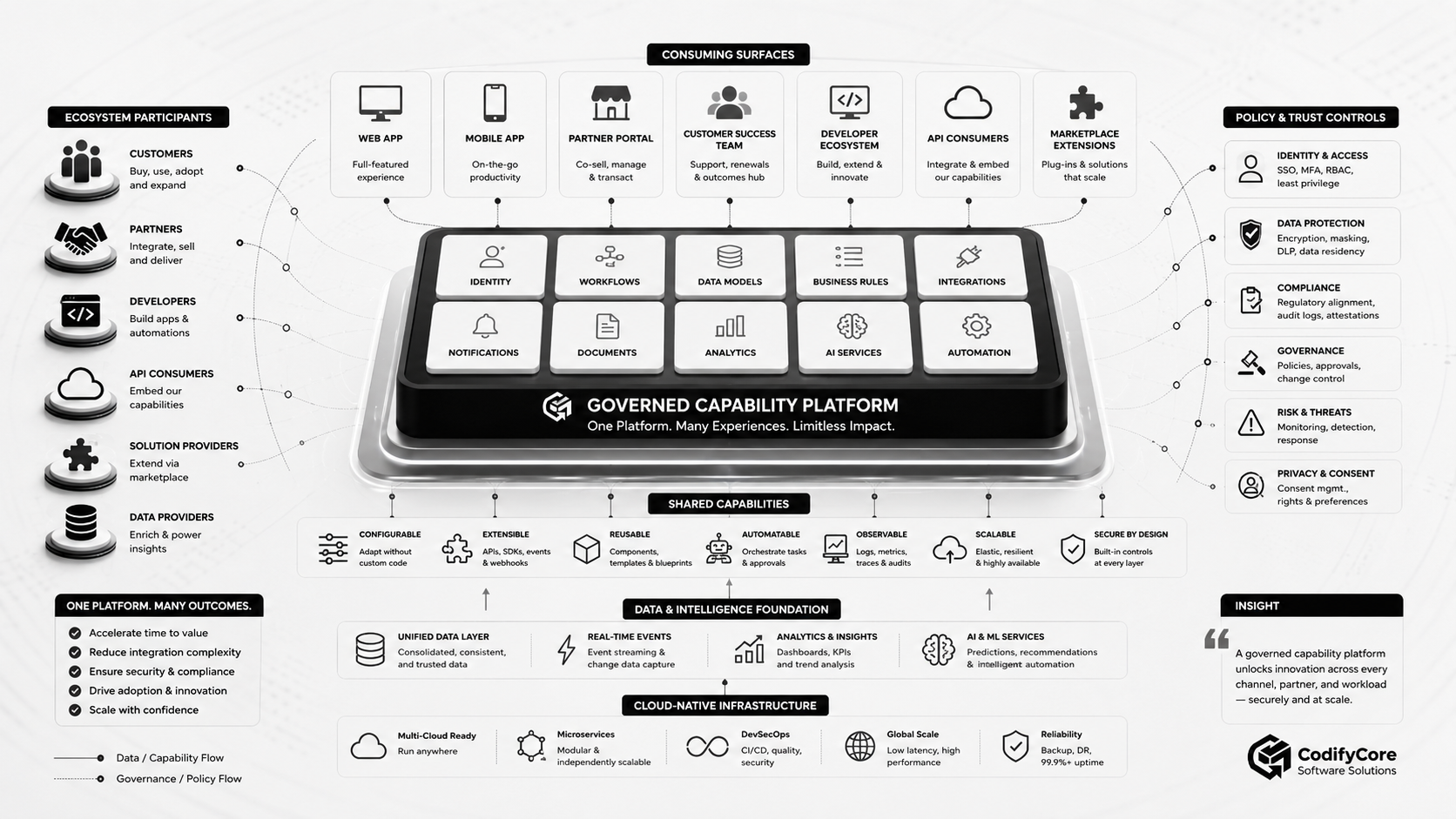
Products become capability providers
A mature product does not only present functionality through its own interface.
It makes selected capabilities available through:
- APIs
- SDKs
- Events
- Webhooks
- Components
- Templates
- Partner portals
- Marketplaces
- Automation tools
- AI-agent interfaces
This allows external participants to create value without copying the product’s internal implementation.
Ecosystem participants can be producers
Partners do not only consume capabilities.
They can also provide:
- Data
- Certifications
- Extensions
- Templates
- Integrations
- Specialist workflows
- Content
- Verification services
- Distribution
A supplier may contribute product data.
A payment provider may provide transaction capability.
A partner may publish an extension.
A certification body may issue evidence.
A customer may automate its own process through the API.
Ecosystem architecture requires governance
Opening APIs does not automatically create a healthy ecosystem.
The product needs:
- Participant identity
- Registration
- Permissions
- Rate limits
- Versioning
- Documentation
- Testing environments
- Certification
- Support
- Revenue or commercial rules
- Data-use policies
- Deprecation processes
The ecosystem must be designed as a product.
Composability: Building experiences from capabilities
Composable architecture builds products by assembling independent components through clear interfaces.
MACH principles describe composable systems as modular, API-first, cloud-native and decoupled from specific presentation layers. The central promise is that capabilities can be rearranged or replaced without requiring the entire product to be rebuilt. [7]
What composability should provide
A composable product should allow teams to:
- Use one capability in several journeys
- Replace an implementation behind a stable contract
- Add a new channel without reproducing business rules
- Extend the product through partners
- Introduce new data or AI services
- Change policies independently of interface code
- Scale high-demand capabilities separately where necessary
Composability is not unrestricted assembly
Poorly governed composability can create:
- Inconsistent experiences
- Dependency sprawl
- Conflicting data models
- Excessive vendor complexity
- Duplicate capabilities
- Difficult incident ownership
Composition still needs:
- Architecture principles
- Approved interfaces
- Shared semantics
- Ownership
- Observability
- Lifecycle management
Example: Rebuilding a recruitment platform around capabilities
Consider a recruitment platform with the following feature requests:
- Employer registration
- Candidate registration
- Job publishing
- Job approval
- Application forms
- Candidate assessments
- Shortlisting
- Interview scheduling
- Notifications
- Subscription plans
- Social login
- Reporting
- AI candidate summaries
A feature-first product may create a separate module for every item.
A capability-oriented model might organise the system differently.
Core domain capabilities
- Organisation management
- Candidate profile management
- Job management
- Application management
- Assessment management
- Selection workflow
- Interview management
Shared capabilities
- Identity
- Authentication
- Verification
- Notifications
- Scheduling
- Document storage
- Search
- Reporting
- Billing
- Integration management
Policies
- Employer approval requirements
- Candidate approval requirements
- Job-post approval rules
- Verification methods
- Subscription entitlements
- Posting limits
- Application retention
- Interview permissions
- Data-access controls
- Regional privacy requirements
Ecosystem interfaces
- HRIS integrations
- Calendar platforms
- Video-meeting providers
- Job aggregators
- Payment services
- Background-check providers
- Mobile applications
- Employer APIs
- Candidate APIs
- AI assistants
Now consider the feature:
Shortlist a candidate and schedule an interview.
The experience composes:
Application Management
+ Selection Workflow
+ Interview Management
+ Scheduling
+ Notifications
+ Calendar Integration
+ Access Policy
The feature remains valuable.
The capabilities continue to create value elsewhere.
Capabilities should be reusable, not generic
A common mistake is designing capabilities so abstractly that they no longer solve real problems.
For example, an engineering team may try to create a universal workflow engine before understanding any actual workflows.
The result can require every product team to become an expert in:
- States
- Transitions
- Rules
- Timers
- Events
- Compensation
- Custom schemas
A more useful progression is:
- Solve one real workflow.
- Identify the stable concepts.
- Solve a second related workflow.
- Extract the genuinely shared behaviour.
- Preserve domain-specific extensions.
- Continue evolving from usage.
Reusable does not mean infinitely configurable.
A capability should provide a clear opinion about the problem it solves.
Product platforms should be managed as products
A product platform serves internal or external consumers through reusable capabilities.
Its consumers may include:
- Product teams
- Developers
- Partners
- Customers
- Operations teams
- AI applications
A platform should therefore have:
- Defined user groups
- Product management
- Discovery
- Documentation
- Support
- Service levels
- Adoption metrics
- Feedback channels
- A roadmap
- Deprecation policies
CNCF guidance emphasises that teams should choose platform capabilities because they create clear value and reduce cognitive load—not because platform usage is mandated. [3]
The platform should provide a paved road
A useful platform makes the correct path:
- Easier
- Faster
- Safer
- Better documented
- Better supported
It should not prevent legitimate product differentiation.
Avoid the central platform bottleneck
A platform fails when every product change requires a ticket to one overloaded central team.
Provide self-service through:
- APIs
- Templates
- Portals
- Events
- SDKs
- Automated provisioning
- Policy-based controls
- Clear extension mechanisms
The platform team owns the paved road.
Product teams own customer outcomes.
How team design changes
Feature projects often create temporary teams.
People are assembled to deliver a scope and dispersed after release. Long-term ownership becomes unclear.
Capability-oriented products need durable teams.
Stream-aligned product teams
These teams own customer or business outcomes across a flow of value.
They should have enough autonomy to:
- Discover problems
- Design solutions
- Release changes
- Operate services
- Measure outcomes
Platform teams
Platform teams provide shared capabilities that reduce complexity for product teams.
Enabling teams
Enabling teams help others adopt unfamiliar practices or technologies and then move on.
Complicated-subsystem teams
These teams own highly specialised areas requiring concentrated expertise.
Team Topologies uses these categories to organise for fast flow and describes platform teams as providers of services that reduce cognitive load for stream-aligned teams. [9]
Align teams with stable responsibilities
If the architecture defines a stable capability but the organisation reorganises its owner every quarter, the capability will still deteriorate.
Product, architecture and team boundaries should support one another.
Outcome-led roadmaps
A capability-first roadmap should not become a list of architectural components.
“Build notification service” is still an output.
A stronger roadmap begins with outcomes:
- Reduce onboarding time from two days to twenty minutes
- Increase successful self-service integrations
- Reduce manual approval workload
- Improve payment recovery
- Shorten partner launch time
- Reduce inconsistent access decisions
- Increase job-post completion rate
The team then determines which capabilities and policies must improve to achieve the result.
Roadmap structure
A useful roadmap can contain:
Outcome
What measurable change is required?
Problem evidence
What demonstrates that the problem exists?
Capability impact
Which existing or missing capabilities affect the outcome?
Policy impact
Which rules or decisions must change?
Ecosystem impact
Which channels or participants are involved?
Measures
How will progress and unintended consequences be evaluated?
This preserves strategic direction without prescribing every feature in advance.
Measuring a capability-oriented product
No single metric is sufficient.
Customer and business outcomes
Measure:
- Activation
- Conversion
- Task completion
- Retention
- Revenue
- Support demand
- Customer effort
- Time-to-value
Capability performance
Measure:
- Number of meaningful consumers
- Successful transaction rate
- Latency
- Availability
- Error rate
- Recovery time
- Consumer satisfaction
- Version adoption
Reuse and leverage
Measure carefully:
- Number of products using the capability
- Development time saved
- Duplicate implementations retired
- Integration time
- Percentage of new journeys assembled from existing capabilities
A capability used once may still be strategically important.
A capability reused everywhere may still be poor.
Policy performance
Measure:
- Decision consistency
- False approvals
- False denials
- Manual exception rate
- Policy-change lead time
- Approval duration
- Policy-related incidents
Ecosystem health
Measure:
- Active integrations
- Partner onboarding time
- API success rate
- Developer activation
- Extension adoption
- Deprecation compliance
- Partner-generated value
Delivery and operational performance
DORA recommends measuring software-delivery outcomes such as change lead time, deployment frequency, failed-deployment recovery, change-failure percentage and deployment rework. Its research also warns that platforms can improve productivity while harming throughput or stability if implemented without sufficient user focus and developer independence. [4]
A balanced scorecard should therefore include:
- Product outcomes
- Platform adoption
- Delivery performance
- Reliability
- Developer experience
- Customer experience
How to move from feature-first to capability-first
Phase 1: Start with outcomes
Select one product area with visible problems.
Document:
- Customer outcome
- Business outcome
- Current friction
- Evidence
- Constraints
Do not begin by creating an enterprise-wide capability catalogue.
Phase 2: Inventory existing features
List current functionality and identify:
- Duplicate rules
- Duplicate data
- Shared operations
- Common integrations
- Repeated workflows
- Inconsistent behaviour
Phase 3: Cluster features into capabilities
Ask:
Which stable ability appears across several features?
For example:
Password reset
Email verification
Two-factor authentication
Social login
Session management
may reveal a broader identity and authentication capability.
Phase 4: Identify policy decisions
For each capability, identify:
- Who can use it
- Which plans include it
- Which limits apply
- Which approvals are required
- Which regulatory conditions affect it
- Which risks require additional controls
Phase 5: Map ecosystem consumers
Identify:
- Current consumers
- Future consumers
- Channels
- Partners
- APIs
- Internal teams
- AI agents
- Operational systems
This helps determine which interfaces and service expectations are justified.
Phase 6: Define the capability contract
Document:
- Purpose
- Boundaries
- Data ownership
- Interfaces
- Events
- Policies
- Dependencies
- Service levels
- Versioning
- Ownership
Phase 7: Keep the first implementation small
Do not build every future option.
Deliver the minimum capability required by the current outcome, with enough boundary clarity to evolve.
Phase 8: Extract shared logic incrementally
Move reusable logic when:
- A second real consumer appears
- Duplication causes risk
- Different scaling is necessary
- Independent deployment creates value
- Ownership needs to change
Phase 9: Create paved-road interfaces
Offer:
- Documented APIs
- Events
- SDKs
- Components
- Templates
- Test environments
- Usage examples
Phase 10: Retire duplicated implementations
A new shared capability creates little value when all old versions remain active indefinitely.
Plan:
- Migration
- Compatibility
- Deprecation
- Consumer support
- Cutover
- Removal
Phase 11: Measure the outcome
Confirm that the change improved:
- Customer value
- Delivery speed
- Reliability
- Policy consistency
- Ecosystem adoption
- Operating cost
Architecture is not successful merely because the diagram became cleaner.
Common capability-first anti-patterns
1. Renaming services as capabilities
Changing “user service” to “identity capability” does not change architecture or ownership.
2. One microservice per capability
Logical boundaries do not always require separate deployment boundaries.
3. Building the platform before the product
A speculative platform can consume years while serving no proven customer need.
4. Mandatory reuse
Forcing teams to use an unsuitable capability can be more expensive than allowing local implementation.
Reuse should be based on value.
5. The universal capability
A universal workflow, customer or notification capability may become so configurable that nobody can use it safely.
6. Centralised policy sprawl
Moving every conditional statement into one policy engine can create an unmanageable rule repository.
7. APIs without product ownership
An undocumented endpoint with no support, lifecycle or compatibility commitment is not an ecosystem capability.
8. Platform success measured by adoption alone
Teams may use a platform because they are forced to.
Measure whether it actually improves their outcomes.
9. Ecosystem without trust controls
An open integration model without identity, permissions, rate limits and lifecycle governance increases risk.
10. AI agents with direct system access
An AI assistant should consume governed capabilities, not receive unrestricted database or infrastructure access.
Why capability-first products are better prepared for AI
AI-native applications need more than access to raw data.
They need:
- Discoverable capabilities
- Structured inputs
- Predictable outputs
- Permission boundaries
- Explicit side effects
- Policy decisions
- Audit records
- Human approval
- Reliable interfaces
A feature-first system may contain powerful functionality that is accessible only through a specific screen and human workflow.
A capability-first system can expose selected abilities through:
- APIs
- Events
- Tools
- SDKs
- Workflows
An AI agent can then request:
get_customer_summary
evaluate_refund_eligibility
draft_support_response
request_refund_approval
instead of navigating hidden application logic or receiving unrestricted database access.
Clear capability and policy boundaries make agent automation safer.
They do not make it automatically safe.
When feature-first development is still appropriate
Feature-first delivery can be entirely reasonable when:
- Testing a new product hypothesis
- Building a short-lived prototype
- Serving one narrow use case
- Validating demand before investing in reuse
- Implementing a genuinely isolated function
- The product has only one consumer and channel
- Reuse would add more complexity than value
The problem is not shipping a feature quickly.
The problem is allowing every temporary implementation to become permanent architecture.
A useful rule is:
Optimise the first implementation for learning, and optimise proven recurring needs for capability leverage.
A decision framework
Build or improve a capability when:
- Several features require the same ability
- Several channels need consistent behaviour
- Duplicated rules create risk
- Another team needs the function
- Partners need to consume it
- Independent scaling creates value
- The domain has a durable lifecycle
- Policy consistency is important
- AI or automation needs a governed interface
Keep the logic local when:
- It serves one narrow experience
- It has no realistic second consumer
- Its rules are inseparable from one domain
- Extraction would increase coordination
- The product is still validating the problem
- A stable boundary cannot yet be identified
The future product model
The next generation of digital products will not be defined by the number of features they contain.
They will be defined by how effectively they can:
- Compose capabilities
- Apply policies
- Serve multiple experiences
- Support partners
- Expose governed interfaces
- Integrate intelligence
- Adapt to regulation
- Change without destabilising the system
The most valuable product architecture will combine three kinds of leverage.
Capability leverage
Build an ability once and improve every experience that uses it.
Policy leverage
Change a governing decision once and enforce it consistently.
Ecosystem leverage
Allow customers, partners, developers and agents to create additional value from the platform.
Feature output remains necessary.
But it becomes the visible surface of a deeper product system.
Conclusion
Feature-first development helped organisations plan visible work.
It is not sufficient for products that must operate across multiple channels, markets, teams, partners and intelligent systems.
Future-ready products organise themselves around:
- Capabilities that provide durable and reusable abilities
- Policies that control those abilities consistently
- Ecosystems that extend those abilities across participants and experiences
The transition does not require abandoning features, microservices or roadmaps.
It requires changing their role.
Features become compositions.
Services become implementations.
Policies become explicit decisions.
Platforms become products.
Partners become ecosystem participants.
Teams become owners of outcomes and long-lived capabilities.
The right question is no longer:
Which feature should we add next?
It is:
Which capability must become stronger, which policy must become clearer, and which ecosystem interaction will create the greatest cumulative value?
That is how a product stops growing only in size and starts growing in leverage.
Frequently Asked Questions
What is feature-first development?
Feature-first development organises product planning and delivery around individual functions or requests rather than durable capabilities and measurable outcomes.
What is capability-first product development?
Capability-first development organises the product around reusable abilities that can be governed by policies and composed into multiple features, channels and integrations.
What is the difference between a feature and a capability?
A feature is a particular user-facing function. A capability is the underlying ability that may support several features and experiences.
Does a capability have to be a microservice?
No. A capability can be implemented as a module, service, library, workflow, data product or managed platform.
What is a product policy?
A product policy is a rule that determines how a capability behaves, including access, entitlement, pricing, approval, compliance, risk and experience rules.
What is policy as code?
Policy as code expresses selected policies in machine-evaluable, version-controlled and testable formats rather than duplicating them across application code.
What is a product ecosystem?
A product ecosystem is the network of customers, partners, developers, channels, applications, data providers and other participants that consume or extend product capabilities.
Is capability-first development the same as platform engineering?
No. Platform engineering can provide shared technical capabilities, while capability-first product development also includes business domains, policies, experiences and external ecosystems.
Is capability-first architecture the same as composable architecture?
They are closely related. Composable architecture assembles products from independent components, while capability-first design determines which durable abilities should become those components.
Should every feature become reusable?
No. Reuse should be based on demonstrated value. A narrow or experimental feature may remain local.
How do you identify a capability?
Look for a stable ability required by several features, channels or consumers, such as identity verification, scheduling, payment or approval management.
What should a capability contract contain?
It should identify purpose, consumers, inputs, outputs, data ownership, policies, interfaces, events, service expectations, versioning and team ownership.
Why are capabilities important for AI agents?
AI agents need structured, discoverable and permission-controlled operations. Capabilities provide safer interfaces than unrestricted access to internal systems.
How should capability teams be organised?
Durable teams should own the capability’s outcome, reliability, interfaces, documentation and lifecycle rather than disbanding immediately after release.
How should a capability-first product be measured?
Measure customer outcomes, capability reliability, policy consistency, ecosystem adoption, delivery performance and developer or consumer satisfaction.