
A Digital Product Passport should not be treated as a QR code attached to a compliance webpage.
It should be treated as a governed product-data infrastructure that connects identity, materials, supply-chain evidence, environmental information, performance, repair, ownership, reuse and end-of-life records throughout a product’s lifecycle.
Compliance may create the immediate deadline. The greater opportunity is to make product information usable by every participant who influences the product’s value:
- Manufacturers
- Suppliers
- Distributors
- Customers
- Repair providers
- Resellers
- Refurbishers
- Recyclers
- Auditors
- Regulators
When implemented narrowly, a DPP becomes another reporting obligation.
When implemented as infrastructure, it can support better product design, faster verification, more reliable service, higher residual value, improved material recovery and new circular business models.
The strategic question is therefore not:
How do we publish the minimum information required by regulation?
It is:
How do we create trusted product data that remains useful from raw-material sourcing to recovery and reintegration?
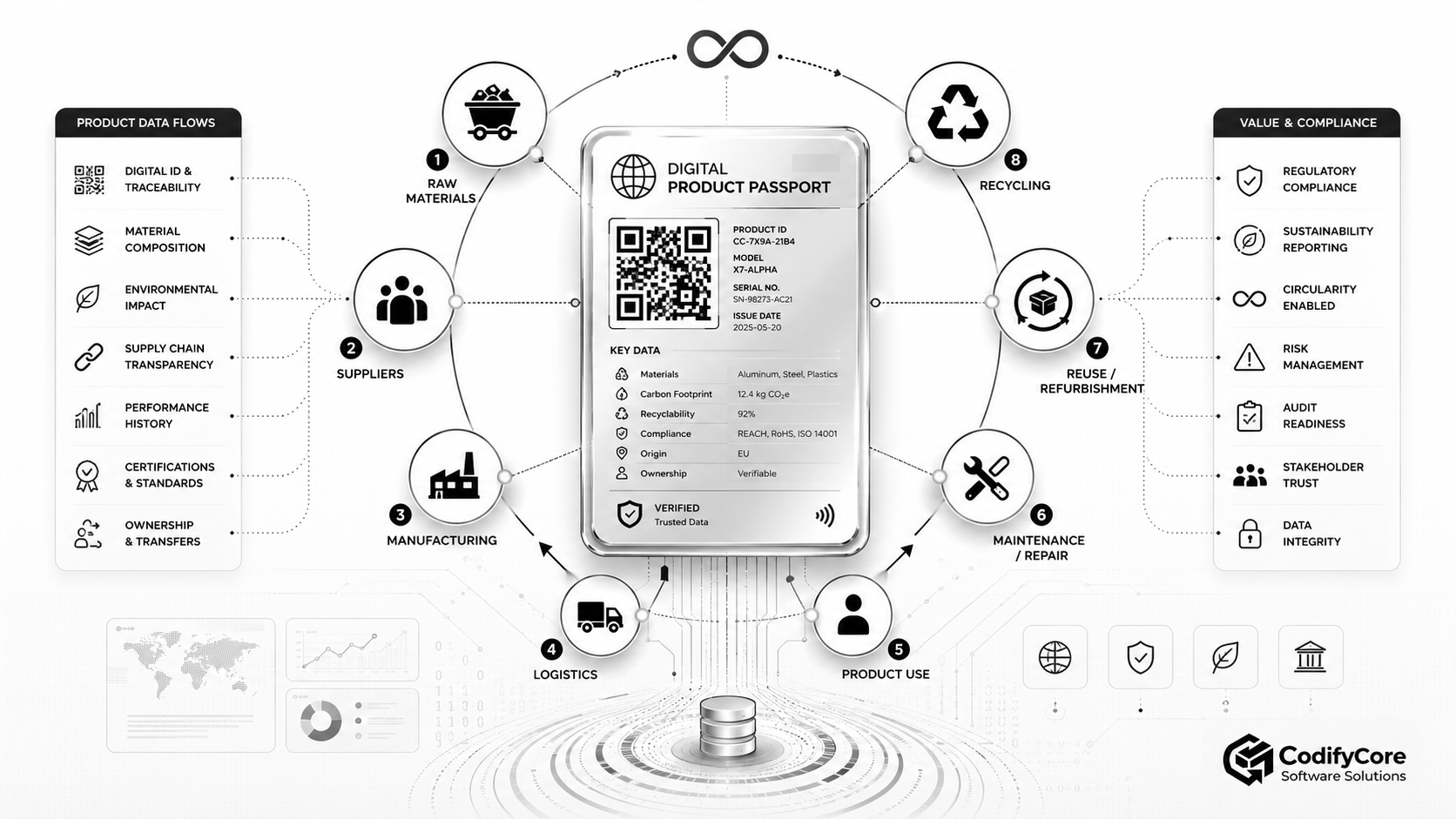
Quick answer: Why should Digital Product Passports go beyond compliance?
Digital Product Passports create value beyond compliance when they become a trusted infrastructure for managing and exchanging product information across the entire lifecycle.
A mature DPP can help organisations:
- Trace materials and components
- Validate supplier claims
- Support repair and maintenance
- Enable resale and refurbishment
- Improve sorting and recycling
- Automate sustainability reporting
- Provide evidence to regulators
- Give customers verifiable product information
- Feed lifecycle evidence back into product design
The key distinction is:
A compliance passport publishes required data. A product-data infrastructure continuously creates, governs and exchanges trusted lifecycle data.
Key takeaways
- A DPP is not simply a digital label, PDF or product webpage.
- The QR code or other data carrier is an entry point. The real system includes product identifiers, data models, integrations, access controls, hosting, verification and lifecycle updates.
- The EU’s Ecodesign for Sustainable Products Regulation creates the general DPP framework, but detailed data requirements will be defined by product-specific rules. [1]
- Batteries are the first major product group with a mandatory EU passport timeline, beginning in February 2027 for the battery categories covered by the Batteries Regulation. [4]
- The planned EU DPP Registry is intended to operate as an index linking unique product identifiers to the locations of detailed passport data rather than storing every product record centrally. [3]
- Not every DPP field should be public. Customers, repairers, recyclers, business partners and authorities may require different access rights.
- Circularity depends on data that remains available after sale—not only at the point when a product enters the market.
- DPP programmes should begin with data ownership, quality and integration rather than the design of a public passport page.
- Blockchain is optional. It should be selected only when a genuine multi-party trust problem justifies distributed-ledger complexity.
- The long-term value of a DPP depends on whether the data can be reused operationally, not merely displayed.
What is a Digital Product Passport?
A Digital Product Passport is a structured digital record connected to a product, component or material through a unique identifier and a data carrier such as a QR code.
Depending on the applicable product rules, the passport may provide information about:
- Product identity
- Manufacturer or responsible economic operator
- Materials and components
- Environmental performance
- Recycled content
- Durability
- Repairability
- Substances of concern
- Certifications
- Operating instructions
- Maintenance
- Disassembly
- Reuse
- Recycling
- End-of-life treatment
The exact content is not universal.
The Ecodesign for Sustainable Products Regulation provides the overall framework, while delegated product rules determine which information is required for a particular product group. [1]
What a DPP is not
A DPP is not automatically:
- One universal database
- A blockchain record
- A static PDF
- A marketing page
- A complete bill of materials published to everyone
- A replacement for ERP or PLM
- A sustainability certificate
- A guarantee that every claim is true
- A one-time IT project
The DPP is the controlled interface through which relevant product information is identified, accessed, verified and maintained.
What is the current EU DPP position?
As of June 2026, the European DPP landscape is moving from framework legislation toward product-specific implementation.
The ESPR framework is in force
The Ecodesign for Sustainable Products Regulation entered into force on 18 July 2024.
It establishes a framework for improving product sustainability and allows requirements to be introduced around areas such as:
- Durability
- Reliability
- Reusability
- Upgradability
- Repairability
- Recyclability
- Recycled content
- Environmental footprints
- Resource efficiency
- Product information
The regulation also establishes the general Digital Product Passport framework. [1]
Product requirements will be phased in
The ESPR does not make an identical DPP mandatory for every product immediately.
Detailed requirements will be developed through product-specific delegated acts.
The Commission’s 2025–2030 working plan identifies priority groups including:
- Iron and steel
- Aluminium
- Textiles, with an emphasis on apparel
- Furniture
- Tyres
- Mattresses
- Several energy-related products
The plan also includes horizontal work on repairability and the recyclability of electrical and electronic equipment. [2]
The central registry is an index, not the complete passport database
The ESPR requires the Commission to establish a DPP Registry.
The legal framework sets 19 July 2026 as the deadline for establishing the registry. The Commission describes the planned registry as a central index that links a globally unique product identifier with the location where the detailed passport is maintained. [3]
Detailed DPP records may therefore remain with:
- The responsible economic operator
- A manufacturer
- An authorised DPP service provider
- Another compliant hosting arrangement
This distributed model is important.
It means DPP infrastructure should be designed for interoperability, persistence and discovery rather than assuming every product record will reside in one EU database.
Batteries are the first major implementation case
The Batteries Regulation requires battery passports from 18 February 2027 for:
- Light means of transport batteries
- Industrial batteries with a capacity greater than 2 kWh
- Electric vehicle batteries
Battery passport information may include identification, technical characteristics, performance, durability, sustainability, repair, reuse and recycling information. [4]
The Commission has continued publishing implementation support and industry guidance during 2026 as the battery value chain prepares for the 2027 deadline. [9]
Some technical details are still evolving
Work continues around:
- Data interoperability
- Service-provider requirements
- Certification
- Registry implementation
- Technical specifications
- Sector-specific data models
- Access rights
- Long-term availability
- Customs integration
Companies should therefore avoid building rigid systems around assumptions that have not yet been confirmed by product-specific legislation or technical standards.
Why circularity is fundamentally a data problem
A linear product model is comparatively simple:
Source
→ manufacture
→ sell
→ use
→ discard
A circular model requires many more decisions:
Can the product be maintained?
Can it be repaired?
Can a component be replaced?
Can the product be resold?
Can it be refurbished?
Can it be remanufactured?
Which materials can be recovered?
Are hazardous substances present?
What is the product’s remaining condition?
Who is authorised to update its record?
Those decisions depend on product information.
A repair provider cannot confidently select a replacement component without compatibility data.
A reseller cannot price an asset accurately without condition and service history.
A recycler cannot optimise recovery without composition and disassembly information.
A manufacturer cannot improve circular design without feedback about failures, repairs, recovery rates and material loss.
The EU Circular Economy Action Plan addresses the entire product lifecycle, including design, use, waste prevention and keeping resources in the economy for as long as possible. [5]
A DPP can provide the connective data layer across those stages.
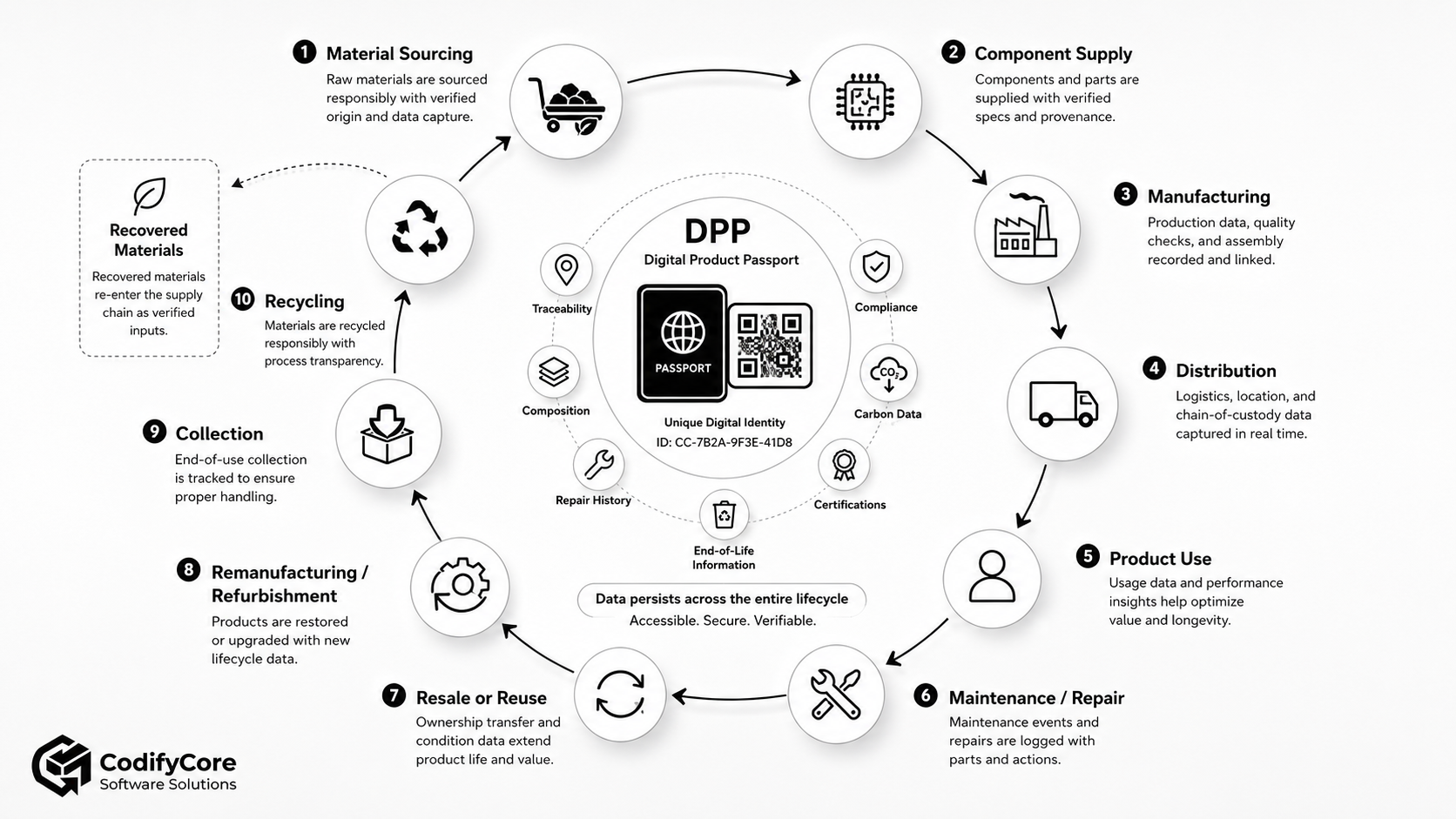
The difference between a compliance record and product-data infrastructure
| Compliance-record approach | Product-data-infrastructure approach |
|---|---|
| Built around a reporting deadline | Built around the full product lifecycle |
| Static data snapshot | Versioned and updateable records |
| Manual data collection | Integrated source systems |
| One generic passport page | Role-specific views and services |
| Minimum mandatory fields | Compliance data plus operationally valuable information |
| Data prepared by one compliance team | Shared ownership across product, IT, operations and supply chain |
| Documents uploaded as evidence | Structured data linked to supporting evidence |
| Limited use after publication | Reused in service, resale, recovery and product design |
| One-way disclosure | Controlled multi-party data exchange |
| Success measured by publication | Success measured by data quality, reuse and outcomes |
Compliance remains essential.
The distinction is whether the organisation treats compliance as the final purpose or as the first use case for a wider product-data capability.
What data makes a DPP valuable?
The most useful DPP data can be divided into several layers.
1. Product identity
This establishes what the record represents.
Examples include:
- Product identifier
- Model identifier
- Batch or lot
- Serialised item identifier
- Version
- Manufacturer
- Responsible economic operator
- Manufacturing facility
- Production date
- Market or jurisdiction
Identity must be stable enough to connect data across systems and time.
2. Material and component composition
This can include:
- Main materials
- Component structure
- Recycled content
- Critical raw materials
- Restricted substances
- Substances of concern
- Material weight
- Component origin
- Supplier declarations
Not all detailed composition information should necessarily be public.
The data model should support different levels of access and granularity.
3. Environmental information
Depending on applicable requirements and available evidence:
- Carbon footprint
- Energy consumption
- Water impacts
- Resource use
- Environmental-footprint indicators
- Recyclability
- Recycled-content claims
- Durability indicators
- Waste-generation information
Every metric should include context.
A number without its method, unit, scope, boundary and version may be misleading.
4. Compliance and assurance
Examples include:
- Applicable regulations
- Conformity status
- Test results
- Certifications
- Audit evidence
- Declaration references
- Issuing body
- Validity period
- Verification status
- Supporting document hashes or references
A passport should distinguish between:
- A claim made by the manufacturer
- A claim received from a supplier
- A calculated value
- A verified result
- An independently certified result
5. Performance and condition
Examples include:
- Rated performance
- Actual performance
- Usage cycles
- Operating hours
- State of health
- Degradation
- Fault history
- Inspection results
- Current condition grade
This information can support maintenance, warranty, resale and remanufacturing.
6. Repair and maintenance
Useful service data may include:
- Repair manuals
- Diagnostic information
- Compatible parts
- Maintenance intervals
- Repair events
- Replaced components
- Software or firmware versions
- Safety instructions
- Authorised service actions
Some information may need to be restricted to qualified repair providers.
7. Ownership, custody and lifecycle events
Where legally and commercially appropriate:
- Custody transfer
- Ownership transfer
- Rental
- Lease
- Return
- Refurbishment
- Remanufacturing
- Recall
- Decommissioning
- Collection
- Recycling
Personal ownership data should not be made publicly visible merely because a product has a DPP.
8. End-of-life information
Examples include:
- Safe disassembly
- Hazard information
- Component separation
- Material recovery routes
- Collection instructions
- Reuse eligibility
- Recycling treatment
- Disposal restrictions
- Producer-responsibility information
The product passport should be dynamic, but not every field should change
A product has different types of data.
Master data
Usually stable:
- Product model
- Manufacturer
- Material specification
- Design version
- Intended use
Batch or item data
Specific to production:
- Serial number
- Manufacturing date
- Facility
- Supplier lot
- Quality result
Lifecycle data
Changes after market placement:
- Maintenance
- Repair
- Ownership
- Condition
- Software update
- Refurbishment
- Recycling
Calculated data
May change when methods or source evidence change:
- Carbon footprint
- Recyclability score
- Environmental indicators
- Remaining useful life
Evidence
Supports claims:
- Certificates
- Test reports
- Supplier declarations
- Audit records
A good architecture does not simply overwrite old values.
It should retain:
- Effective dates
- Version history
- Source
- Method
- Responsible actor
- Approval status
- Superseded values
That creates an audit trail without exposing every internal change publicly.
What does a DPP infrastructure look like?
A scalable DPP platform normally contains several architectural layers.
Layer 1: Source systems
Product data already exists across systems such as:
- ERP
- PLM
- PIM
- MES
- LCA software
- Supplier portals
- Laboratory systems
- Quality-management systems
- Document repositories
- IoT platforms
- Service-management applications
- Warranty systems
- Recycling systems
The DPP should integrate with these systems rather than forcing teams to maintain every field manually.
Layer 2: Product identity and resolution
This layer manages:
- Product identifiers
- Model, batch and item relationships
- Component relationships
- Economic-operator identifiers
- Facility identifiers
- Data-carrier links
- Identifier resolution
- Redirects and persistence
The data carrier should not depend on a fragile temporary URL.
Layer 3: Canonical data model
Different systems often describe the same fact differently.
One system may use:
material_origin
Another may use:
country_of_source
A third may store free text inside a supplier document.
A canonical model creates common definitions, structures, units and relationships.
Layer 4: Data mapping and transformation
This layer:
- Imports source data
- Maps fields
- Converts units
- Validates formats
- Resolves identifiers
- Detects missing values
- Normalises terminology
- Links supporting evidence
Layer 5: Governance and assurance
This controls:
- Data ownership
- Approval
- Verification
- Access
- Versioning
- Retention
- Audit
- Data quality
- Consent
- Confidentiality
- Policy enforcement
Layer 6: DPP core services
Typical platform services include:
- Template management
- Product-record creation
- Passport generation
- Component relationships
- Evidence management
- Workflow and approval
- Status management
- Access control
- Versioning
- Reporting
- Data export
- API management
Layer 7: Lifecycle-event services
This layer records or references:
- Production
- Shipment
- Installation
- Service
- Repair
- Upgrade
- Transfer
- Return
- Refurbishment
- Collection
- Recycling
Layer 8: Access and experience
Different users may access the passport through:
- Public product page
- Customer application
- Repair portal
- Partner API
- Recycler interface
- Regulator portal
- Customs integration
- Internal analytics
- Machine-to-machine exchange
Layer 9: Registry and discovery
The EU registry is intended to connect a unique product identifier with the location of the detailed passport data.
The detailed record remains distributed, while the registry supports discovery and compliance checks. [3]
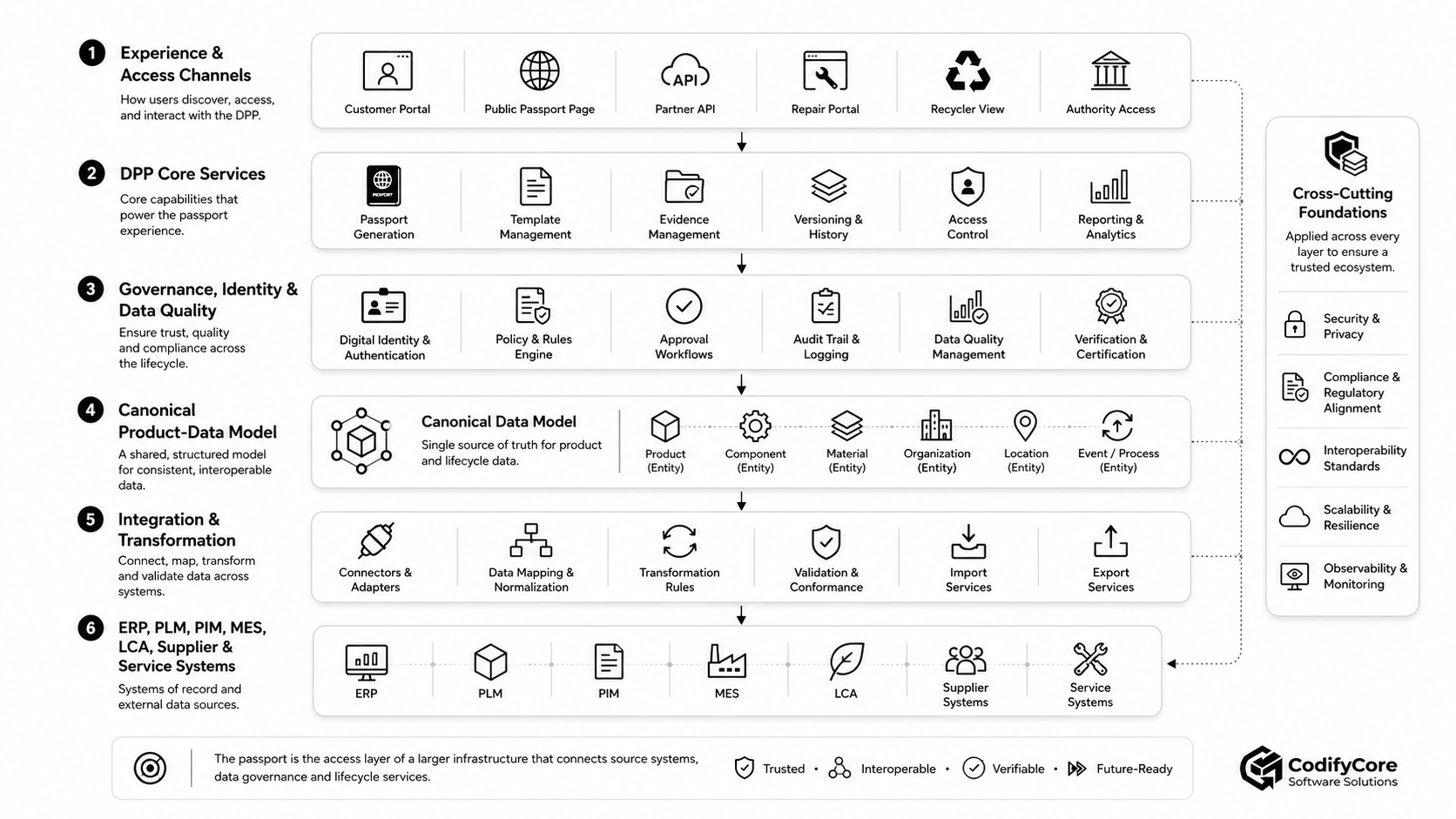
DPP does not replace ERP, PLM or PIM
A DPP platform should coordinate existing systems rather than duplicate all their functions.
| System | Principal responsibility |
|---|---|
| ERP | Commercial, procurement, inventory and operational transactions |
| PLM | Product design, engineering structure, change and lifecycle management |
| PIM | Market-facing product information and channel distribution |
| MES | Production execution and manufacturing records |
| LCA platform | Environmental-impact calculations |
| QMS | Quality procedures, inspections and non-conformance |
| Service platform | Maintenance, repairs and installed-product history |
| DPP platform | Governed assembly and exchange of passport-relevant lifecycle data |
The DPP platform becomes the orchestration and publication layer.
It determines:
- Which source is authoritative
- Which information applies to the model, batch or item
- Which evidence supports each claim
- Which participant can view or update the information
- Which version should be presented
- Which information must remain available over time
Public data, restricted data and confidential data
One public view is not sufficient for a mature DPP.
Public or customer information
Potential examples:
- Product identity
- Main materials
- Durability
- Repair guidance
- Environmental indicators
- Recycling instructions
- Public certifications
Business-partner information
Potential examples:
- Supplier evidence
- Detailed component relationships
- Quality results
- Chain-of-custody information
- Commercially relevant specifications
Repair-provider information
Potential examples:
- Diagnostic procedures
- Compatible parts
- Disassembly steps
- Software configuration
- Safety instructions
Recycler information
Potential examples:
- Detailed composition
- Material location
- Hazardous substances
- Separation instructions
- Recovery routes
Authority information
Potential examples:
- Compliance evidence
- Technical documentation
- Economic-operator information
- Audit trails
- Test results
- Registry information
Internal information
Potential examples:
- Unapproved drafts
- Supplier pricing
- Risk assessments
- Proprietary manufacturing methods
- Internal quality investigations
Access should be determined through policy, identity and purpose—not by creating entirely separate passport records that may contradict each other.
Beyond compliance: Where does the business value come from?
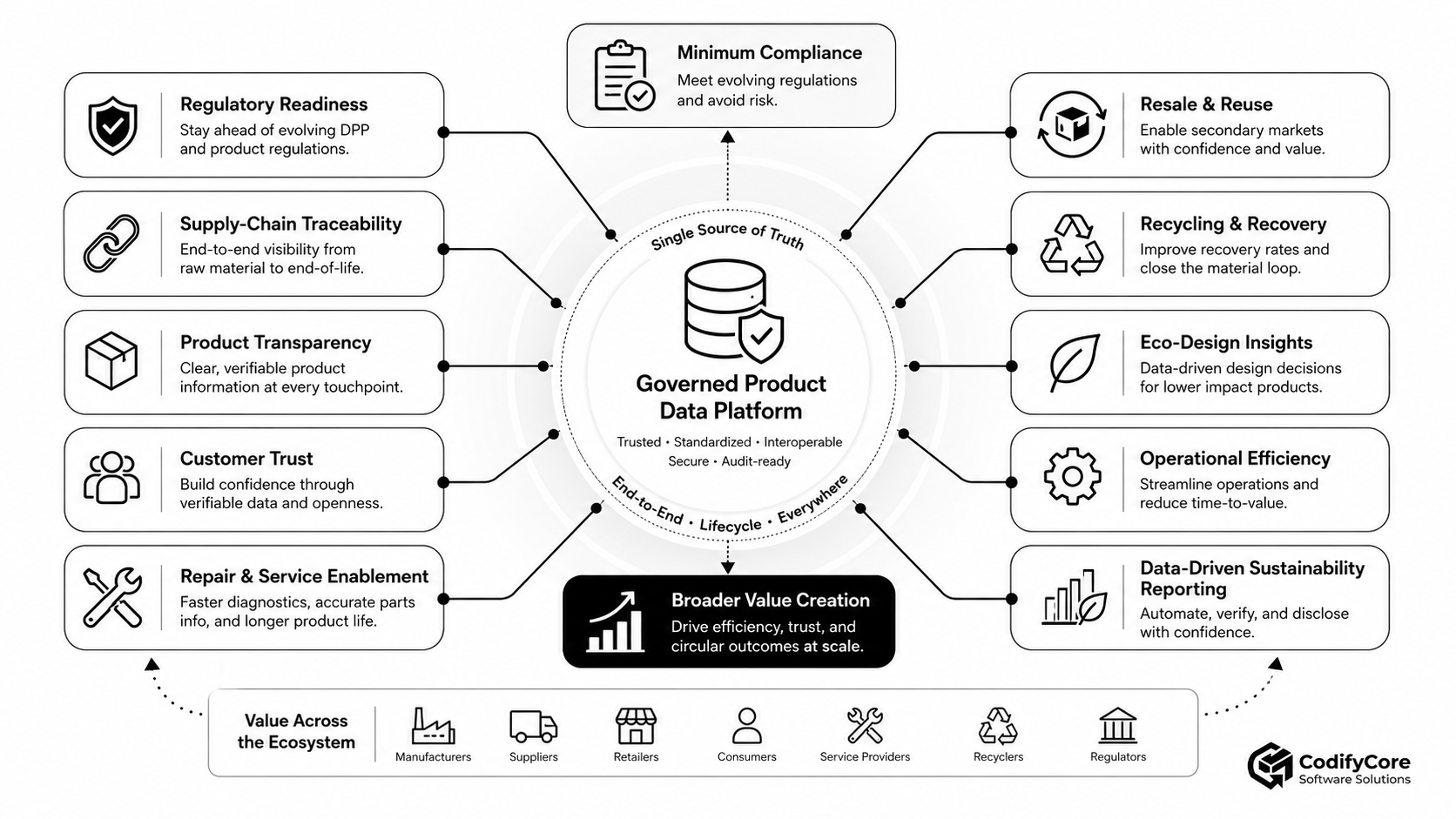
1. Faster regulatory response
A governed data foundation makes it easier to:
- Identify affected products
- Apply new templates
- Locate required information
- Assess data gaps
- Produce evidence
- update disclosures
- Respond to authorities
Without this foundation, every new rule becomes another manual collection project.
2. Improved supply-chain traceability
The platform can connect:
- Product
- Component
- Material
- Supplier
- Facility
- Batch
- Certification
- Shipment
- Lifecycle event
Traceability becomes operational rather than document-based.
3. More credible product transparency
A product claim is more useful when the user can understand:
- Who supplied it
- When it was created
- Which method was used
- Whether it was verified
- Which product version it applies to
This is more meaningful than displaying isolated sustainability statements.
4. Better repair and service
A service provider may use the DPP to identify:
- Correct model and revision
- Component compatibility
- Repair instructions
- Safety requirements
- Previous maintenance
- Software version
- Replacement history
This can reduce information-search effort and avoid incorrect parts or procedures.
5. Higher residual value
Resale and refurbishment depend on confidence.
A lifecycle record may support evidence about:
- Product identity
- Age
- Service history
- Component replacement
- Condition
- Remaining performance
- Authenticity
This can make used products easier to assess and transact.
6. More effective recycling
Recyclers may benefit from:
- Material composition
- Hazard information
- Disassembly guidance
- Component location
- Material weight
- Recovery instructions
- Producer-responsibility information
This can help improve sorting and treatment decisions.
7. Better eco-design
End-of-life and service data can be fed back into product development.
Teams can analyse:
- Frequently failing components
- Difficult disassembly steps
- Low-recovery materials
- Repair bottlenecks
- Returned-product condition
- Actual product lifetime
The DPP can therefore become a feedback mechanism rather than a one-way disclosure tool.
8. Automated sustainability reporting
The same governed source data can support:
- Product disclosures
- Customer requests
- Procurement questionnaires
- Regulatory reports
- Sustainability dashboards
- Audit evidence
This reduces repeated re-entry and inconsistent reporting.
9. Stronger customer and partner trust
Trust does not come from the QR code itself.
It comes from:
- Clear provenance
- Consistent definitions
- Evidence
- Verification
- Controlled updates
- Transparent limitations
Data quality matters more than interface design
A polished passport page can still contain poor information.
DPP data quality should be assessed across several dimensions.
Completeness
Are required fields present?
Accuracy
Does the value represent the real product?
Validity
Does the value conform to the required format, range or method?
Consistency
Does the same fact match across source systems?
Timeliness
Is the data still current?
Granularity
Does it apply to the model, batch, item, component or facility claimed?
Provenance
Can the organisation identify where the data came from?
Verification
Has the claim been reviewed, tested or independently certified?
Persistence
Will the information remain available throughout the required period?
A compliance percentage alone can hide important weaknesses.
For example:
Field completion: 98%
Verified supplier claims: 41%
The first metric looks strong.
The second may reveal the real implementation risk.
The difference between provenance and truth
Provenance identifies the source and history of information.
It does not automatically make the information true.
A supplier may provide a digitally signed recycled-content declaration that is factually incorrect.
The signature can establish:
- Which supplier submitted it
- When it was submitted
- Whether it was altered
It does not prove that the supplier measured or investigated the claim correctly.
A trustworthy DPP therefore requires several assurance levels.
Self-declared
The actor states the information.
Evidence-backed
A supporting document or dataset is attached.
Reviewed
The responsible organisation has checked the claim.
Verified
A defined verification process has been performed.
Certified
An authorised independent body has certified the information.
The passport should communicate these distinctions rather than representing all claims as equally reliable.
Does a DPP need blockchain?
No.
Neither the ESPR concept nor the general function of a DPP requires blockchain.
Conventional architecture may be sufficient when:
- One responsible operator controls the product record
- Data access can be governed through secure services
- Digital signatures establish document integrity
- APIs support partner exchange
- Audit logs provide sufficient history
- A central trust authority is accepted
A distributed ledger may be considered when:
- Several independent organisations update shared lifecycle state
- No participant should control the complete record
- Multi-party approval is required
- Shared tamper-evident history provides measurable value
- A consortium has a viable governance model
Even then, complete product records and sensitive data should not normally be written to a public ledger.
Possible ledger entries might include:
- Identifier
- Event reference
- Document hash
- Approval
- Credential status
- Ownership or custody transition
Technology should follow the trust model—not marketing terminology.
Interoperability is the foundation of the DPP ecosystem
A DPP creates limited value when it can be understood only by one platform.
Interoperability requires alignment across:
- Identifiers
- Data carriers
- Data models
- Terminology
- Units
- Access rights
- Authentication
- APIs
- Events
- Evidence
- Security
- Versioning
EU standardisation work around DPPs covers areas including data carriers, data exchange, authentication, reliability, integrity, security and privacy. [6]
Technical interoperability
Can systems connect and exchange information?
Syntactic interoperability
Do they use compatible structures and formats?
Semantic interoperability
Do they interpret the information in the same way?
Organisational interoperability
Do participants agree on roles, responsibilities and processes?
Legal interoperability
Can information be shared under the relevant contracts, regulations and data-protection obligations?
The most difficult failures are often semantic and organisational rather than technical.
Two systems may successfully exchange the field:
recycled_content = 40
but still disagree about:
- Percentage by mass or volume
- Pre-consumer or post-consumer material
- Product, component or packaging scope
- Calculation date
- Verification method
Common DPP implementation mistakes
1. Starting with the QR-code page
The visible page is the final output, not the starting point.
Begin with data, identity, governance and lifecycle processes.
2. Creating a separate compliance database
A manually maintained DPP database quickly diverges from ERP, PLM, quality and supplier systems.
3. Publishing documents instead of structured data
PDFs are useful as evidence but difficult for automated validation, comparison and reuse.
4. Assuming one template fits every product
Different products and regulations require different granularity, evidence and lifecycle updates.
5. Treating all data as public
Uncontrolled publication can expose:
- Personal information
- Trade secrets
- Security-sensitive data
- Commercial relationships
- Proprietary designs
6. Ignoring post-sale updates
A static record cannot support service, resale, refurbishment or recovery effectively.
7. Making suppliers use complex software
Smaller suppliers may have limited technical capability.
The platform should support:
- Portal entry
- Spreadsheet import
- API submission
- ERP integration
- Document-assisted extraction
- Validation feedback
- Reusable supplier profiles
8. Confusing data availability with data quality
A value can exist and still be:
- Outdated
- Incorrect
- Unverified
- Applied to the wrong product
- Calculated with an incompatible method
9. Overengineering the first release
An organisation does not need a global product-data network before learning from one product family.
10. Waiting for every technical detail to be final
Companies can prepare now by improving identifiers, source-data quality, ownership, integration and governance without hard-coding uncertain regulatory fields.
A practical implementation roadmap
Phase 1: Establish governance
Create a cross-functional DPP team involving:
- Product
- Engineering
- Compliance
- Sustainability
- Supply chain
- Manufacturing
- Service
- Data governance
- Security
- Legal
Assign one accountable programme owner.
Phase 2: Map the regulatory scope
For each product family, document:
- Applicable regulation
- Product category
- Market
- Responsible economic operator
- Expected passport level
- Likely implementation date
- Required evidence
- Unresolved questions
Do not assume that all products follow the battery timetable.
Phase 3: Define business outcomes
In addition to compliance, select practical goals such as:
- Reduce supplier-data collection time
- Improve repair-information access
- Support resale verification
- Increase component traceability
- Automate sustainability reporting
- Improve recycling instructions
Phase 4: Build the product-identity model
Define relationships between:
- Product model
- Variant
- Batch
- Serialised item
- Component
- Material
- Packaging
- Facility
- Economic operator
Identity errors will propagate through every later stage.
Phase 5: Inventory required data
For each field, record:
- Definition
- Source system
- Owner
- Format
- Unit
- Granularity
- Update frequency
- Evidence
- Verification level
- Access class
- Retention requirement
- Current quality
Phase 6: Design the canonical model
Create common:
- Entities
- Attributes
- Relationships
- Units
- Enumerations
- Provenance fields
- Evidence references
- Version rules
Avoid tying the model to one temporary regulation or user interface.
Phase 7: Integrate source systems
Prioritise high-value sources:
- PLM for engineering data
- ERP for operators and procurement
- MES for production records
- Supplier systems for upstream evidence
- LCA for environmental metrics
- Service systems for lifecycle events
Phase 8: Implement data-quality controls
Add:
- Required-field validation
- Type and range checks
- Unit validation
- Cross-field rules
- Duplicate detection
- Identifier checks
- Expiry alerts
- Evidence requirements
- Approval workflows
Phase 9: Create access policies
Define which roles can:
- Read
- Submit
- Approve
- Correct
- Supersede
- Export
- Audit
Access should be enforced at the data and service layer, not only hidden in the user interface.
Phase 10: Build role-specific experiences
Start with the audiences that create the highest value or regulatory risk.
Examples:
- Customer passport view
- Supplier-submission portal
- Compliance dashboard
- Repair interface
- Recycler view
- Authority export
Phase 11: Create lifecycle-update processes
Define who can report:
- Repair
- Ownership transfer
- Component replacement
- Refurbishment
- Collection
- Recycling
Determine how each event is verified and whether it changes the authoritative product state.
Phase 12: Pilot one product family
Choose a product family with:
- Manageable scope
- Real supplier participation
- Clear data sources
- Operational users
- Measurable circular value
Phase 13: Test interoperability
Test:
- Data-carrier resolution
- API exchange
- Partner access
- Role-based views
- Version handling
- Evidence retrieval
- Long-term availability
- Mobile scanning
- Error conditions
Phase 14: Scale through templates and reusable connectors
Create reusable:
- Product templates
- Data mappings
- Supplier forms
- Validation rules
- Access policies
- Integration connectors
- Reporting outputs
Build versus buy: What should companies evaluate?
A DPP platform should be assessed on more than passport-page design.
Regulatory flexibility
Can templates and rules evolve without rewriting the platform?
Data architecture
Can it represent models, batches, items, components and materials?
Integration
Does it support APIs, files, portals and enterprise systems?
Governance
Can the organisation define ownership, approval, access and verification?
Interoperability
Can data be exchanged through non-proprietary, structured interfaces?
Supplier participation
Can suppliers of different technical maturity contribute data?
Lifecycle updates
Can service, reuse and end-of-life events be added safely?
Security
Does it support identity, least privilege, encryption and audit?
Portability
Can data be exported and migrated if the provider changes?
Availability
Can passport data remain accessible if the original operator or platform ceases activity?
Scale
Can it handle the expected number of:
- Products
- Components
- Suppliers
- Events
- Passport views
- API requests
How should DPP success be measured?
Compliance metrics
- Percentage of in-scope products with valid passports
- Required-field completion
- Evidence availability
- Regulatory validation success
- Passport-resolution success
- Expired certifications
- Audit findings
Data-quality metrics
- Verified-data percentage
- Source-system coverage
- Duplicate rate
- Validation-error rate
- Stale-data rate
- Unresolved data conflicts
- Supplier-data acceptance rate
Operational metrics
- Time to create a passport
- Manual effort per product
- Supplier onboarding time
- Integration failure rate
- Approval duration
- Cost per passport
- Support incidents
Circularity metrics
- Repair-information use
- Successful component identification
- Products resold or refurbished
- Product-life extension
- Material-recovery information accessed
- Recycled-content verification
- End-of-life events recorded
Ecosystem metrics
- Active suppliers
- Repair-provider usage
- Recycler usage
- Partner API adoption
- Authority requests fulfilled
- Customer passport engagement
What should organisations do now?
Companies do not need to predict every final DPP field before beginning preparation.
The safest near-term actions are:
- Identify products likely to fall within early DPP requirements.
- Map product, component, supplier and facility identifiers.
- Locate the authoritative source for each important data category.
- Measure data completeness and verification.
- Establish cross-functional ownership.
- Improve supplier-data collection.
- Separate structured facts from supporting documents.
- Introduce versioning and provenance.
- Design role-based access.
- Pilot one lifecycle use case beyond compliance.
These investments remain valuable even when detailed regulatory specifications change.
The future of Digital Product Passports
The DPP is likely to become part of a larger product-data ecosystem rather than remain an isolated sustainability tool.
It can connect with:
- Product lifecycle management
- Supply-chain traceability
- Digital credentials
- Data spaces
- Conformity documentation
- Repair platforms
- Digital building logbooks
- Customs systems
- Waste systems
- AI-assisted product services
- Secondary marketplaces
The most important shift is from document exchange to structured product-data exchange.
Today, many product relationships depend on:
- Emails
- Spreadsheets
- PDF certificates
- Portals
- Manual questionnaires
A standards-based DPP ecosystem can make selected facts:
- Machine-readable
- Discoverable
- Permission-controlled
- Verifiable
- Reusable
- Updateable
This will not happen merely because products have QR codes.
It requires shared identifiers, semantics, governance, security and incentives throughout the value chain.
Conclusion
Digital Product Passports are being introduced through regulation, but their long-term significance extends beyond regulatory disclosure.
They create an opportunity to establish product information as durable infrastructure.
A successful DPP programme connects:
- Identity
- Product structure
- Supplier evidence
- Environmental data
- Compliance
- Performance
- Repair
- Ownership
- Reuse
- Recovery
The visible passport is only the access point.
The real asset is the governed product-data system behind it.
Organisations that approach DPPs as a last-minute compliance page may satisfy the minimum requirement while creating another disconnected data process.
Organisations that build reusable product-data infrastructure can use the same investment to support:
- Compliance
- Traceability
- Service
- Customer trust
- Circular operations
- Product improvement
- New business models
The question is no longer simply:
What data must we disclose?
It is:
What trusted product information must remain useful throughout the lifecycle, and how can every authorised participant access the right part of it at the right time?
That is how a Digital Product Passport moves beyond compliance and becomes infrastructure for the circular economy.
Frequently Asked Questions
What is a Digital Product Passport?
A Digital Product Passport is a structured digital record connected to a product, component or material through a unique identifier and data carrier.
Is a DPP just a QR code?
No. The QR code or other data carrier provides access. The DPP also requires identifiers, data, hosting, governance, access control, integrations and lifecycle management.
When does the EU Digital Product Passport become mandatory?
There is no single date for every product. Requirements will be introduced by product group. Relevant battery passports become mandatory from 18 February 2027.
Which batteries require a passport?
The Batteries Regulation covers light means of transport batteries, industrial batteries above 2 kWh and electric vehicle batteries from February 2027.
Will the EU store all passport data centrally?
The planned EU Registry is intended mainly to index unique identifiers and the locations of detailed DPP data. Detailed information can remain hosted by economic operators or service providers.
What information will a DPP contain?
The exact information depends on the product rules. It may include identity, composition, sustainability, durability, repair, compliance, performance and end-of-life information.
Is all DPP information public?
No. Different information can be available to consumers, businesses, repairers, recyclers and public authorities according to access rights.
Does a DPP require blockchain?
No. Blockchain is optional and should be used only when a distributed trust requirement justifies it.
Can a DPP replace ERP or PLM?
No. A DPP platform generally integrates product information from ERP, PLM, PIM, manufacturing, supplier, environmental and service systems.
How does a DPP support the circular economy?
It can provide the information required to maintain, repair, resell, refurbish, remanufacture, disassemble and recycle products.
Who is responsible for the passport?
Responsibility depends on the applicable legislation. Under the battery framework, the economic operator placing the finished covered battery on the market is responsible for the passport.
Can suppliers update a DPP?
They may contribute data through controlled processes, but the responsible economic operator should retain governance over the authoritative passport.
What is the biggest DPP implementation challenge?
The most common challenge is obtaining consistent, verified and interoperable data from multiple internal systems and supply-chain partners.
What should a company do first?
Start by identifying in-scope products, mapping product identifiers, locating authoritative data sources and assigning ownership for each required data category.
How does a DPP create value beyond compliance?
It can support supply-chain transparency, service, resale, recycling, sustainability reporting, customer trust and circular product design.