
Decentralized identity is most valuable when verified information must move securely between independent organisations. It is less valuable when one organisation already controls the user account, the data source and the transaction.
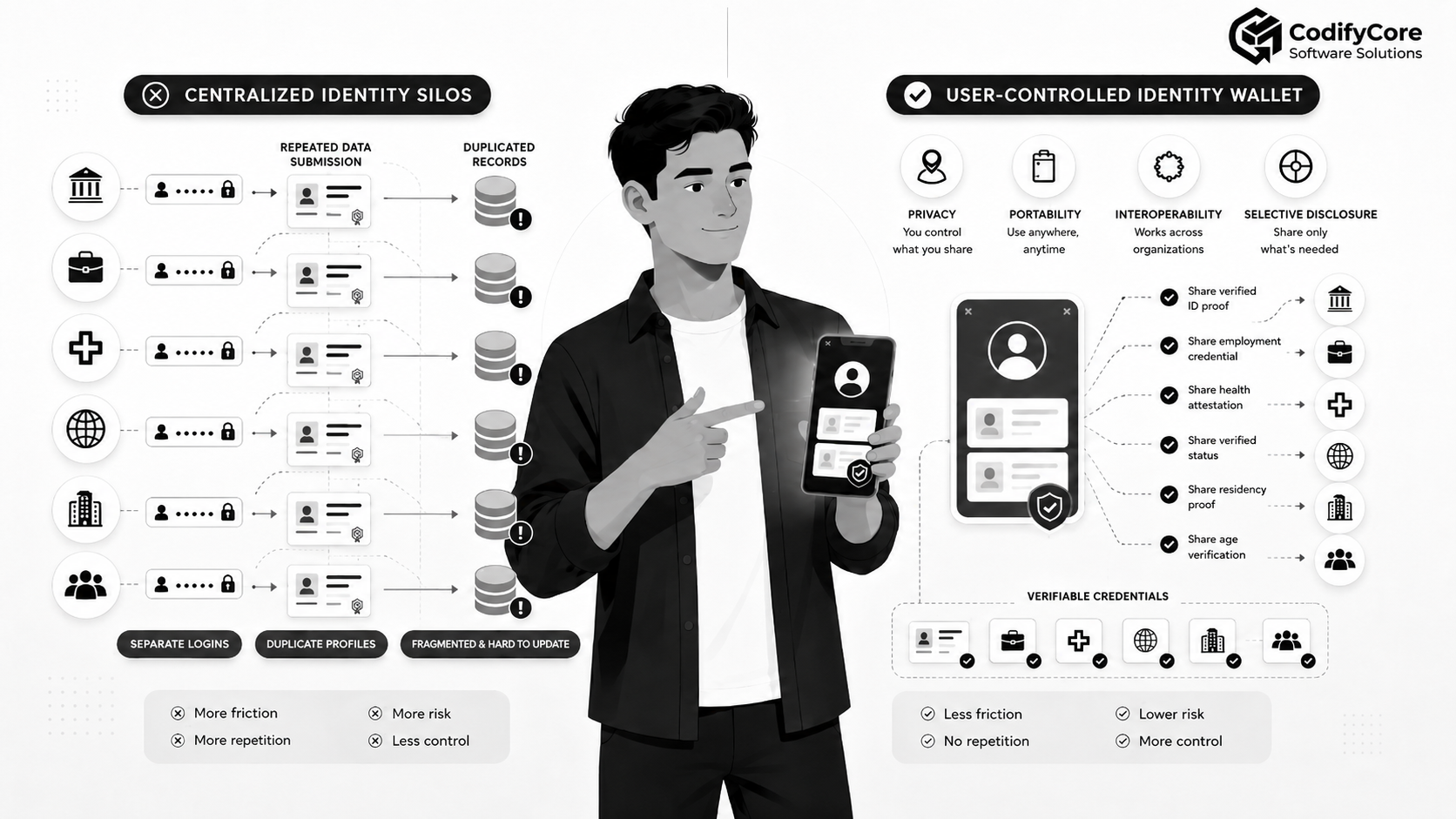
Digital identity has traditionally been built around accounts. A person creates a profile with an organisation, submits information, receives a password and repeats the process elsewhere.
That model works, but it also produces duplicated records, repeated identity checks, disconnected databases and organisations collecting more personal information than they need.
Decentralized Identifiers, or DIDs, and Verifiable Credentials, or VCs, offer a different model. Instead of asking every organisation to recreate and revalidate the same facts, an authorised issuer can provide a digitally signed credential that a holder can later present to another organisation.
The receiving organisation can verify who issued the credential, whether it has been altered, whether it is still valid and, depending on the credential technology, whether the presenter is its legitimate holder.
This does not remove the need for trusted institutions. It changes how their assertions are issued, carried and verified.
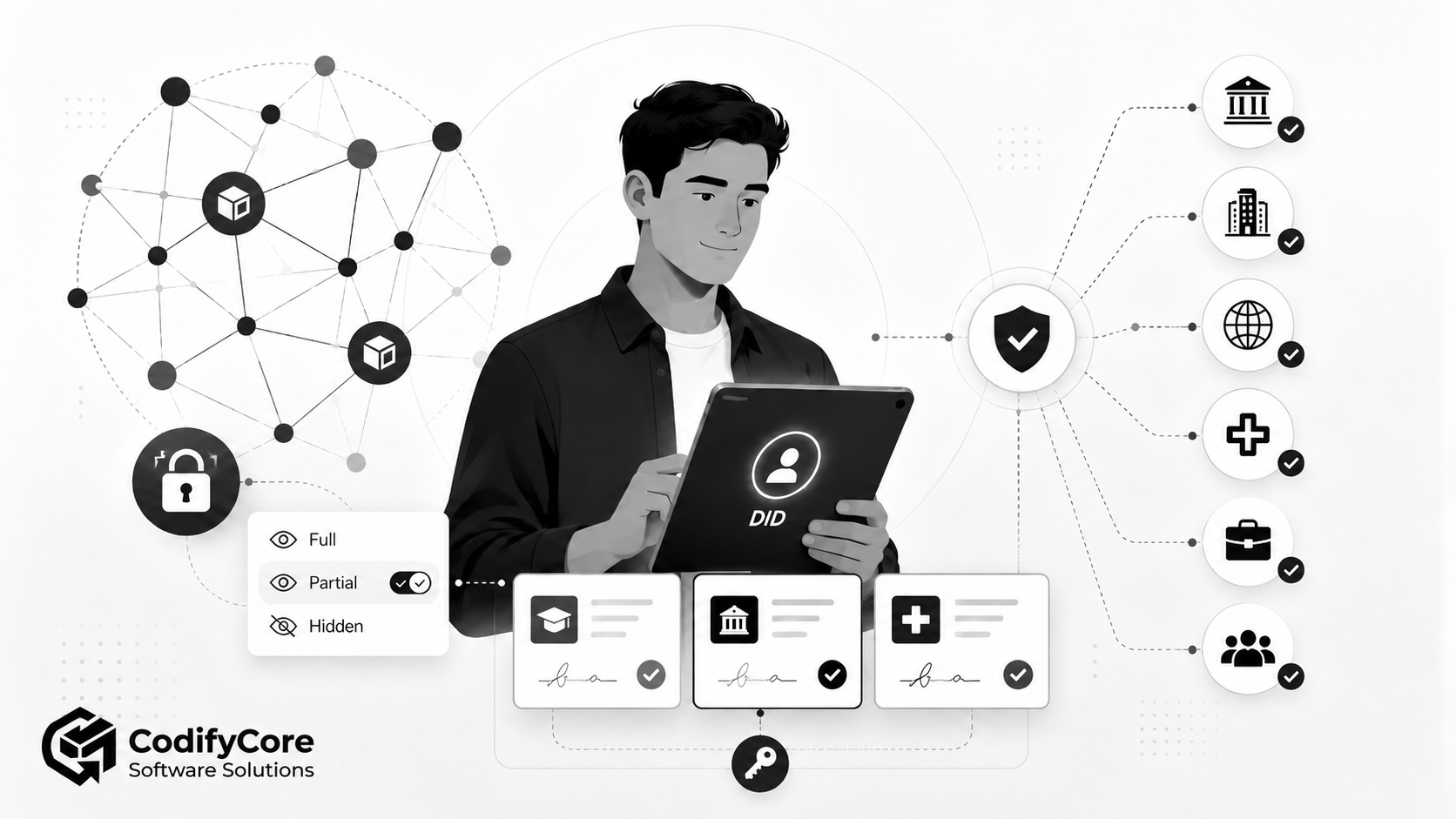
Quick answer: Where do DIDs and verifiable credentials add value?
DIDs and verifiable credentials add the most value when a person, business, product or device needs to reuse trusted information across multiple independent systems.
They can reduce repeated verification, improve credential portability, support privacy-preserving disclosure and make digitally issued records easier to authenticate.
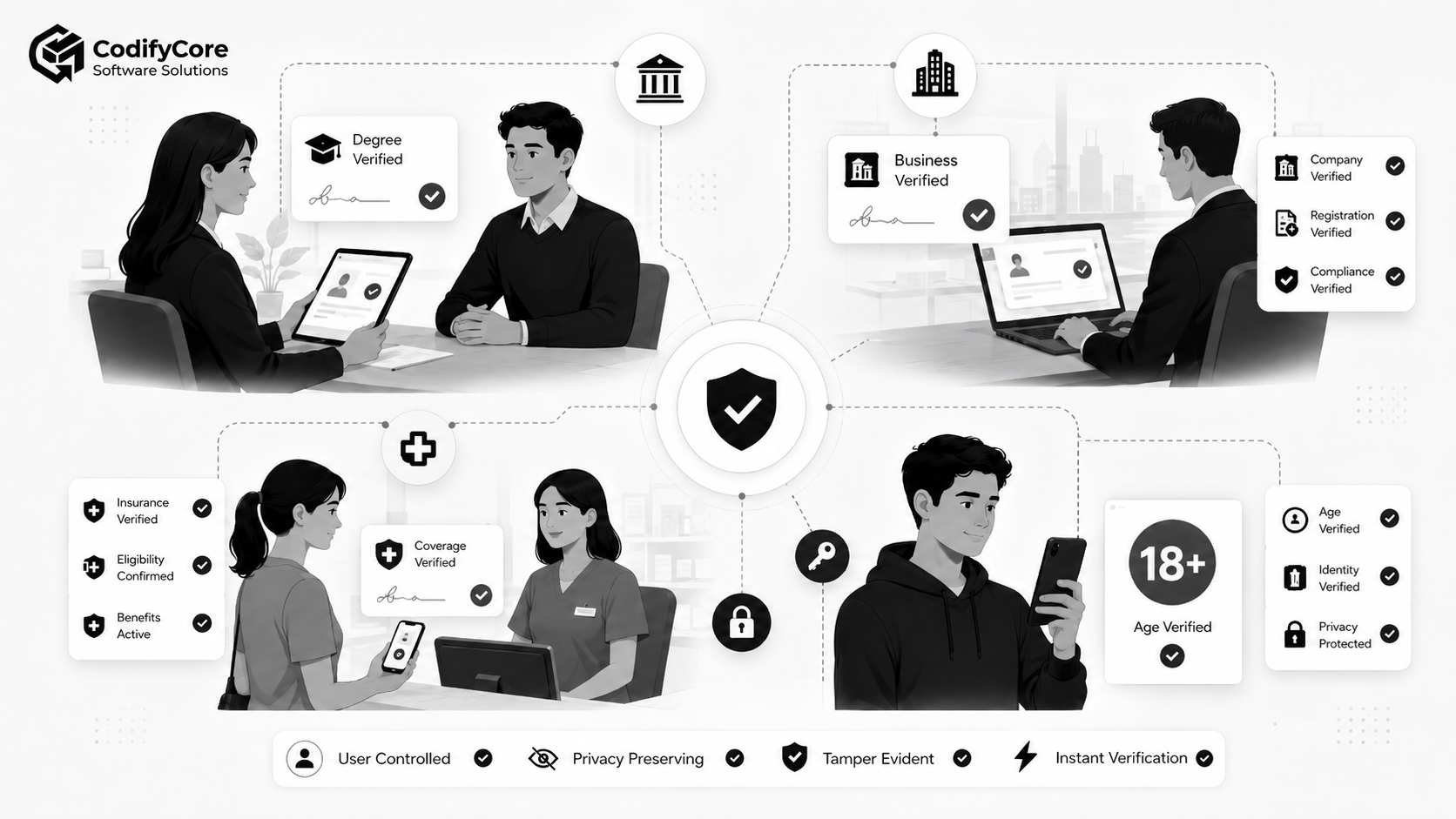
They are particularly relevant to:
- Educational and professional qualifications
- Workforce and contractor onboarding
- Business and supplier verification
- Government-issued documents
- Age and eligibility verification
- Healthcare and benefits administration
- Regulated cross-border services
- Product, component and supply-chain attestations
They are usually unnecessary when a conventional account, database lookup or OpenID Connect flow already solves the problem within a single controlled environment.
Key takeaways
- A DID identifies a person, organisation, device, service or other subject and provides a way to discover the cryptographic material associated with that identifier.
- A verifiable credential contains claims made and digitally secured by an issuer.
- A credential being cryptographically valid does not automatically mean every claim inside it is true. The verifier must still decide whether the issuer is trusted and whether the credential is appropriate for the transaction.
- DIDs and verifiable credentials do not inherently require a blockchain.
- Selective disclosure and unlinkability depend on the credential format and cryptographic design. They are not automatic features of every verifiable credential.
- The difficult part of decentralized identity is usually not generating a digital signature. It is establishing governance, issuer trust, lifecycle management, recovery and interoperable implementation.
What is a Decentralized Identifier?
A Decentralized Identifier is a URI-based identifier designed to support cryptographically verifiable interactions without requiring every interaction to depend on one central identity provider. [1]
A DID commonly looks similar to this:
did:example:123456789abcdefghi
The word following did: identifies the DID method. The rest of the value follows the rules defined by that method.
Resolving a DID can return a DID document containing information such as:
- Public verification keys
- Authentication methods
- Key-agreement methods
- Controllers
- Service endpoints
- Other method-specific metadata
A DID document should not be treated as a public identity profile. Personal information should generally not be published in it. Its main purpose is to provide the technical information needed to establish control and support trusted interactions.
What makes a DID decentralized?
“Decentralized” does not necessarily mean that every DID is written to a public blockchain.
Different DID methods can use different technical foundations. A method may depend on a distributed ledger, an organisation-controlled web domain, a peer-to-peer exchange, a local key relationship or another type of verifiable registry. [6]
The useful question is therefore not:
Does this system use DIDs?
The better questions are:
Who controls the identifier, where is its verification material stored, how is it updated, and what happens when keys are lost or compromised?
What is a Verifiable Credential?
A verifiable credential is a tamper-evident set of claims whose authorship can be cryptographically verified. [2]
A university might issue a credential stating that a person completed a degree. A professional body might issue a licence. A government might issue a driving entitlement. A business registry could issue a credential confirming an organisation’s registration status.
A simplified credential may contain:
{
  "type": ["VerifiableCredential", "UniversityDegreeCredential"],
  "issuer": "did:example:university",
  "validFrom": "2026-06-01T00:00:00Z",
  "credentialSubject": {
    "id": "did:example:graduate",
    "degree": {
      "name": "Bachelor of Science",
      "field": "Computer Science"
    }
  }
}
A real credential also requires an appropriate cryptographic protection mechanism, schema, status strategy and implementation profile.
What does verification prove?
Credential verification may establish that:
- The credential was issued using cryptographic material associated with the stated issuer
- The credential has not been altered
- The credential is within its validity period
- The credential has not been suspended or revoked
- The presentation was created for the intended verifier
- The presenter can demonstrate legitimate possession, where holder binding is used
It does not, by itself, establish that the issuer is competent, honest or legally authorised to make the claim.
A fraudulent organisation can digitally sign a false credential just as easily as a legitimate organisation can sign a true one. Cryptography verifies provenance and integrity. Governance establishes whether that provenance should be trusted. [3]
DID, credential, wallet and presentation: What is the difference?
| Component | Primary function | Simple analogy |
|---|---|---|
| DID | Identifies a subject or controller and connects it to verification methods | A resolvable identifier |
| DID document | Provides keys, controllers or service information associated with a DID | A technical verification record |
| Verifiable credential | Contains signed claims made by an issuer | A digitally signed certificate |
| Digital wallet | Stores credentials and helps the holder manage presentations | A document wallet |
| Verifiable presentation | Packages credential information for a specific verifier or transaction | Showing selected evidence |
| Trust registry | Helps verifiers determine which issuers, schemas or services are recognised | An approved authority directory |
| Status service | Communicates whether credentials are valid, suspended or revoked | A validity register |
DIDs and verifiable credentials are complementary, but they are not inseparable.
A verifiable credential ecosystem can use DIDs for issuers, holders or both. It can also use other recognised identifiers, certificates and trust mechanisms. Adding DIDs should be an architectural decision, not a mandatory branding exercise.
How do DIDs and verifiable credentials work?
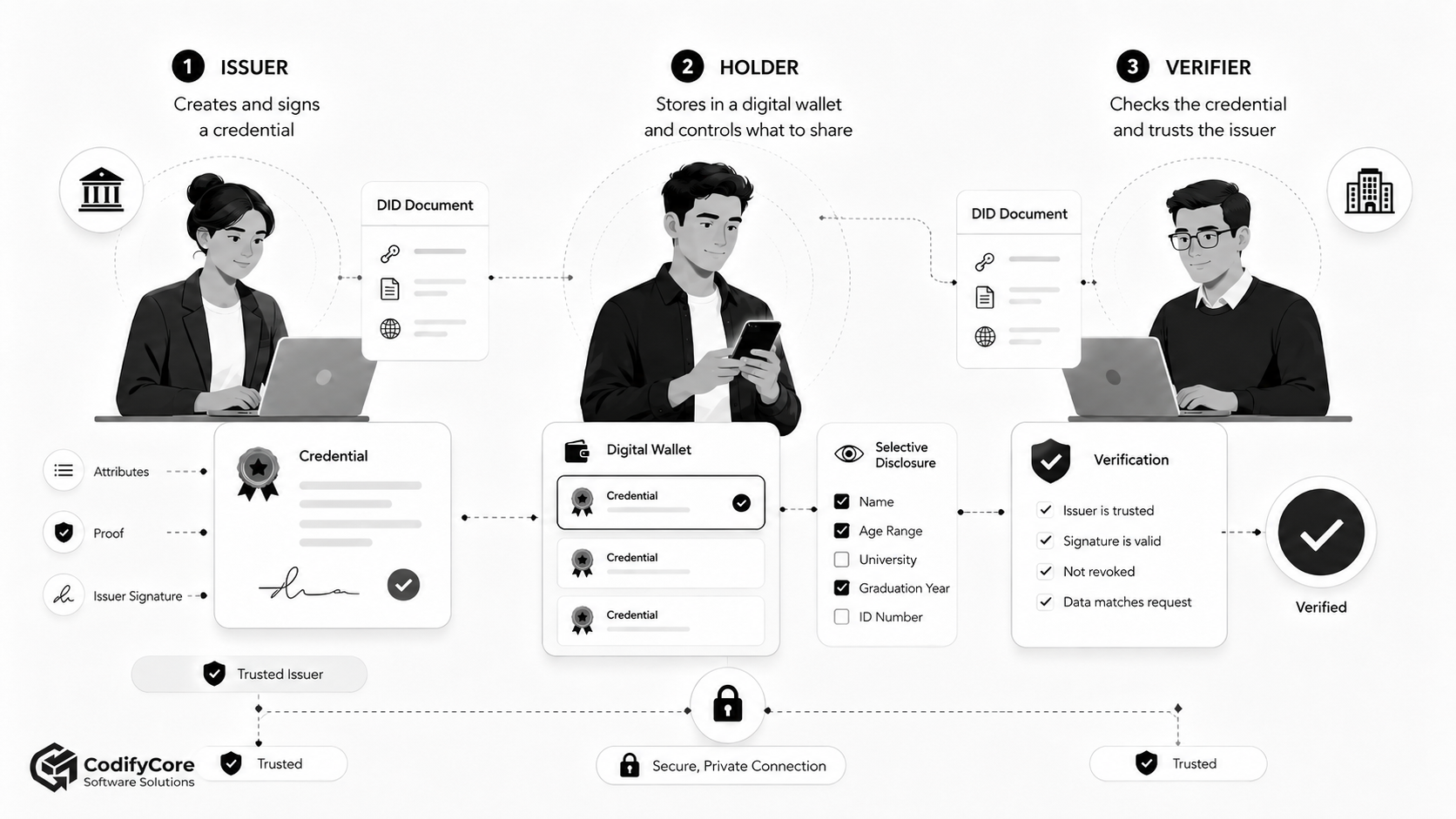
The standard model contains three main roles:
- Issuer: Creates and signs a credential
- Holder: Receives and controls the credential
- Verifier: Requests and evaluates evidence from the credential
Step 1: The issuer verifies information
The issuer first establishes the facts it intends to certify.
A university confirms that a student completed a programme. A government department confirms a licence. A business registry confirms that a company is active.
Verifiable credentials do not replace this underlying verification process. They provide a standardised and machine-verifiable way to package its result.
Step 2: The issuer creates the credential
The issuer creates a credential containing the relevant claims, validity information, issuer identifier, credential type and any required schema or status reference.
The credential is cryptographically secured using an approved proof or signature mechanism.
Step 3: The wallet receives the credential
Modern credential-issuance protocols allow a wallet to request and receive credentials through a protected flow. OpenID for Verifiable Credential Issuance defines an OAuth-based approach to this process and supports multiple credential formats. [4]
The wallet may store the credential on a user’s device, inside a secure hardware-backed environment, within encrypted cloud storage or through a hybrid architecture.
Step 4: A verifier requests evidence
A verifier asks for information required for a particular transaction.
For example:
- Proof that the user is over 18
- Proof of a professional licence
- Proof of employment
- Proof that a business is registered
- Proof that a supplier holds a required certification
A well-designed request asks only for the information necessary to make the decision.
Step 5: The holder reviews the request
The wallet should clearly explain:
- Who is requesting the information
- What information is being requested
- Why it is being requested
- What will be disclosed
- Whether the request can be declined
The holder then approves or rejects the presentation.
Step 6: The wallet creates a presentation
Depending on the format, the presentation may include:
- The complete credential
- Selected claims from one credential
- Claims from multiple credentials
- A derived proof
- A yes-or-no predicate, such as confirmation that an age threshold is satisfied
OpenID for Verifiable Presentations provides a standardised mechanism for requesting and receiving credentials and presentations across wallet and verifier systems. [5]
Step 7: The verifier evaluates the result
The verifier checks more than the digital signature.
A complete verification decision can include:
- Cryptographic integrity
- Issuer authentication
- Credential status
- Validity period
- Credential schema
- Holder binding
- Request binding
- Intended audience
- Replay protection
- Issuer accreditation
- Regulatory or business policy
The final decision is therefore a combination of cryptographic verification and organisational policy.
Do DIDs and verifiable credentials require blockchain?
No.
Blockchain is one possible infrastructure for a DID method or trust registry, but it is not a requirement of either DIDs or verifiable credentials.
A blockchain may be useful when several independent parties need to coordinate updates to a shared registry and no single party should control that registry.
It may add unnecessary complexity when:
- A recognised institution already controls the relevant namespace
- The issuer can publish keys through an authenticated web domain
- Personal or commercially sensitive information could be exposed
- Transaction cost and throughput are important
- A governance authority already provides a trusted registry
- Key rotation and data removal requirements are difficult to reconcile with an immutable ledger
No personal credential should be placed directly on a public blockchain merely because the application uses decentralized identity.
At most, a ledger may contain identifiers, keys, status anchors or integrity references. Even then, the design must be assessed for metadata leakage, correlation and long-term privacy risks.
Where are DIDs and verifiable credentials useful in real applications?
The technology is moving beyond experimental identity demonstrations. Current standards support credential issuance and presentation, while regulated programmes and large-scale pilots are testing wallets across public services, education, travel, payments, mobile driving licences and organisational identity. [4][5][7]
However, deployment maturity varies. Some applications are entering regulated implementation, while others remain pilots, ecosystem programmes or early commercial deployments.
1. Educational and professional qualifications
Education is one of the clearest use cases.
A university can issue a digital diploma to a graduate. The graduate can store it in a wallet and present it to employers, licensing bodies or another educational institution.
The verifier can check:
- Which institution issued the diploma
- Whether the credential was changed
- Whether it remains valid
- Which qualification was awarded
- Whether the credential belongs to the presenter
This can reduce manual certificate checks, document uploads, email exchanges and fraudulent PDF certificates.
European digital identity pilots have already tested digital diploma issuance and recognition of professional qualifications across participating systems. [8]
Why the model adds value: One credential can be reused across many independent employers, universities, regulators and countries.
2. Employment and contractor onboarding
A candidate or contractor may need to prove:
- Identity
- Education
- Professional certification
- Right to work
- Safety training
- Employment history
- Background-screening completion
Today, this information is often submitted separately to recruiters, employers, agencies, clients and workforce-management platforms.
Verifiable credentials can allow trusted organisations to issue reusable evidence. The worker presents only what the next organisation needs, subject to legal and policy requirements.
This does not mean every detail of an employment history should be permanently bundled into one credential. Smaller, purpose-specific credentials generally create better privacy and lifecycle management.
Why the model adds value: The same verified evidence is needed by many employers and intermediaries that do not share a single identity database.
3. Business, supplier and organisational identity
Digital identity is not limited to people.
A business wallet could hold credentials confirming:
- Legal registration
- Tax status
- Industry membership
- Insurance coverage
- Authorised representatives
- Security certification
- Sustainability certification
- Supplier approval
- Regulatory licence
During onboarding, a supplier could present those credentials to a customer, marketplace, financial institution or procurement platform.
The verifier would still need rules specifying which registries and certification bodies it accepts. The technology helps transport and verify the evidence; it does not define the business’s trust policy.
Why the model adds value: Businesses repeatedly provide the same records to customers and platforms across organisational boundaries.
4. Age, residency and eligibility verification
Many services need to know whether a condition is true without needing the user’s complete identity.
Examples include:
- Whether a person is over 18
- Whether a person is a resident of an eligible region
- Whether a customer qualifies for a student discount
- Whether a traveller holds a required entitlement
- Whether a person is eligible for a benefit
Traditional identity checks often expose a full identity document containing the person’s name, exact birth date, photograph, address and identification number.
A privacy-preserving credential can potentially prove the required condition while withholding unrelated attributes.
The EU Digital Identity Wallet programme, for example, presents age verification as an application of selective disclosure: proving an age requirement without disclosing the exact date of birth. [7]
Why the model adds value: The verifier needs confirmation of an attribute, not a permanent copy of the user’s complete identity.
5. Healthcare, insurance and benefits
Potential credentials include:
- Insurance coverage
- Professional medical licences
- Vaccination or test evidence
- Benefit eligibility
- Care-provider authorisation
- Training and facility accreditation
A patient may present proof of coverage to a provider. A clinician may present a professional licence to a hospital. A service provider may prove that it is authorised to process a particular type of referral.
Healthcare requires especially careful handling because credentials can reveal sensitive information even when the underlying claims are not shown. Metadata, credential types and presentation patterns can themselves expose information.
Why the model adds value: Several independent providers, insurers, regulators and patients need to exchange verified information while limiting disclosure.
6. Government documents and cross-border services
Government-issued digital credentials can support:
- Mobile driving licences
- Identity attributes
- Social-security records
- Travel-related documents
- Public-service access
- Electronic signatures
- Professional licences
The European Digital Identity Framework requires Member States to provide wallet capabilities under a harmonised framework, with technical specifications covering exchanges between issuers, wallets and service providers. Its pilots include driving licences, payments, travel, education and other public and private services. [7][11]
Why the model adds value: The credential must be recognised by multiple public and private organisations across jurisdictions.
7. Product, component and supply-chain attestations
DIDs and credentials can also apply to non-human subjects such as organisations, devices, services, products or components.
A credential might assert that:
- A manufacturer produced a component
- A laboratory completed a test
- A certification body approved a material
- An auditor verified a sustainability claim
- A service provider performed maintenance
- An organisation is authorised to update a product record
This can complement Digital Product Passport and traceability systems by separating claims from the systems that consume them.
For example, a product passport may include data from many organisations. Instead of treating every submitted field as equally trustworthy, the platform could retain cryptographic evidence showing which participant issued each important claim.
This model does not make incorrect supply-chain data true. It makes the origin, integrity and status of each assertion easier to evaluate.
Why the model adds value: Many independent actors contribute claims about the same product and those claims may need to remain verifiable outside the original platform.
Where does decentralized identity actually add value?
A useful rule is:
Use portable credentials when trust must cross organisational boundaries. Use conventional identity when the entire relationship remains inside one controlled system.
Strong indicators that verifiable credentials may be appropriate
The case becomes stronger when several of the following conditions exist:
Multiple independent issuers and verifiers
Many universities issue qualifications and many employers verify them. Many certification bodies issue credentials and many customers request them.
No single organisation controls the complete ecosystem.
Repeated presentation of the same evidence
Users or businesses repeatedly submit the same identity records, certificates or compliance documents.
A portable credential could reduce duplication.
Verification must continue outside the original platform
The receiving organisation needs to verify evidence without logging into the issuer’s internal application or receiving a manually processed email.
Privacy requires minimal disclosure
The verifier needs one claim or a derived result rather than the complete source document.
Portability is strategically important
The holder should be able to change wallets, platforms, employers or service providers without asking the original issuer to recreate every credential.
Credentials have a meaningful lifecycle
The organisation can define issuance, expiry, suspension, revocation, renewal and recovery procedures.
A governance framework exists
Participants agree on recognised issuers, schemas, assurance levels, credential formats and verifier obligations.
When are DIDs and verifiable credentials the wrong solution?
One organisation controls everything
If one company owns the account, database, application and decision process, a conventional identity and access-management system will usually be simpler.
The verifier always needs live source data
A credential represents an issuer’s assertion at a particular point or over a defined validity period.
If the verifier must query a constantly changing authoritative record for every transaction, a secured API may be more appropriate.
The credential will only be used once
Portable credentials provide less benefit when there is no realistic reuse.
No one has defined who is trusted
A technically valid credential is not useful if verifiers do not know which issuers they should recognise.
A normal authentication protocol already solves the need
OpenID Connect, SAML and conventional federation remain effective for login and delegated authentication.
Verifiable credentials solve a different problem: portable, holder-mediated evidence.
The organisation cannot support key and credential recovery
Wallet loss, compromised devices, inaccessible keys and revoked credentials are operational realities. A production system needs usable recovery paths.
“Blockchain” is the only business requirement
Technology selection should begin with the trust problem, user journey and governance model—not a predetermined ledger.
Verifiable credentials compared with existing identity models
| Requirement | Local account | Federated identity | Verifiable credential |
| Login to one application | Strong fit | Strong fit | Usually unnecessary |
| Login across partner services | Weak fit | Strong fit | Possible, but not always needed |
| Reusable evidence across unrelated organisations | Weak fit | Limited | Strong fit |
| Holder-mediated disclosure | Limited | Limited | Strong fit |
| Offline or proximity presentation | Limited | Limited | Possible, depending on format |
| Selective disclosure | Usually no | Claim filtering only | Possible, depending on cryptography |
| Issuer contacted during every use | Not applicable | Usually involved | Not always required |
| Governance required | Internal | Federation agreement | Credential ecosystem and trust framework |
| Wallet and recovery complexity | No | Low | Significant |
| Best use | Internal access | Cross-service authentication | Portable trusted evidence |
Decentralized identity is therefore not a replacement for every password, directory, API or identity provider.
In many applications, the best architecture combines them:
- OpenID Connect for login
- APIs for live operational data
- Verifiable credentials for portable evidence
- Existing IAM for permissions and session management
- Trust registries for issuer recognition
What architecture is required for a production system?
A production credential ecosystem usually needs more than an issuer, wallet and verifier.
1. Trust framework
The framework defines:
- Who can issue each credential type
- Which accreditation is required
- Which assurance levels exist
- Which verifiers may request particular data
- What legal responsibilities apply
- How disputes and errors are handled
2. Credential schemas and semantics
Participants must interpret claims consistently.
A field called certified is meaningless unless the ecosystem defines:
- Certified by whom
- Against which standard
- For which scope
- During which validity period
- Under which assessment process
3. Issuance protocol
The issuance process needs:
- Holder authentication
- Authorisation
- Secure credential delivery
- Proof of possession where required
- Protection against replay and interception
- Credential-offer and consent handling
OpenID4VCI provides a standardised foundation for OAuth-protected credential issuance. [4]
4. Presentation protocol
The verifier needs a standard way to describe what it requires and receive a suitable response.
OpenID4VP defines mechanisms for requesting and presenting credentials and supports presentations containing one or more credential formats. [5]
5. Credential status
Some credentials must be suspended or revoked before their stated expiry date.
A status system should allow a verifier to determine whether a credential remains usable while minimising tracking of where and when the holder presents it.
W3C’s Bitstring Status List provides a compact status mechanism designed with privacy and performance considerations. [10]
6. Wallet security and recovery
The wallet architecture must consider:
- Hardware-backed keys
- Device compromise
- Malware
- Backup
- Device replacement
- Lost credentials
- Account recovery
- Biometric or PIN protection
- Multi-device use
- Accessibility
- Delegation and guardianship
“User controlled” should not mean “permanently lost when one phone breaks.”
7. Verifier policy engine
Cryptographic verification produces evidence. The policy engine determines whether the evidence satisfies the transaction.
It may evaluate:
- Recognised issuer
- Required attributes
- Credential type
- Assurance level
- Validity and status
- Jurisdiction
- Presentation freshness
- Holder binding
- Regulatory rules
8. Audit and consent records
Audit logs can be necessary for security and compliance, but excessive logging can undermine privacy by making credential use traceable.
Logs should be purpose-limited, access-controlled and designed to avoid retaining unnecessary credential contents.
Selective disclosure is not automatic
Selective disclosure allows a holder to reveal some claims while withholding others.
For example, a credential may contain:
- Full name
- Date of birth
- Address
- Identification number
- Citizenship
An age-restricted service may need only proof that the holder is over 18.
Not every credential signature supports this safely.
Some approaches disclose individually selected claims. More advanced cryptographic suites can also produce presentations that are difficult to correlate across different verifiers.
BBS-based verifiable credentials, for example, can support selective disclosure and unlinkable proof generation. [9]
However, privacy can still be weakened by:
- A stable holder identifier
- A unique credential number
- Reused signature material
- Highly distinctive claim combinations
- Wallet telemetry
- Verifier cookies
- IP addresses
- Status checks
- Device fingerprinting
- Collusion between ecosystem participants
Selective disclosure must therefore be evaluated as part of the full application, not only at the credential-signature layer.
The most important risks
Verifiability being confused with truth
A credential proves that an issuer made a claim. It does not prove that the issuer investigated the claim properly or that the claim remains accurate.
Over-disclosure
A verifier may request more data than the transaction requires, and users may approve requests they do not understand.
Correlation
Stable identifiers, signatures, schemas or metadata may allow separate presentations to be linked.
Issuer tracking
If every status check contacts the issuer directly, the issuer may learn when and where the holder uses the credential.
Verifier impersonation
A malicious verifier may imitate a trusted service and request sensitive credentials.
Wallet compromise
A stolen or compromised device may expose credentials or private keys.
Weak recovery
Poor recovery mechanisms can permanently exclude legitimate holders. Overly permissive recovery can enable account takeover.
Governance capture
A supposedly decentralised ecosystem can still become dependent on one wallet provider, trust registry, platform owner or certification authority.
Exclusion and accessibility
A wallet-only service may disadvantage people without supported devices, reliable connectivity, accessible interfaces or the documents required for onboarding.
The W3C’s decentralized credential threat model identifies over-disclosure, correlation, issuer tracking, spoofing, recovery failure and exclusion as areas that implementations must address. [3]
A practical implementation roadmap
Phase 1: Define the decision being made
Do not begin by designing a universal identity wallet.
Begin with one decision, such as:
- Is this candidate professionally certified?
- Is this supplier currently approved?
- Is this customer over the required age?
- Did an accredited laboratory issue this test result?
Phase 2: Identify the trust relationships
Document:
- Who issues the evidence
- Why the issuer is trusted
- Who verifies it
- Which holder controls it
- Which authority governs disputes
- Which party can suspend or revoke it
Phase 3: Determine whether portability is needed
Ask whether the same evidence will realistically be presented to multiple independent verifiers.
When the answer is no, a signed API response or conventional database integration may be simpler.
Phase 4: Design the minimum credential
Include only the claims required for the intended use.
Avoid turning a credential into a permanent copy of an organisation’s complete customer record.
Phase 5: Select formats and protocols
Choose:
- Credential data model
- Credential format
- Signature or proof mechanism
- Issuance protocol
- Presentation protocol
- Identifier approach
- Status mechanism
- Holder-binding strategy
Choose a DID method only after understanding its governance, resolution, cost, privacy and recovery characteristics.
Phase 6: Build trust and policy infrastructure
Define issuer accreditation, schemas, assurance levels, verifier requirements and status responsibilities.
This is often more important than the wallet interface.
Phase 7: Threat-model the complete journey
Assess issuance, storage, presentation, verification, revocation, logging and recovery.
Include malicious issuers, malicious verifiers, compromised wallets and honest systems that collect too much data.
Phase 8: Test interoperability
A solution is not interoperable simply because every participant uses JSON, DIDs or the words “verifiable credential.”
Test across:
- Multiple issuers
- Multiple wallets
- Multiple verifiers
- Different devices
- Credential renewal
- Revocation
- Recovery
- Cross-jurisdiction scenarios
- Accessibility conditions
Phase 9: Pilot with measurable outcomes
Useful measures include:
- Time required for verification
- Manual reviews avoided
- Fraudulent documents detected
- Percentage of successful presentations
- User abandonment rate
- Data fields disclosed per transaction
- Support and recovery incidents
- Number of interoperable systems
- Cost per completed verification
Are DIDs necessary for every verifiable credential project?
No.
Use DIDs when they solve a real identifier-control or key-discovery problem.
They can be valuable when:
- The identifier must remain portable
- The controller needs to rotate keys independently
- Different systems must resolve verification material
- The subject is not tied to one platform account
- Several cryptographic relationships must be expressed
They may be unnecessary when:
- An established certificate infrastructure already works
- A trusted domain is the appropriate issuer identifier
- The identifier should remain internal
- A regulated format already specifies another method
- The ecosystem has no need for DID resolution
The objective is trusted interoperability, not maximum decentralisation.
The future of decentralized identity
The most meaningful change is not that every person will own a blockchain identity.
It is that digital services are beginning to separate three functions that were previously bundled together:
- Authentication: Who is interacting with the service?
- Authorisation: What is that party allowed to do?
- Evidence: Which trusted facts can that party prove?
Traditional identity providers are effective at authentication. Access-management systems handle authorisation. Verifiable credentials can provide portable evidence.
As standards mature, these models are likely to coexist.
A customer may log in using a passkey, present an age credential from a wallet, receive service permissions from an IAM platform and share a professional credential issued by an entirely different organisation.
The practical future is therefore not “decentralised identity replaces centralised identity.”
It is a composable identity architecture in which the right trust mechanism is used for each part of the transaction.
Conclusion
DIDs and verifiable credentials create real value when trusted evidence must travel between independent organisations.
They can improve portability, reduce repeated verification, strengthen document integrity and support more privacy-conscious data sharing.
But they do not automatically establish truth, eliminate institutions, guarantee privacy or make governance unnecessary.
A successful implementation requires:
- A clear reusable-credential problem
- Recognised issuers
- Defined verifier policies
- Minimal claim design
- Secure wallets
- Status and recovery mechanisms
- Interoperable protocols
- Privacy threat modelling
- Sustainable governance
The right question is not whether an organisation should “adopt decentralized identity.”
The right question is:
Which facts do our users, partners, products or systems repeatedly need to prove across organisational boundaries—and would portable, cryptographically verifiable evidence make that process safer, faster or more private?
When the answer is clear, DIDs and verifiable credentials can become practical infrastructure rather than another layer of technology hype.
Frequently Asked Questions
What is the difference between a DID and a verifiable credential?
A DID is an identifier that can be associated with cryptographic verification methods. A verifiable credential is a digitally secured set of claims issued about a person, organisation, product, device or another subject.
Do verifiable credentials require DIDs?
No. DIDs are commonly used with verifiable credentials, but credentials can use other identifiers and trust mechanisms.
Do DIDs require blockchain?
No. The infrastructure depends on the selected DID method. Some methods use distributed ledgers, while others use web-based, peer-to-peer or alternative registries.
What does a verifiable credential prove?
It can prove that a credential originated from the stated issuer, has not been altered and satisfies defined validity checks. It does not automatically prove that the issuer’s claims are factually correct.
Can a verifiable credential be revoked?
Yes. Credentials can include status information that allows verifiers to check whether they have been suspended or revoked.
Is selective disclosure available in every credential?
No. Selective disclosure depends on the credential format, signature mechanism and presentation protocol.
Are decentralized identity wallets completely private?
Not automatically. Privacy depends on identifier design, credential contents, signature technology, wallet behaviour, status checking, verifier practices and surrounding web or device tracking.
When should a business use verifiable credentials?
A business should consider them when the same trusted evidence must be reused across multiple independent organisations and when cryptographic integrity, portability or minimal disclosure provides measurable value.
Can verifiable credentials be used for products and companies?
Yes. Credential subjects can include organisations, devices, services, products and other entities—not only individual people.
Will verifiable credentials replace passwords?
Not entirely. They may support authentication in some systems, but passwords, passkeys, OpenID Connect, IAM platforms and verifiable credentials address different requirements and will often be used together.