
Enterprise automation has traditionally been built around workflows.
A process engine calls an API, moves data between systems, waits for an approval and continues along a path that developers designed in advance.
AI agents introduce a different operating model.
A support agent may understand a customer problem but require another agent to investigate an invoice. A procurement agent may need a compliance agent to evaluate supplier documents. An operations agent may need a security agent to approve a remediation plan before an execution agent changes production infrastructure.
These agents may be:
- Developed by different teams
- Written in different programming languages
- Built with different agent frameworks
- Hosted by different cloud providers
- Operated by different companies
- Connected to different tools and data sources
Without a shared protocol, every relationship requires custom integration.
One agent needs to understand another agent’s proprietary endpoint, authentication method, task format, status model, output structure and error behaviour. As the number of agents increases, point-to-point connections become another form of integration sprawl.
The Agent2Agent Protocol, commonly called A2A, addresses this problem.
A2A provides an open interaction model through which independent agents can:
- Advertise their capabilities
- Discover other agents
- Exchange messages
- Delegate tasks
- Report task status
- Request additional input or authorisation
- Stream incremental results
- Return structured outputs
- Coordinate long-running work
A2A does not turn every agent into one shared intelligence.
It creates a standard boundary through which agents can collaborate while keeping their internal models, memory, tools and proprietary logic private.
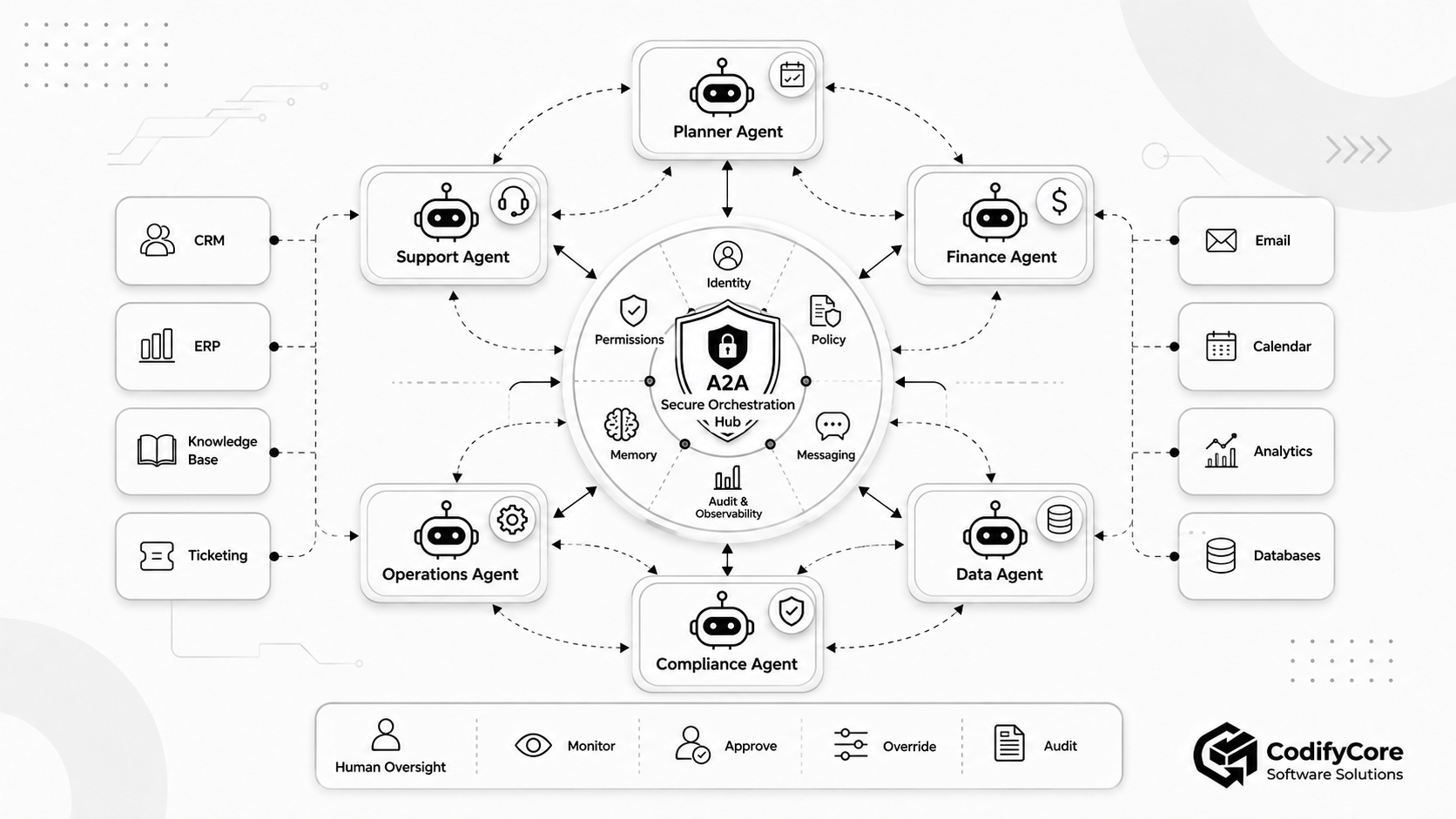
Quick answer: What does A2A mean for enterprise automation?
A2A is an open protocol for communication and collaboration between independent AI agents.
It allows one agent to discover another agent’s capabilities, send it a message or task, follow the task’s progress and receive structured results—even when the agents use different models, frameworks, languages or infrastructure.
A practical A2A interaction looks like this:
- A client agent discovers a remote agent through its Agent Card.
- The client checks the remote agent’s skills, supported interfaces and authentication requirements.
- The client sends a message describing the requested work.
- The remote agent accepts, rejects or requests more information.
- A task is created for work that requires state or multiple steps.
- The remote agent reports progress through task-status updates.
- It may request user input, credentials or approval.
- It returns one or more artifacts as the task output.
- The client agent uses the result or delegates the next part of the workflow.
The core distinction is:
MCP helps an agent use tools and data. A2A helps independent agents work with other agents.
Key takeaways
- A2A standardises agent communication, not internal agent reasoning.
- Agents can remain opaque: they do not have to expose their model, private memory, prompts, tools or proprietary implementation.
- An Agent Card acts as a machine-readable business card describing an agent’s identity, endpoint, skills, interfaces and security requirements.
- The A2A Task is the primary unit for stateful or long-running work.
- Messages are used for communication, clarification and instructions; task outputs should normally be returned as Artifacts.
- A2A supports synchronous responses, streaming updates and asynchronous push notifications.
- A2A and MCP are complementary. An A2A remote agent may internally use MCP to reach APIs, files, databases and other tools.
- Authentication uses existing enterprise mechanisms such as OAuth 2.0, OpenID Connect, bearer tokens, API keys and mutual TLS.
- A2A does not automatically establish that a remote agent is trustworthy, competent or authorised for a particular business decision.
- Every agent must independently enforce permissions before accessing data or performing an action.
- Inter-agent communication increases the risk of privilege propagation, prompt injection, memory contamination and cascading failure.
- Human approval remains essential for financial, destructive, external, legally significant or production-impacting actions.
- The strongest first use cases involve a coordinator agent delegating bounded tasks to a small number of specialised agents.
- A deterministic workflow remains better when the process is predictable and every branch must be tightly controlled.
What is an Agent-to-Agent system?
An Agent-to-Agent system is a distributed software architecture in which two or more autonomous or semi-autonomous agents communicate, delegate work and coordinate outcomes.
Each agent may have its own:
- Model
- Instructions
- Memory
- Domain knowledge
- Tools
- Permissions
- Policies
- Execution environment
- Operator
- Lifecycle
For example, an enterprise may have:
- A customer-support agent
- A billing agent
- A fraud agent
- A compliance agent
- A scheduling agent
- A document-analysis agent
A customer-support agent should not need to reproduce every capability itself.
It may ask the billing agent to investigate a charge, the compliance agent to determine which disclosure rules apply and the scheduling agent to arrange a call.
The agents collaborate while preserving separate ownership and responsibilities.
A2A systems versus multi-agent systems
The terms are related but not identical.
A multi-agent system can be implemented entirely inside one application using one framework and proprietary communication.
An A2A system uses a standard protocol boundary so independently implemented agents can communicate.
| Architecture | Description |
|---|---|
| Single agent | One agent reasons and uses tools |
| Framework-native multi-agent system | Several agents communicate inside the same framework |
| Proprietary remote agents | Independent agents communicate through custom APIs |
| A2A system | Independent agents communicate using a shared open protocol |
A2A is most valuable when agents cross framework, team, cloud, vendor or organisational boundaries.
Why APIs alone are not enough
An ordinary API exposes predefined data or operations.
For example:
GET /customers/{id}
POST /refunds
GET /supplier-certificates
An agent represents a higher-level, stateful capability.
A compliance agent may:
- Interpret an ambiguous request
- Select several evidence sources
- Ask for missing documentation
- Apply jurisdiction-specific rules
- Coordinate human review
- Produce a structured assessment
Exposing that agent as a collection of low-level endpoints can hide the fact that it performs long-running, conversational and adaptive work.
A2A adds concepts that ordinary API designs do not consistently standardise:
- Agent capability discovery
- Agent skills
- Multi-turn communication
- Task lifecycle
- Input-required states
- Authorisation-required states
- Incremental artifacts
- Streaming progress
- Agent-to-agent delegation
- Negotiation of supported content types
The underlying systems still use APIs.
A2A provides the interaction model around the higher-level agent capability.
What A2A standardises
A2A focuses on the communication boundary between a client agent and a remote agent.
It standardises:
- Discovery metadata
- Supported agent skills
- Protocol interfaces
- Messages
- Tasks
- Task status
- Output artifacts
- Streaming events
- Push notifications
- Version negotiation
- Authentication declarations
- Error behaviour
- Extensions
It deliberately does not require the agents to share:
- Internal prompts
- Chain of thought
- Model weights
- Private memory
- Internal tools
- Planning algorithms
- Proprietary business logic
This opacity allows an organisation to expose the outcome-oriented capability of an agent without publishing its complete implementation.
The core roles in an A2A interaction
User
The user, system or business event initiates a goal.
Examples include:
- Resolve this customer issue.
- Evaluate these supplier bids.
- Investigate this failed deployment.
- Prepare a regulatory evidence package.
- Schedule interviews for the shortlisted applicants.
A2A client
The A2A client represents the component communicating with a remote agent.
It may be:
- A coordinator agent
- Another specialist agent
- An enterprise application
- An orchestration platform
- A user-facing assistant
The client discovers the remote agent, sends requests and processes task updates or results.
A2A server or remote agent
The A2A server exposes an agent through one or more protocol interfaces.
It:
- Publishes its capabilities
- Authenticates clients
- Authorises requests
- Receives messages
- Creates and manages tasks
- Produces artifacts
- Reports progress
A2A client and server describe protocol roles. An agent can act as a client in one interaction and a server in another.
A2A enterprise architecture
A production A2A platform needs more than a collection of agents connected by arrows.
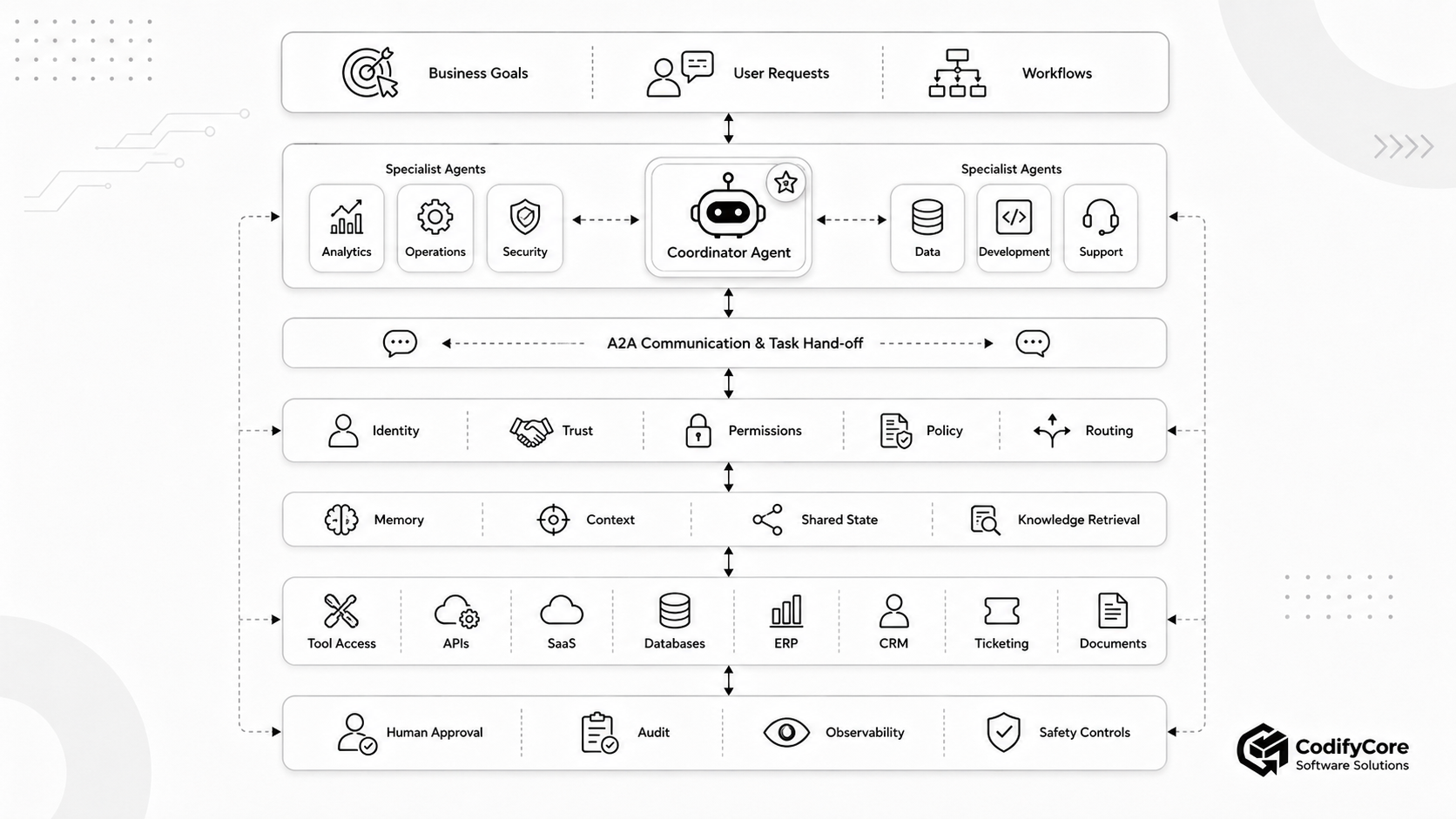
1. Business and experience layer
This receives:
- User requests
- Business events
- Scheduled triggers
- Workflow tasks
- Application requests
- Partner requests
It identifies the outcome that the system should achieve.
2. Coordinator or routing layer
The coordinator determines:
- Whether another agent is needed
- Which agent has the relevant capability
- Which task should be delegated
- Which information should be shared
- Whether several agents can work in parallel
- How results should be combined
The coordinator should not automatically have permission to perform everything that its specialist agents can do.
3. Specialist-agent layer
Specialist agents may cover:
- Finance
- Compliance
- Support
- Data analysis
- Operations
- Security
- Procurement
- Human resources
- Software development
Each should expose a bounded domain capability rather than a vague universal service.
4. A2A communication layer
This handles:
- Agent Cards
- Messages
- Tasks
- Artifacts
- Status updates
- Streaming
- Push notifications
- Version negotiation
- Protocol extensions
5. Identity, trust and policy layer
This determines:
- Which agent is calling
- Which organisation operates it
- Which user it represents
- Which skill it may invoke
- Which tenant owns the task
- Which data it may receive
- Which actions are permitted
6. Context and state layer
This may contain:
- Task state
- Conversation context
- Shared references
- Correlation identifiers
- Approved summaries
- Artifacts
- Workflow checkpoints
Agents should exchange the minimum context required for the delegated task.
7. Tool and enterprise-system layer
Specialist agents may use:
- APIs
- MCP servers
- Databases
- CRM
- ERP
- Ticketing systems
- Document stores
- SaaS platforms
- Workflow engines
- Code-execution environments
8. Oversight and operations layer
This includes:
- Human approval
- Audit
- Observability
- Evaluation
- Incident response
- Rate limiting
- Safety controls
- Cost management
How agent discovery works
Before one agent can delegate work, it must know what the remote agent offers.
A2A standardises this through the Agent Card.
What is an Agent Card?
An Agent Card is a JSON document describing an A2A server.
It may include:
- Agent name
- Description
- Provider
- Version
- Supported interfaces
- Service endpoint
- Authentication requirements
- Capabilities
- Skills
- Supported input modes
- Supported output modes
- Examples
- Extensions
A client uses this information to decide whether the agent is suitable.
A simplified example may look like:
{
  "name": "Supplier Compliance Agent",
  "description": "Evaluates supplier evidence against approved policies.",
  "version": "1.0.0",
  "skills": [
    {
      "id": "supplier-assessment",
      "name": "Supplier Assessment",
      "description": "Reviews supplier compliance evidence."
    }
  ],
  "supportedInterfaces": [
    {
      "url": "https://agents.example.com/compliance",
      "protocolBinding": "HTTP+JSON"
    }
  ]
}
Discovery through a well-known URL
A public or domain-discoverable agent can expose its card at:
https://agent.example.com/.well-known/agent-card.json
Curated registries
Enterprises may use controlled registries where agents are:
- Approved
- Categorised
- Searchable by skill
- Assigned trust levels
- Bound to owners
- Subject to lifecycle controls
The current A2A specification standardises the Agent Card but does not prescribe one universal registry API.
Direct configuration
Private or tightly controlled systems may configure approved Agent Card URLs directly.
This is simpler but less dynamic.
Protecting sensitive capabilities
A public Agent Card should not expose:
- Internal service addresses
- Privileged skills
- Security-sensitive workflows
- Credentials
- Confidential implementation details
A2A supports authenticated extended Agent Cards so additional capabilities can be disclosed only after the client is authenticated.
Agent Cards may also be digitally signed so clients can check their authenticity and integrity.
Messages, Tasks, Parts and Artifacts
These are the central A2A interaction objects.
Message
A Message is one communication unit between the client and the remote agent.
Messages can:
- Start an interaction
- Provide instructions
- Ask for clarification
- Supply additional information
- Report progress
- Request user input
Part
A Part contains one piece of message or artifact content.
It can represent content such as:
- Text
- Structured data
- File references
- Binary data
- Media
- Extension-defined content
This allows agents to exchange more than plain conversational text.
Task
A Task is the primary unit of stateful work.
It includes:
- Task ID
- Context ID
- Current status
- Artifacts
- Message history
- Metadata
Tasks are particularly useful when work:
- Takes several steps
- Requires progress updates
- Needs additional input
- Produces incremental results
- May be paused or resumed
- Requires later retrieval
Artifact
An Artifact represents an output produced by a task.
Examples include:
- A report
- A spreadsheet
- A compliance assessment
- A remediation plan
- A generated document
- Structured data
- An image
- A code patch
A2A distinguishes communication from output:
Messages coordinate the work. Artifacts contain the results.
The A2A task lifecycle
A task can move through states such as:
| State | Meaning |
|---|---|
| Submitted | The task was received and acknowledged |
| Working | The remote agent is processing it |
| Input required | More information is needed |
| Authentication required | Credentials or human authorisation are required |
| Completed | The task finished successfully |
| Failed | The task ended with an error |
| Rejected | The agent declined to perform it |
| Canceled | The task was canceled |
The interrupted states are especially important.
An agent should not invent missing information or bypass authorisation merely to continue.
It can explicitly tell the client:
- I need the supplier certificate.
- I need the user to authenticate.
- I need a manager to approve this payment.
- I cannot perform this task under the current policy.
How a complete A2A workflow operates
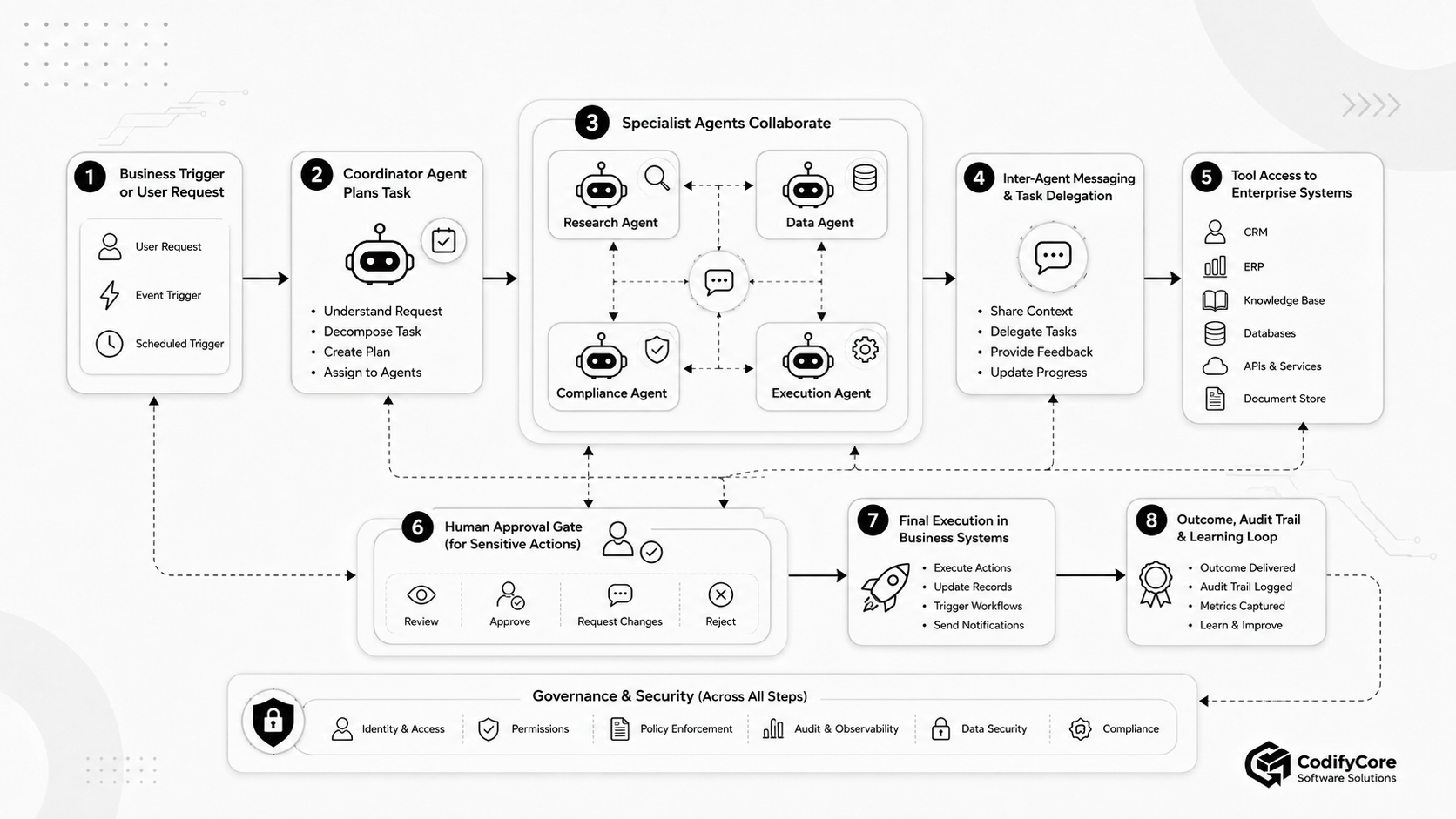
Step 1: A business goal is received
A user or system requests an outcome:
Investigate the delayed shipment, determine whether compensation is due and notify the customer.
Step 2: The coordinator creates a plan
The coordinator may determine that it needs:
- A logistics agent
- A customer-policy agent
- A finance agent
- A communication agent
Step 3: Relevant agents are discovered
The coordinator examines approved Agent Cards and selects agents with suitable skills and security requirements.
Step 4: The first task is delegated
The logistics agent receives:
- Shipment identifier
- Permitted purpose
- Relevant customer context
- Required output format
- Deadline
- Correlation ID
It should not receive unrelated customer or financial information.
Step 5: The logistics agent uses its tools
The remote agent may internally use:
- Carrier APIs
- ERP
- Warehouse data
- Tracking systems
- MCP tools
It returns a structured artifact stating that the shipment was delayed by 48 hours.
Step 6: Another specialist evaluates policy
The customer-policy agent determines:
- Which service commitment applied
- Whether compensation is permitted
- Maximum authorised amount
- Whether approval is required
Step 7: Finance prepares the transaction
The finance agent prepares, but does not yet execute, a proposed account credit.
Step 8: Human approval is requested
Because the action affects customer funds, the task moves to an authorisation-required state.
A reviewer sees:
- Customer
- Order
- Delay evidence
- Policy basis
- Proposed credit
- Systems affected
Step 9: The approved action is executed
The finance agent applies the credit using a narrowly scoped, time-limited permission.
Step 10: Communication is generated
The communication agent drafts or sends the approved customer message according to policy.
Step 11: The outcome is audited
The system records:
- Agent identities
- Tasks
- Artifacts
- Policy decisions
- Approval
- Tool calls
- Final business outcome
Synchronous, streaming and asynchronous interactions
Not every agent task completes immediately.
Direct response
A remote agent may return a Message directly when the request is simple and no task state is needed.
Example:
Which formats do you support?
Standard task response
The agent can acknowledge a task and return the result after processing.
Streaming
A2A supports incremental updates for tasks such as:
- Generating a long report
- Processing a large dataset
- Investigating an incident
- Creating several output artifacts
- Conducting a multi-step analysis
Streaming can deliver:
- Task-state changes
- Progress messages
- Partial artifacts
- Final artifacts
Push notifications
For tasks lasting minutes, hours or days, the client does not need to keep one connection open.
A remote agent can send updates to a registered webhook.
Webhook receivers must validate the source and process duplicate notifications idempotently.
A2A versus MCP
A2A and Model Context Protocol solve different integration problems.
| Area | A2A | MCP |
|---|---|---|
| Primary relationship | Agent to agent | Agent or model to tool/resource |
| Main purpose | Collaboration and delegation | Tool and context access |
| Capability unit | Agent skill | Tool, resource or prompt |
| Stateful work | Task lifecycle | Usually host-managed |
| Discovery | Agent Card | MCP capability discovery |
| Long-running work | Tasks, streaming and push | Depends on server and host |
| Internal implementation | Agent remains opaque | Tool interface is exposed |
| Example | Ask compliance agent to assess a supplier | Use database tool to retrieve supplier evidence |
A common enterprise architecture uses both:
Coordinator Agent
        ↓ A2A
Compliance Agent
        ↓ MCP
Policy documents + supplier database + verification API
A2A delegates a business task to another agent.
MCP helps that specialist agent use the resources required to complete it.
A2A versus ordinary microservices
A remote agent should not be used merely to wrap a deterministic function.
Use a conventional service when:
- Inputs and outputs are fully defined
- Behaviour is deterministic
- The operation should be fast
- No interpretation is required
- No multi-turn interaction is needed
Use an agent when:
- Requests may be ambiguous
- The process requires judgement
- Several tools may be selected dynamically
- Missing information may need to be requested
- The workflow changes based on intermediate results
- The output requires interpretation or synthesis
A2A complements service architecture; it does not replace every API.
A2A versus workflow orchestration
Workflow engines provide:
- Durable state
- Timers
- Retries
- Scheduling
- Compensation
- Human tasks
- Deterministic transitions
- Operational guarantees
A2A provides an agent communication model.
For important enterprise processes, use a workflow engine as the durable outer control plane and allow agents to operate within bounded steps.
For example:
Workflow engine
    ↓
Coordinator agent
    ↓ A2A
Specialist agents
    ↓
Approval
    ↓
Workflow engine commits next state
Do not rely on natural-language conversation history as the only record of a critical business process.
Enterprise use cases
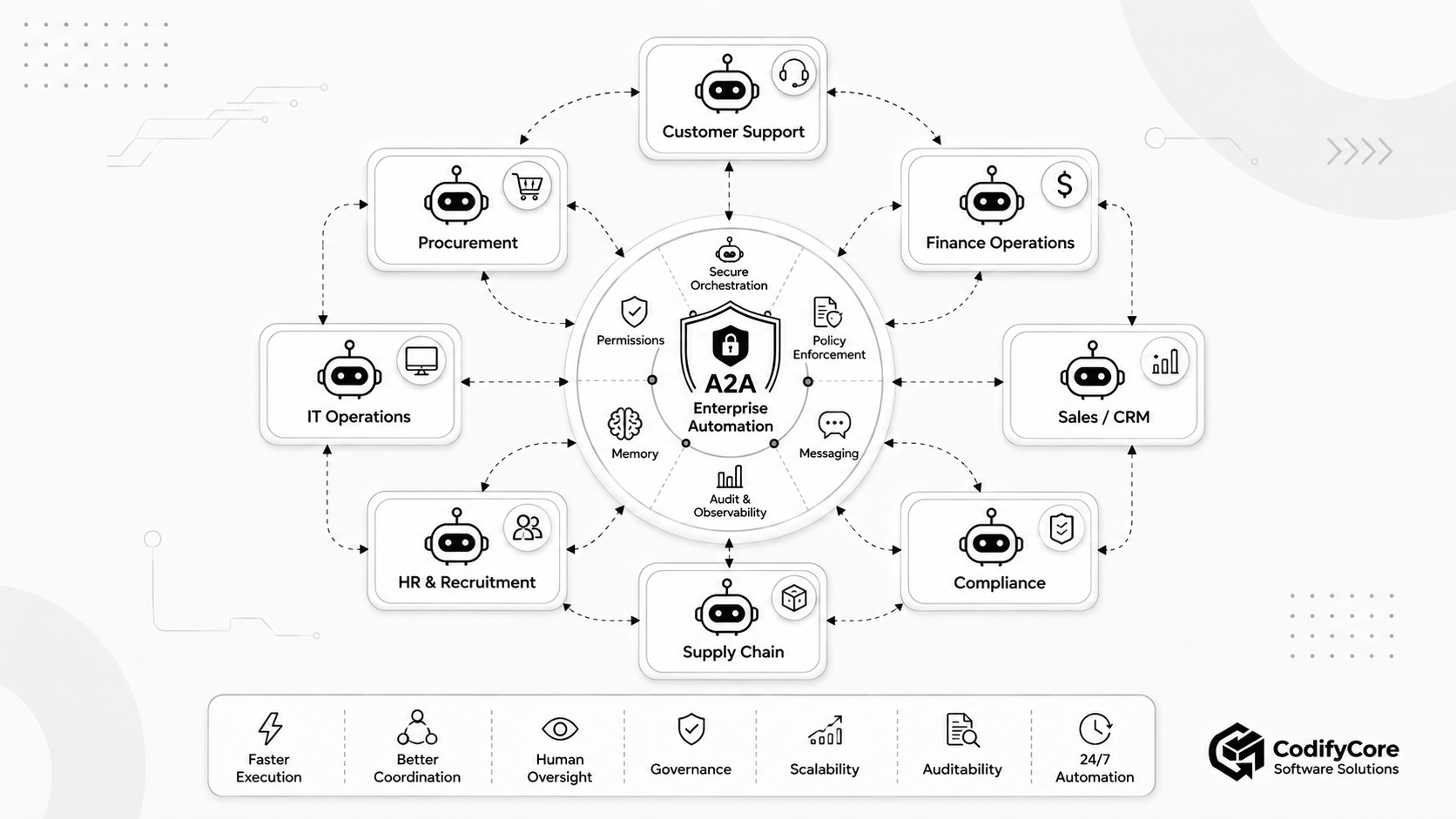
1. Customer support
A support agent can collaborate with:
- Billing agent
- Order agent
- Product-support agent
- Logistics agent
- Customer-policy agent
It can investigate a complete issue without gaining unrestricted access to every underlying system.
2. Procurement
A procurement agent may delegate:
- Market analysis to a research agent
- Supplier validation to a compliance agent
- Cost comparison to a finance agent
- Contract review to a legal agent
- Supply risk analysis to a logistics agent
The final supplier decision should remain governed by deterministic rules and human authority.
3. Finance operations
Agents can coordinate:
- Invoice matching
- Expense review
- Credit assessment
- Payment preparation
- Exception analysis
- Financial reporting
Payments, write-offs and policy exceptions should normally require approval.
4. IT operations
A coordinator agent can ask:
- Monitoring agent to identify the incident
- Security agent to evaluate exposure
- Configuration agent to identify recent changes
- Remediation agent to prepare a fix
- Communication agent to update stakeholders
Production changes can pause at a human approval gate.
5. Sales and CRM
A sales agent may coordinate:
- Account research
- Opportunity analysis
- Pricing
- Product configuration
- Legal review
- Meeting scheduling
- Proposal preparation
Each domain agent can remain owned by the team responsible for that capability.
6. Human resources and recruitment
A recruitment agent may work with:
- Candidate-screening agent
- Scheduling agent
- Assessment agent
- Compliance agent
- Offer-preparation agent
- Onboarding agent
Candidate rejection, employment decisions and offers should retain appropriate human oversight.
7. Compliance
A compliance agent may collect evidence from:
- Policy agent
- Product-data agent
- Supplier agent
- Document-verification agent
- Audit agent
It can produce an assessment artifact without receiving unrestricted authority to approve legal compliance.
8. Supply chain
Agent collaboration can support:
- Supplier disruption analysis
- Inventory optimisation
- Logistics planning
- Quality investigation
- Carbon-data collection
- Product-passport preparation
- Recall coordination
Why enterprises may benefit from specialised agents
Clearer domain ownership
A finance agent can be governed by finance.
A compliance agent can be governed by compliance.
The coordinator consumes their capabilities without owning their internal policy or tools.
Framework independence
Teams can select different:
- Models
- Languages
- Frameworks
- Cloud platforms
- Deployment approaches
The protocol standardises the interaction boundary.
Reduced duplication
Each application does not need to recreate:
- Supplier assessment
- Fraud analysis
- Pricing analysis
- Document validation
- Scheduling
Those abilities can be exposed as reusable agent services.
Independent evolution
A specialist agent can improve its model, instructions and tools without requiring every client to understand its internal changes, provided its external contract remains compatible.
Organisational boundaries
A company may collaborate with:
- Supplier agents
- Logistics agents
- Insurance agents
- Regulatory agents
- Technology-provider agents
without granting them direct access to internal memory or infrastructure.
What A2A does not solve
It does not guarantee agent quality
An agent can be protocol-compliant and still produce:
- Incorrect conclusions
- Poor reasoning
- Incomplete results
- Unsafe recommendations
- Hallucinated evidence
It does not establish trust automatically
An Agent Card describes what an agent claims it can do.
The enterprise must still determine:
- Who operates it
- Whether the provider is approved
- Which assurance process applies
- Which data it may receive
- How it has been tested
- Which liabilities apply
It does not create a universal ontology
Two agents may use the word “customer,” “account” or “approved” differently.
Shared business semantics remain necessary.
It does not provide enterprise governance by itself
A2A defines communication mechanisms.
Organisations still need:
- Agent inventory
- Ownership
- Risk classification
- Access policy
- Lifecycle management
- Evaluation
- Incident response
- Cost controls
It does not eliminate integration
A specialist agent must still integrate correctly with:
- Databases
- APIs
- Business rules
- Identity systems
- Workflows
- Documents
It does not make autonomous execution safe
An agent should not be allowed to perform every action merely because another agent requested it.
Security risks in A2A systems
A multi-agent architecture creates new trust paths.
Agent impersonation
An attacker may publish a malicious Agent Card or imitate a trusted agent endpoint.
Controls include:
- HTTPS
- Certificate validation
- Signed Agent Cards
- Approved registries
- Provider allowlists
- Mutual TLS where appropriate
Excessive delegation
A coordinator may delegate work that it was not authorised to perform itself.
Delegation must not expand authority.
The remote agent should verify:
- Caller identity
- User identity where applicable
- Tenant
- Requested skill
- Resource scope
- Purpose
- Required approval
Confused-deputy attacks
A remote agent may have powerful credentials and accidentally use them on behalf of an unauthorised caller.
Do not assume that a trusted agent is authorised for every action.
Prompt injection propagation
One agent may retrieve malicious content and pass it to another agent.
The second agent may interpret the content as an instruction rather than data.
Every agent should treat incoming messages, artifacts and retrieved content as untrusted.
Context poisoning
Incorrect information supplied by one agent may contaminate the task state or another agent’s memory.
Record provenance and distinguish:
- User instruction
- Agent hypothesis
- Verified fact
- Tool result
- Policy decision
- Human approval
Privilege chaining
Several low-risk actions may combine into a high-risk outcome.
For example:
Research agent finds employee
→ identity agent finds account
→ support agent resets email
→ access agent changes credentials
The complete chain must be evaluated, not only each call in isolation.
Cascading failure
One incorrect artifact can trigger several downstream decisions.
Use:
- Validation
- Checkpoints
- Confidence thresholds
- Independent verification
- Human approval
- Compensation
Data leakage
Messages and artifacts may contain:
- Personal data
- Credentials
- Documents
- Commercial information
- Source code
- Internal policy
Share only the minimum context required.
Denial of service and cost amplification
Agents may:
- Delegate recursively
- Retry indefinitely
- Generate excessive tasks
- Exchange large artifacts
- Create tool loops
- Consume large model budgets
Enforce:
- Hop limits
- Task quotas
- Timeouts
- Budget limits
- Maximum artifact sizes
- Recursion controls
Rogue or compromised agents
An approved agent may become compromised or change behaviour.
Enterprises need:
- Revocation
- Version pinning
- Continuous evaluation
- Behaviour monitoring
- Emergency isolation
- Registry updates
Authentication and authorisation
A2A uses familiar enterprise security mechanisms.
Agent Cards can declare schemes such as:
- API keys
- HTTP bearer authentication
- OAuth 2.0
- OpenID Connect
- Mutual TLS
The protocol itself does not place user identity directly inside every message payload.
Identity is normally established through the transport and authentication layer.
Every request must be authorised
The remote agent should authorise:
- Task creation
- Task retrieval
- Task listing
- Cancellation
- Subscription
- Artifact access
- Skill invocation
- Underlying business actions
In-task authorisation
A task may begin successfully but later require additional authority.
For example, an agent can investigate an account using read access but require separate authorisation before issuing a refund.
The task can enter an authentication-required state while the client obtains:
- User approval
- OAuth consent
- Additional credentials
- A privileged review decision
The task can then resume.
Multi-tenancy
A2A deployments must preserve tenant boundaries across:
- Agent discovery
- Tasks
- Context IDs
- Artifacts
- Message history
- Logs
- Push notifications
- Cached Agent Cards
- Downstream tools
Never rely on a tenant identifier supplied by the model as the sole enforcement mechanism.
Tenant scope should come from authenticated identity and trusted routing context.
Human oversight
A2A can coordinate autonomous agents, but enterprise automation still requires clear human boundaries.
Require approval for:
- Financial transfers
- Refunds
- Account suspension
- External communications
- Production deployments
- Security-policy changes
- Contract commitments
- Hiring decisions
- Regulatory submissions
- Destructive operations
- High-volume updates
Approval should be bound to the exact:
- Action
- Agent
- Target
- Amount
- Arguments
- Environment
- Expiry
- Task
- Policy version
The system should revalidate the current state before execution after an approval delay.
Observability for multi-agent workflows
An A2A transaction can cross:
- Several agents
- Several organisations
- Several models
- Several tools
- Several clouds
- Several hours or days
Observability must follow the complete workflow.
Record:
- User request ID
- Parent workflow ID
- Task ID
- Context ID
- Client-agent identity
- Remote-agent identity
- Agent Card version
- Model version where available
- Skill
- Policy decisions
- Messages
- Artifact metadata
- Tool calls
- Approval
- Errors
- Latency
- Cost
- Final outcome
A2A guidance recommends distributed tracing, comprehensive task logging, operational metrics and auditing of important state changes.
OpenTelemetry can propagate trace context across the HTTP interactions, but the enterprise must preserve correlation when an agent creates new tasks or calls tools internally.
Agent registries and governance
An enterprise agent registry should contain more than Agent Cards.
Useful metadata includes:
- Agent owner
- Provider
- Approved environments
- Business domain
- Skills
- Data classification
- Allowed tenants
- Risk rating
- Authentication scheme
- Required scopes
- Evaluation status
- Model dependencies
- Version
- Support contact
- Incident history
- Approval requirements
- Retirement date
Agent lifecycle
Govern:
- Registration
- Security review
- Evaluation
- Approval
- Deployment
- Monitoring
- Version change
- Suspension
- Revocation
- Retirement
A discoverable agent should not automatically become an approved agent.
Choosing an orchestration topology
Central coordinator
One coordinator delegates tasks to specialist agents.
Advantages:
- Clear control
- Easier auditing
- Central policy enforcement
- Simpler user experience
Risks:
- Bottleneck
- Single point of failure
- Coordinator receives broad context
- Excessive central authority
Hierarchical orchestration
A coordinator delegates to domain coordinators, which delegate to specialists.
Useful for large organisations.
The main risks are excessive delegation depth and unclear accountability.
Peer-to-peer mesh
Agents discover and contact one another directly.
This can increase flexibility but makes:
- Policy enforcement
- Cost control
- Traceability
- Loop prevention
- Incident containment
more difficult.
Deterministic graph with A2A steps
A workflow engine controls the structure, while A2A agents perform selected tasks.
This is often the safest enterprise starting point.
When A2A is a strong fit
Consider A2A when:
- Agents are built with different frameworks
- Agents are owned by different teams
- Agents run in different clouds
- A capability must be reused by several assistants
- Work crosses organisational boundaries
- Tasks are stateful or long-running
- Agents need clarification or additional authorisation
- Outputs include structured artifacts
- Vendor independence is important
- The enterprise expects a growing agent ecosystem
When A2A may be unnecessary
A2A may add little value when:
- One application contains all agents
- The framework already provides sufficient internal orchestration
- The process uses only one agent
- A deterministic API solves the requirement
- The operation is low-latency and stateless
- Agents will never be reused externally
- The organisation cannot govern distributed agent authority
- A normal workflow is safer and simpler
Do not turn every internal model call into a networked agent service.
A practical implementation roadmap
Phase 1: Choose one cross-agent business outcome
Examples include:
- Resolve a customer billing dispute
- Assess a supplier
- Investigate an IT incident
- Prepare a compliance report
- Coordinate recruitment scheduling
Phase 2: Separate agent responsibilities
Define which agent owns:
- Planning
- Domain analysis
- Data retrieval
- Policy evaluation
- Execution
- Communication
Avoid several agents with overlapping and ambiguous responsibilities.
Phase 3: Define the task contract
For every delegated task, specify:
- Goal
- Required input
- Expected artifact
- Completion criteria
- Maximum duration
- Allowed data
- Required assurance
- Approval boundaries
- Failure behaviour
Phase 4: Publish restricted Agent Cards
Expose only the information required for discovery.
Use authenticated extended cards for sensitive capabilities.
Phase 5: Establish identity and authorisation
Define:
- Agent identity
- User delegation
- Tenant
- Scopes
- Allowed skills
- Data-access boundaries
- Credential expiry
- Revocation
Phase 6: Implement one client and one remote agent
Start with a bounded relationship rather than a broad agent mesh.
Phase 7: Add durable task handling
Support:
- Task status
- Persistence
- Retry
- Cancellation
- Input required
- Authentication required
- Artifact storage
- Idempotency
Phase 8: Add observability
Propagate:
- Trace ID
- Workflow ID
- Task ID
- Context ID
- User and tenant scope
- Agent identity
Phase 9: Add human approval
Begin by requiring approval for every state-changing operation.
Relax only those operations that prove safe through evaluation.
Phase 10: Threat-model the chain
Test:
- Agent impersonation
- Malicious Agent Cards
- Prompt injection
- Cross-tenant access
- Excessive delegation
- Recursive task loops
- Artifact poisoning
- Credential misuse
- Cascading failure
Phase 11: Test interoperability
Use independently implemented agents where possible.
Test:
- Discovery
- Version negotiation
- Authentication
- Tasks
- Messages
- Artifacts
- Streaming
- Cancellation
- Error handling
- Push notifications
Phase 12: Measure outcomes
Track:
- Task-completion rate
- Correct-agent routing
- Delegation count
- Total workflow latency
- Inter-agent failure rate
- Artifact-validation failures
- Human interventions
- Permission denials
- Cost per completed outcome
- Business time saved
Common implementation mistakes
1. Creating an agent for every microservice
Agents should represent capabilities requiring interpretation or adaptive work—not every deterministic endpoint.
2. Exposing all agents to all callers
Use controlled registries, allowlists and capability-based access.
3. Trusting Agent Card descriptions blindly
Capability claims require provider verification and testing.
4. Passing complete conversation history
Share task-specific context, not every user message and private memory.
5. Allowing delegated authority to expand
A downstream agent must not receive more authority than the initiating user and client agent are permitted to delegate.
6. Using messages as the only durable state
Persist important task state and outputs structurally.
7. Ignoring artifact validation
An artifact is untrusted until its format, source and content are validated.
8. Using autonomous agents where a workflow is sufficient
Flexibility is not automatically better than predictability.
9. Missing global limits
Per-agent limits do not prevent the full agent network from exceeding cost, time or action limits.
10. No single accountable owner
A workflow involving ten agents still requires one accountable business and technical owner.
The emerging state of A2A
A2A was introduced by Google in April 2025 and was transferred to Linux Foundation governance in June 2025.
The protocol reached version 1.0 as its first stable, production-ready release. Its current specification includes:
- A canonical protocol data model
- Agent Card discovery
- Messages, tasks and artifacts
- Streaming and push updates
- Version negotiation
- Authentication declarations
- JSON-RPC, gRPC and HTTP+JSON/REST bindings
- Extensions and custom-binding guidance
- Multi-tenant and enterprise-security guidance
By April 2026, the Linux Foundation reported support from more than 150 organisations and production use across areas including supply chain, finance, insurance and IT operations. [1][2]
These adoption figures indicate meaningful momentum.
They do not mean that every A2A implementation is automatically mature, interoperable or secure.
Enterprises should still validate the:
- Protocol version
- SDK quality
- Supported binding
- Security model
- Framework integration
- Operational behaviour
- Vendor implementation
- Governance process
The future of enterprise automation
The first generation of automation connected applications.
The second connected APIs and workflows.
The next generation may connect outcome-oriented agents.
A future enterprise request could look like:
Assess the impact of the supplier disruption, identify affected customer commitments, prepare alternative sourcing options, calculate the financial implications and request approval for the preferred plan.
No single agent should need unrestricted access to:
- Supply-chain systems
- Customer contracts
- Finance
- Compliance
- Procurement
- Communications
A coordinator can delegate bounded work to separately governed domain agents.
Each specialist returns evidence and artifacts.
Deterministic policy controls what can happen next.
Humans approve consequential decisions.
This model can increase modularity and reuse, but only when agent collaboration is treated as distributed enterprise computing rather than an informal conversation among chatbots.
Conclusion
A2A provides a standard communication layer for a world in which enterprises operate many specialised AI agents.
It allows agents to:
- Discover one another
- Advertise skills
- Delegate work
- Exchange context
- Manage long-running tasks
- Request input or authorisation
- Stream progress
- Return structured results
Its main value is interoperability.
A support agent built by one team can work with a finance agent from another platform without either agent exposing its private implementation.
But protocol interoperability is only one layer of a trustworthy system.
Enterprises must still provide:
- Identity
- Authentication
- Authorisation
- Data minimisation
- Policy enforcement
- Human approval
- Durable workflows
- Artifact validation
- Observability
- Evaluation
- Incident response
- Lifecycle governance
The right question is not:
How many agents can we connect?
It is:
Which specialised responsibilities should be delegated across agent boundaries, and how can every delegation remain authorised, observable and accountable?
That is what will determine whether A2A becomes meaningful enterprise automation or simply a larger network of unpredictable systems.
Frequently Asked Questions
What is A2A?
A2A, or Agent2Agent Protocol, is an open standard that allows independent AI agents to discover, communicate and collaborate across different frameworks, vendors and platforms.
Who created the A2A protocol?
Google introduced A2A in April 2025. The project was subsequently transferred to Linux Foundation governance.
Is A2A production-ready?
A2A version 1.0 is described by the project as its first stable, production-ready protocol release. Individual products and integrations still require separate evaluation.
What is an Agent Card?
An Agent Card is a machine-readable JSON description of an agent’s identity, endpoint, skills, capabilities, supported interfaces and authentication requirements.
Where is an Agent Card published?
A public agent can publish its card at /.well-known/agent-card.json. Enterprises can also use registries or direct configuration.
What is an A2A Task?
A Task is the stateful unit of work in A2A. It records the current state, context, message history and output artifacts.
What is an A2A Artifact?
An Artifact is an output generated by a task, such as a report, document, structured dataset, image or code patch.
What is the difference between a Message and an Artifact?
Messages coordinate and discuss the task. Artifacts contain the task’s outputs.
Does A2A support long-running tasks?
Yes. It supports task states, streaming updates, resubscription and asynchronous webhook notifications.
What is the difference between A2A and MCP?
A2A enables independent agents to collaborate. MCP enables an agent or model to access tools, APIs, data sources and resources.
Can an A2A agent use MCP?
Yes. A remote A2A agent can internally use MCP servers to access the tools and information needed to complete its task.
Does A2A replace APIs?
No. A2A uses and complements existing APIs and enterprise services.
Does A2A require one AI model?
No. Agents can use different models, languages, frameworks and infrastructure.
Do A2A agents share memory?
Not necessarily. A2A is designed so agents can collaborate without exposing their private memory or internal implementation.
How is A2A secured?
A2A uses established enterprise mechanisms including HTTPS, OAuth 2.0, OpenID Connect, API keys, bearer tokens and mutual TLS.
Does A2A automatically make agents trustworthy?
No. Protocol compliance does not establish provider trust, agent competence, data quality or business authority.
Should A2A agents receive administrator access?
No. Each agent should receive narrowly scoped, short-lived permissions for the current task.
Can A2A support human approval?
Yes. A task can pause when authentication or authorisation is required, allowing the client to obtain human approval or credentials before continuing.
When should an enterprise use A2A?
Use it when independently developed or operated agents need to collaborate across framework, platform, team, cloud or organisational boundaries.
When is A2A unnecessary?
It may be unnecessary for one-agent systems, simple API operations, deterministic workflows or agents contained entirely within one framework.