
The new guidance aims to bring life-cycle evidence into food sourcing and procurement decisions in humanitarian operations.
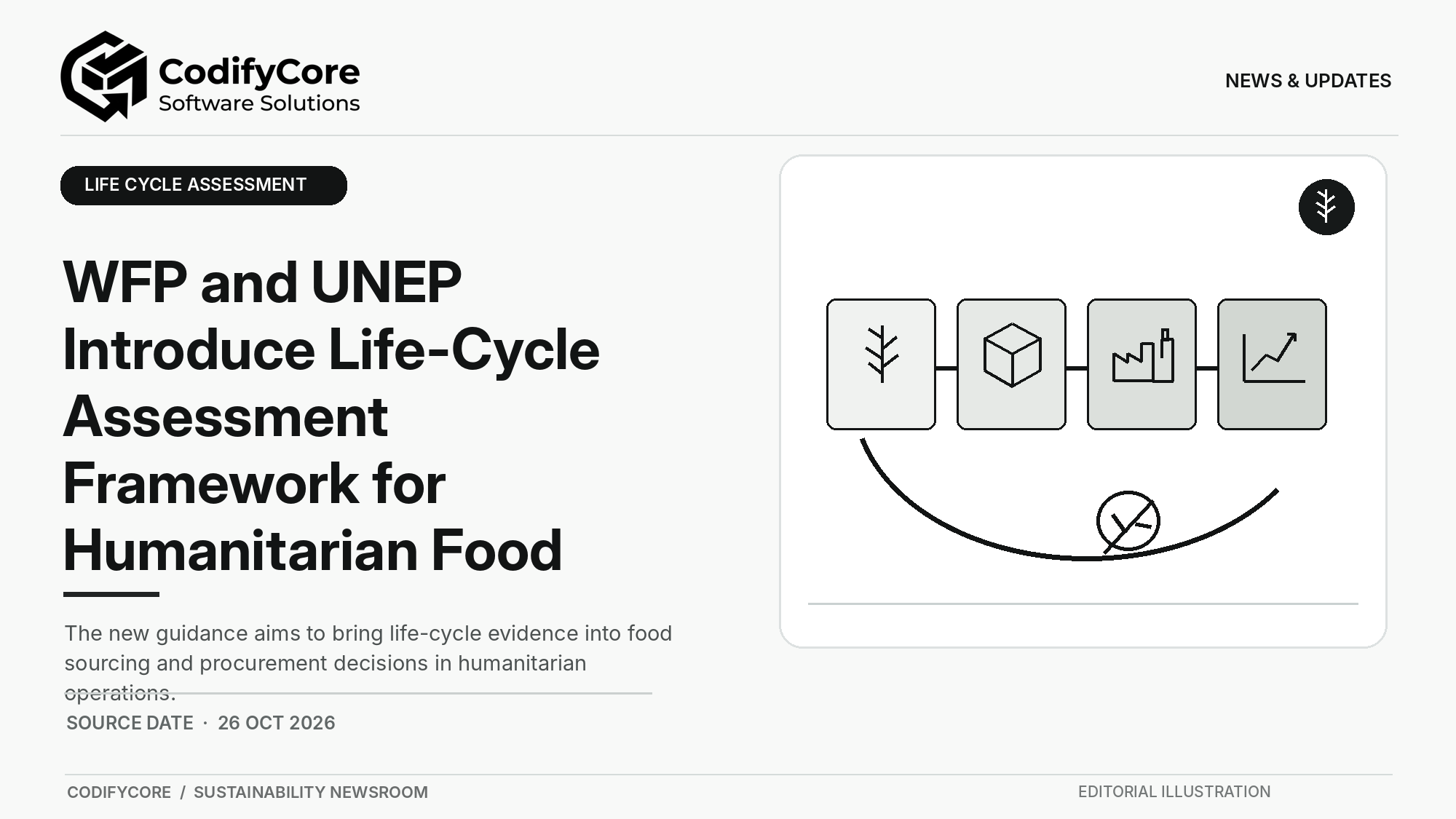
The World Food Programme (WFP) and United Nations Environment Programme Copenhagen Climate Centre introduced a Food Commodity Life-Cycle Assessment (FC-LCA) framework for humanitarian organisations, published on 26 October 2026.
The guidance is intended to help humanitarian teams evaluate the environmental and social impacts associated with the food they procure, including the impacts of upstream production. It provides a more standardised basis for identifying significant impacts and comparing possible sourcing or production improvements.
What the framework covers
The publication sets out a practical approach based on life-cycle assessment principles and includes a case study involving fortified maize meal. It considers how choices about agricultural production, sourcing and supply chains can influence environmental outcomes.
The authors describe their approach as streamlined. That qualification matters: the framework is informed by LCA standards and methods, but is not presented as a complete replacement for a full ISO 14040/14044 study in every context.
Why food-supply assessments matter
Humanitarian procurement must weigh cost, reliability, nutritional needs and rapid delivery, alongside environmental effects. Looking only at transport emissions can miss substantial upstream impacts from food production.
Life-cycle methods seek to identify where impacts occur across a product’s system boundaries. Results depend on consistent assumptions, data quality and the comparability of the scenarios being assessed.
Publication and next steps
A global information session held on 26 October, documented publicly in November, introduced the framework and discussed its application to humanitarian procurement. The guidance offers organisations a way to test practical sustainability improvements, but does not establish a new universal procurement requirement or independently verify the footprint of every food commodity.
Further adoption will depend on data availability, practitioner capacity and whether LCA findings can be integrated with operational decisions.
Sources
- WFP Logistics Cluster, framework published 26 October 2026
- WREC information session note, published 12 November 2026
Editorial note: This article reports on the publicly available sources identified above. It is independent news coverage, not a press release, legal opinion or endorsement. Regulatory proposals, consultations, reports and binding rules are distinguished in the article. Event dates are not the same as CodifyCore’s publication date.