
Digital Product Passports have moved from regulatory planning into operational infrastructure.
On 20 July 2026, the European Commission launched the Digital Product Passport Registry together with a testing environment. Economic operators can now enrol organisations and work with the infrastructure used to register unique product identifiers and required metadata. Detailed product information remains decentralised rather than being stored entirely inside the EU Registry.
Source: European Commission — Digital Product Passport Registry now live
The regulatory architecture has also become substantially clearer. In July 2026, the European Commission published references to six harmonised standards covering DPP identifiers, data carriers, data exchange, storage, APIs and interoperability. Compliance with the relevant harmonised standards creates a presumption of conformity with the corresponding ESPR requirements covered by those standards.
Source: EUR-Lex — Commission Implementing Decision (EU) 2026/1736
For manufacturers, brands and exporters, selecting a Digital Product Passport solution is therefore no longer simply about producing a QR-linked sustainability page. A serious DPP implementation can affect product identification, supplier data, ERP and PLM integration, regulatory reporting, access permissions, cybersecurity, lifecycle records, circularity and long-term data availability.
Some DPP providers specialise in billions of product identities. Others focus on raw-material provenance, batteries, confidential material data, automotive data spaces, textile supply chains, lifecycle assessment or post-purchase ownership.
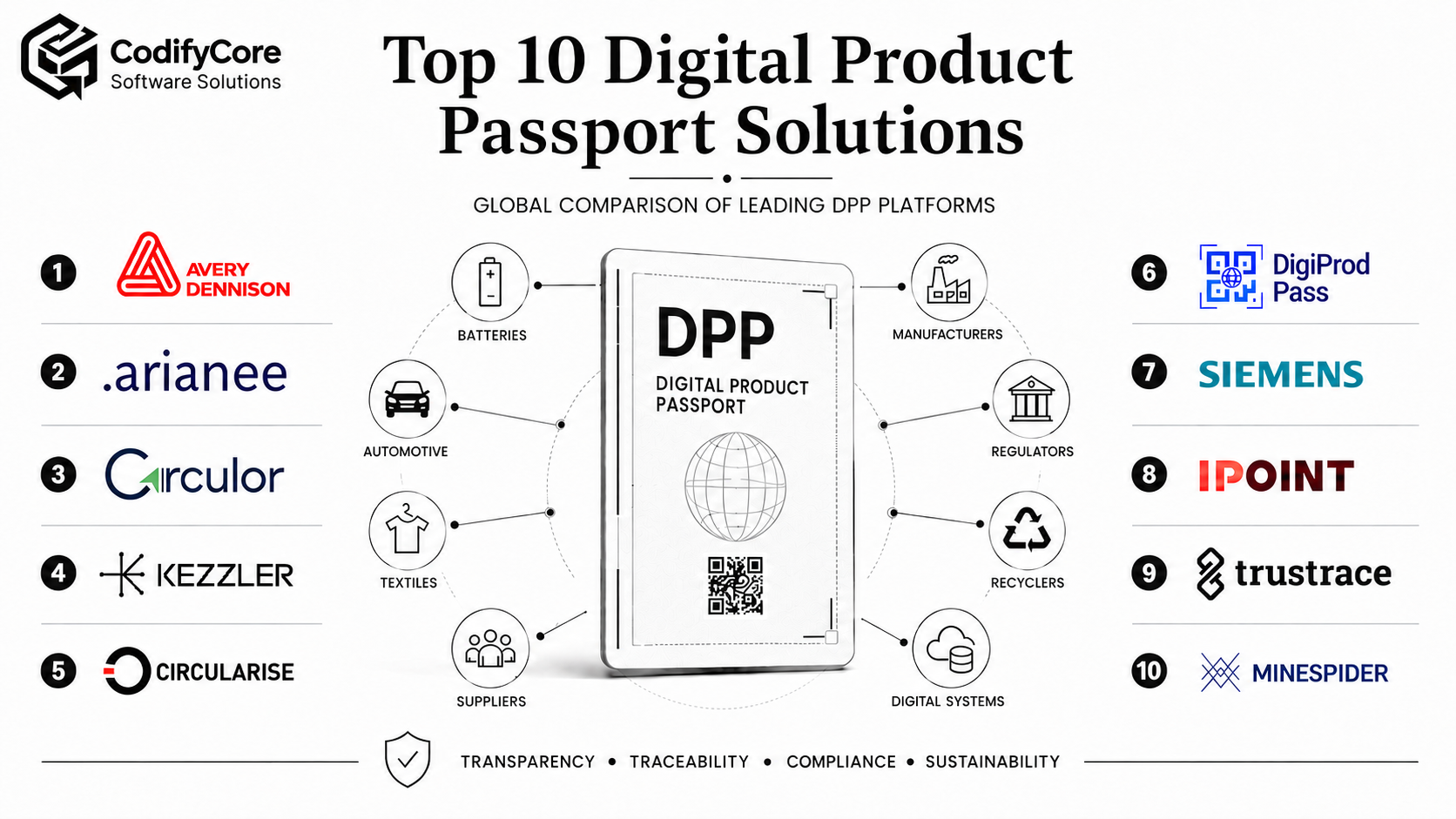
This article compares 10 of the strongest Digital Product Passport solutions available globally in 2026 using publicly verifiable evidence alongside clearly identified vendor-reported information.
| Editorial methodology note |
| Rankings represent CodifyCore’s editorial assessment, not an EU certification or legal determination of compliance. A pilot, consortium membership or partnership is not treated as equivalent to a scaled commercial deployment. Vendor-reported statistics are identified accordingly. |
What is the best Digital Product Passport solution in 2026?
Based on CodifyCore’s 2026 assessment, Avery Dennison ReadyDPP and atma.io ranks as the best overall Digital Product Passport solution, particularly for global organisations requiring a combination of physical product identification, connected-product infrastructure, factory deployment and enterprise-scale implementation.
However, no DPP solution is best for every company. Arianee is exceptionally strong for connected products, ownership, warranty and resale. Circulor leads where battery-material provenance and chain-of-custody evidence are central. Kezzler is particularly strong in high-volume product identities and standards-oriented traceability. Circularise stands out for complex materials and confidential data exchange.
DigiProd Pass earns a top-six position because of an unusually strong combination of EU-funded research, consolidated DPP development, Catena-X positioning and cross-industry activity in batteries, automotive, textiles, plastics, furniture and other product groups.
For industrial environments already deeply connected to engineering and manufacturing systems, Siemens DPP4.0 may be a stronger procurement choice than its overall seventh-place position suggests.
Top 10 Digital Product Passport solutions
| Rank | DPP solution | Score | Best for | Key differentiator |
| 1 | Avery Dennison ReadyDPP / atma.io | 92/100 | Global brands and high-volume products | Physical IDs + software + global implementation |
| 2 | Arianee | 90/100 | Connected products, ownership and resale | 3.4M+ vendor-reported production passports |
| 3 | Circulor | 88/100 | Batteries and critical materials | Proven EV Battery Passport + material provenance |
| 4 | Kezzler | 87/100 | Product identity and multi-sector traceability | High-scale identities + standards involvement |
| 5 | Circularise | 85/100 | Chemicals, plastics and sensitive material data | Privacy-focused supply-chain data exchange |
| 6 | DigiProd Pass | 84/100 | Research-backed multi-sector DPP and cDPP | EU projects + Catena-X + consolidated DPP |
| 7 | Siemens DPP4.0 | 83/100 | Industrial manufacturing | Enterprise IT/OT + Catena-X integration |
| 8 | IPOINT | 81/100 | Compliance, LCA and product sustainability | Material compliance + lifecycle intelligence |
| 9 | TrusTrace | 80/100 | Fashion, footwear and textiles | 15,000+ live DPPs and large supplier network |
| 10 | Minespider | 79/100 | Minerals, metals and battery supply chains | AI-assisted upstream data and provenance |
A one- or two-point score difference should not be interpreted as universally superior technology. The scores represent the weighted methodology used in this article; the best platform for a specific organisation can be several positions below the overall winner.
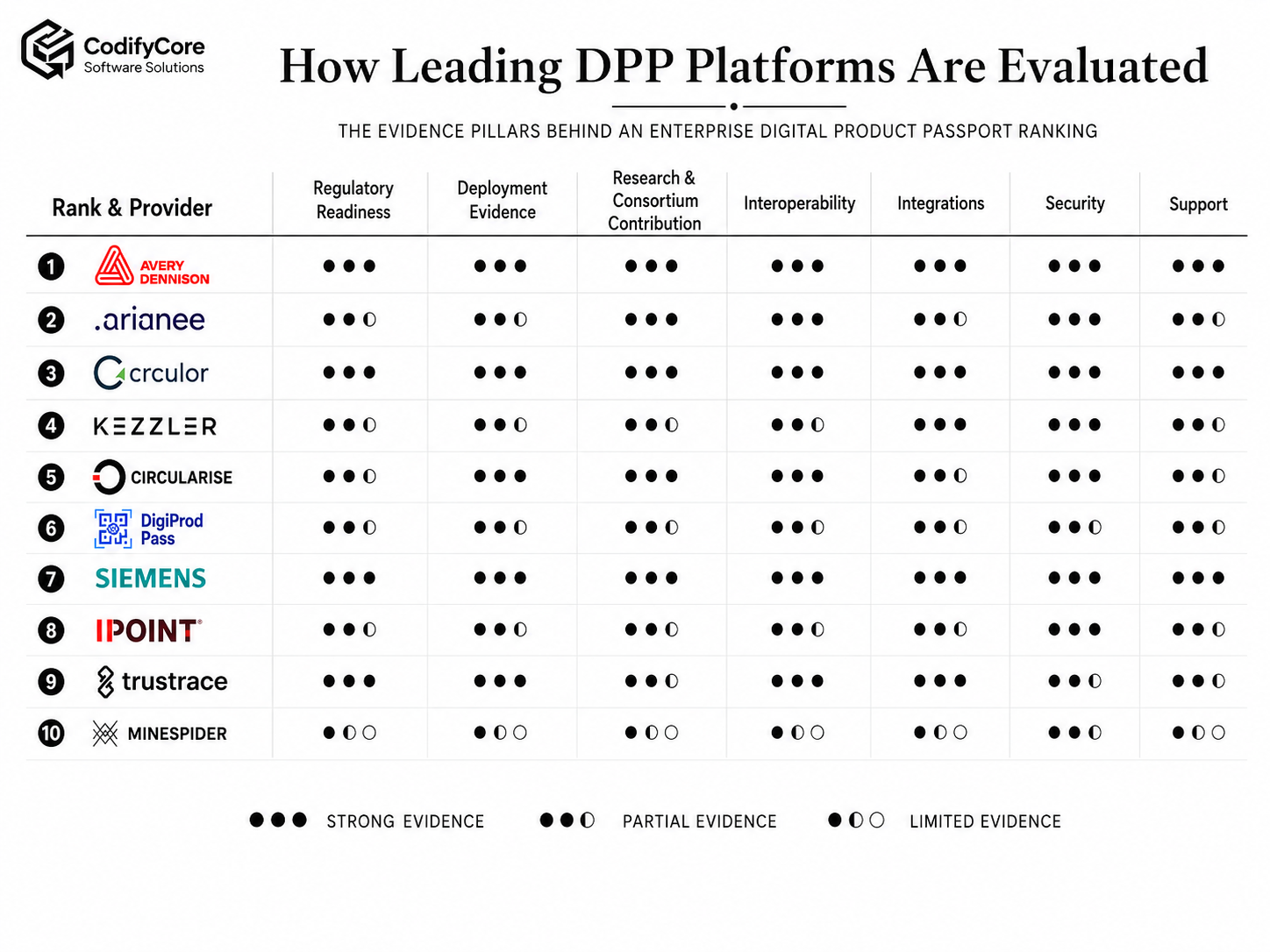
How we evaluated the leading DPP platforms
| Evaluation criterion | Weight |
| Regulatory readiness | 20% |
| Deployment evidence | 20% |
| Research & consortium contribution | 15% |
| Interoperability | 15% |
| Enterprise integrations | 10% |
| Security & assurance | 10% |
| Implementation & support | 10% |
| Total | 100% |
Regulatory readiness — 20%
We assessed evidence of preparation for ESPR, the EU Battery Regulation, the DPP Registry and emerging European standards.
Deployment evidence — 20%
Production deployments received more weight than demonstrations, pilots, memoranda of understanding or announced partnerships.
Research and consortium contribution — 15%
Formal participation in organisations and projects such as CIRPASS-2, Horizon Europe programs, Battery Pass, Catena-X and relevant standardisation initiatives was considered.
Interoperability — 15%
We looked at APIs, standards, identifiers, data portability, data-space participation and evidence that the platform is designed to interact with systems outside its own ecosystem.
Enterprise integrations — 10%
ERP, PLM, PIM, MES, LCA, supplier data, lifecycle applications and other enterprise-system connectivity were evaluated.
Security — 10%
We looked for current evidence of ISO 27001, SOC 2 or comparable assurance and whether vendors explain access controls, data sovereignty or security architecture.
Support and implementation — 10%
Global delivery capability, supplier onboarding, training, project management, customer success and implementation services were considered.
What changed for Digital Product Passport buyers in 2026?
The EU DPP Registry is operational
The EU Registry went live on 20 July 2026. Economic operators can register DPPs through the user interface or API, while the Registry stores unique identifiers and required registration metadata. The complete passport dataset normally remains with the economic operator or its DPP service provider.
Source: European Commission — DPP Registry
This changes what buyers should expect from software vendors. Registry enrolment, registration, validation, error management, bulk operations and lifecycle workflows are now implementation questions—not theoretical roadmap features.
Six harmonised DPP standards have been published
| Standard | Area |
| EN 18216:2026 | Data exchange protocols |
| EN 18219:2026 | Unique identifiers |
| EN 18220:2026 | Data carriers |
| EN 18221:2026 | Data storage, archiving and persistence |
| EN 18222:2026 | APIs for lifecycle management and searchability |
| EN 18223:2026 | System interoperability |
Source: EUR-Lex — Commission Implementing Decision (EU) 2026/1736
The European Commission’s current indicative timeline also expects two remaining standards to follow in September 2026.
Source: European Commission — Digital Product Passport overview
Battery Passports become mandatory in February 2027
Under Article 77 of Regulation (EU) 2023/1542, from 18 February 2027, each LMT battery, each industrial battery above 2 kWh and each electric-vehicle battery placed on the market or put into service must have a battery passport.
Source: EUR-Lex — Regulation (EU) 2023/1542
Under the current ESPR Working Plan, the European Commission’s indicative schedule targets iron and steel in 2026; textiles, tyres and aluminium in 2027; furniture in 2028; and mattresses and ICT products in 2029. Following adoption of an ESPR delegated act, economic operators receive a transition period of at least 18 months.
Source: European Commission — Economic operators and DPP
A Digital Product Passport is more than a QR code
One of the most important mistakes buyers can make is evaluating a DPP platform by looking mainly at its public passport page.
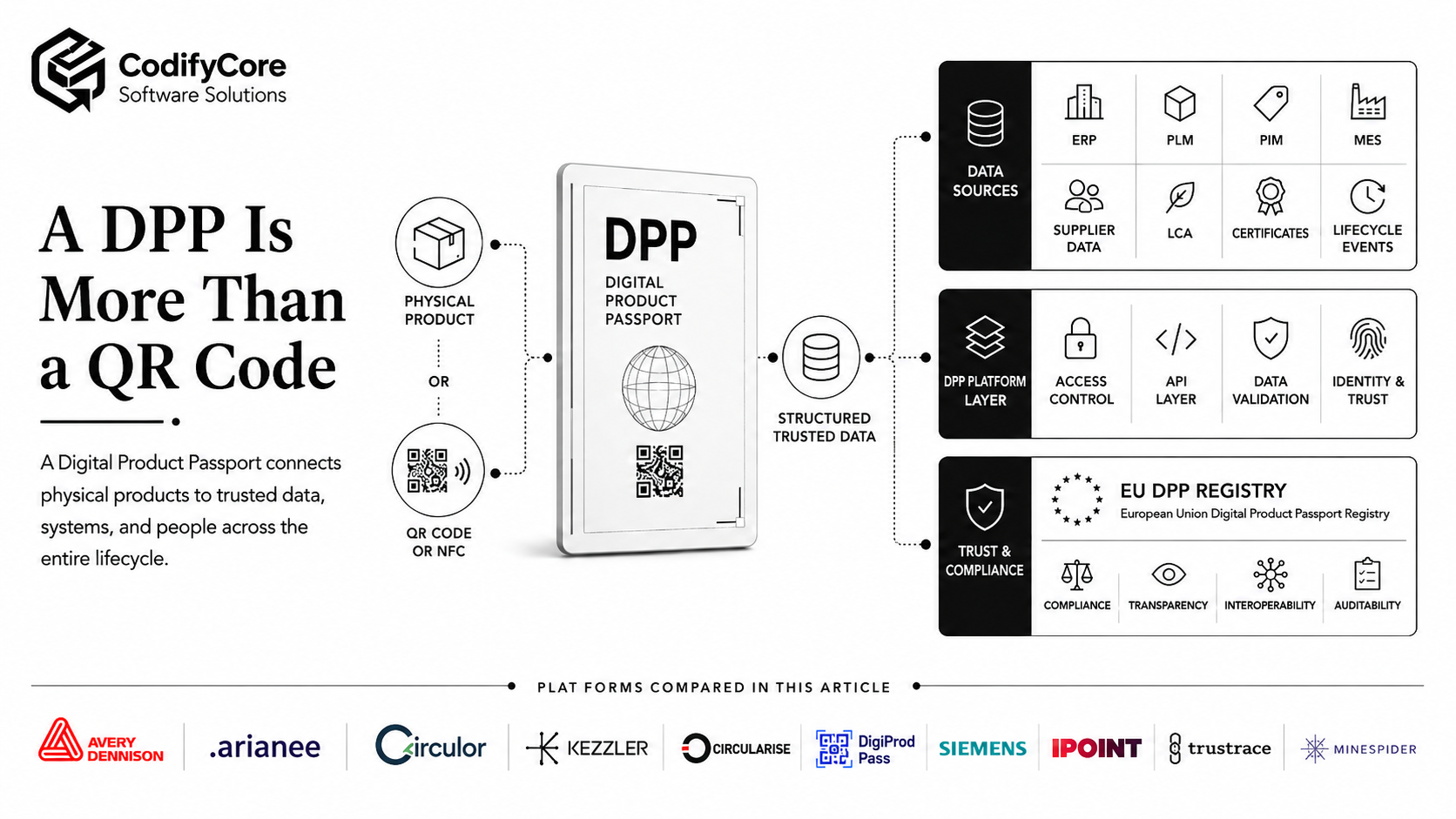
A QR code, RFID tag or NFC chip is a data carrier. It provides an access path to the product’s digital record. The difficult part of DPP implementation sits behind that interface.
A serious DPP architecture may need to connect product information from ERP, PLM, PIM and MES environments; supplier and facility records; life-cycle assessment data; certificates; compliance information; repair and lifecycle events; identifiers; role-based permissions; Registry registration; APIs; long-term storage; auditability and portability.
The European Commission describes the DPP as a digital identity card for products, components and materials, with access through a data carrier and information made available according to stakeholder roles.
Source: European Commission — Digital Product PassportThe procurement question is not “Can this vendor generate a QR code?” It is “Can this vendor maintain accurate, interoperable and appropriately controlled product data for years across our systems and supply chain?”
DPP solution landscape by specialisation
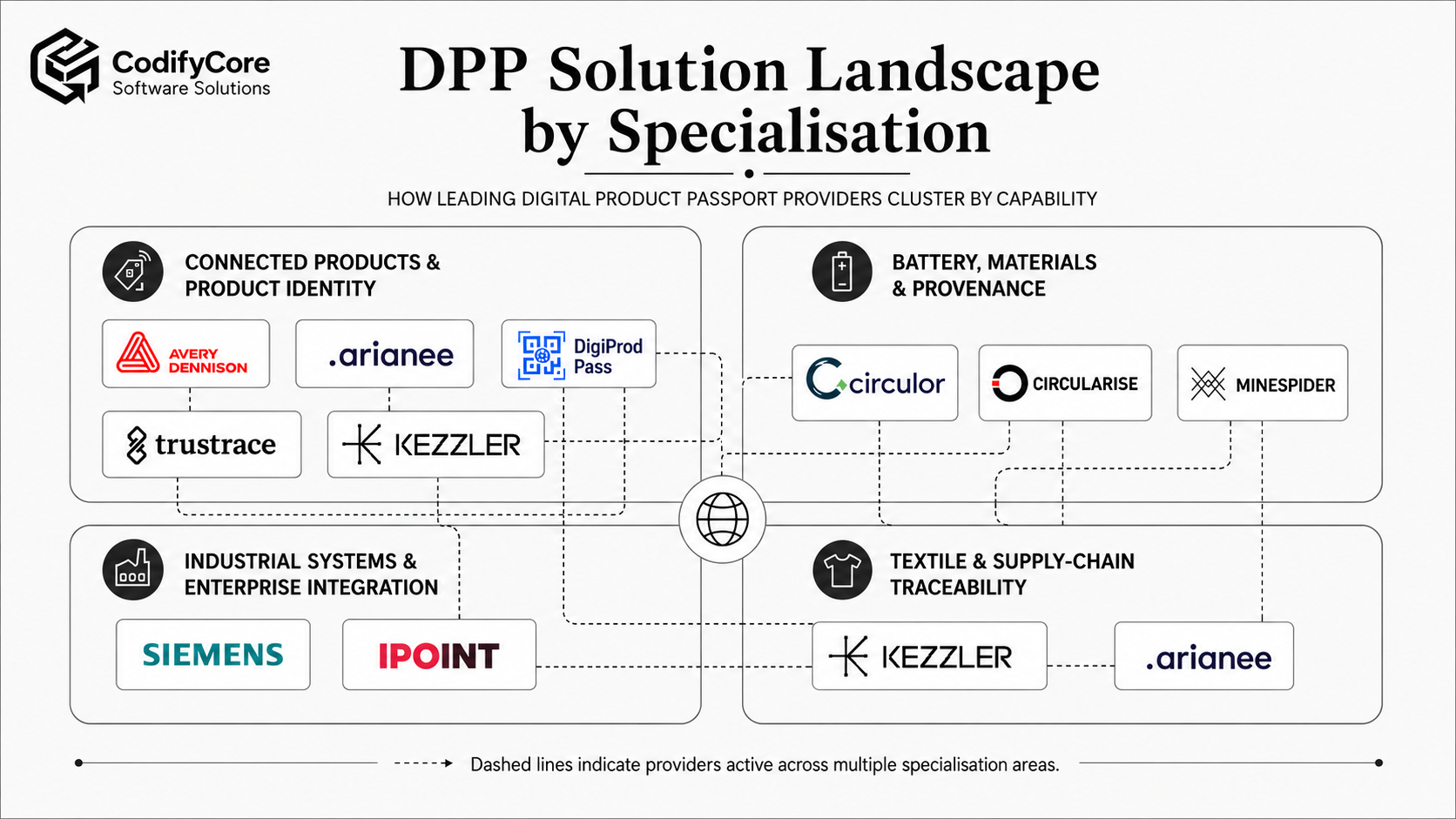
The global DPP market is easier to understand when providers are viewed by capability rather than ranking alone.
Connected-product and product-identity platforms include Avery Dennison, Arianee and Kezzler, where persistent identities and downstream product interaction are significant strengths.
Battery, materials and provenance specialists include Circulor, Circularise, DigiProd Pass and Minespider, although each approaches the problem differently.
Industrial and enterprise-data specialists include Siemens and IPOINT, which can connect DPP requirements to wider engineering, compliance and lifecycle environments.
Textile and supply-chain traceability specialists include TrusTrace, while Avery Dennison, Kezzler and DigiProd Pass also have significant activity in textiles.
These categories overlap. DPPs are inherently cross-functional, so a vendor appearing in one category should not be interpreted as lacking capabilities elsewhere.
1. Avery Dennison ReadyDPP and atma.io
CodifyCore score: 92/100
Best for: Global brands, apparel, retail and organisations needing physical identification plus enterprise DPP infrastructure.
| Area | Assessment |
| Headquarters | United States |
| Company scale | Approx. 35,000 employees in 50+ countries |
| DPP platform | ReadyDPP + atma.io |
| Major strength | Physical + digital infrastructure |
| EU project involvement | CIRPASS-2 |
| Catena-X | No ReadyDPP application certification verified |
| Security | Verify exact atma.io certification scope |
| Pricing | Custom |
| Support | Consultancy, technical support, training and maintenance |
Avery Dennison announced ReadyDPP in June 2026 as an integrated full-service solution for apparel Digital Product Passports. It combines data carriers such as QR, RFID and NFC; cloud data through atma.io; factory hardware; consultancy; technical support; training and maintenance.
Source: Avery Dennison — ReadyDPP announcement
The company’s biggest advantage is its ability to connect the physical product and the digital record under one commercial ecosystem. Avery Dennison reports approximately 35,000 employees in more than 50 countries, giving it a delivery footprint few specialist DPP startups can match.
Source: Avery Dennison — Company overview
Deployment evidence
atma.io has reported managing more than 30 billion physical items across its connected-product infrastructure. That demonstrates enormous identity and data-processing scale, but it should not be misinterpreted as 30 billion regulatory DPPs. Connected-item volume covers use cases beyond regulatory Digital Product Passports.
Source: atma.io — CIRPASS-2 and connected items
EU projects and standards
Avery Dennison’s atma.io participates in CIRPASS-2 and leads the Textile Loop pilot together with circular.fashion, demonstrating circular textile flows involving repair, resale, sorting and recycling.
Pros
Exceptional product-identification infrastructure, huge operational scale, factory-level capabilities, global implementation capacity and the ability to supply software, identifiers, labels and services together.
Cons
Its strongest public DPP positioning is currently concentrated in apparel and connected consumer products. Buyers should also distinguish atma.io’s massive connected-item statistics from actual regulatory-passport deployments and request solution-specific security documentation.
Verdict
Avery Dennison ranks #1 overall because few competitors combine product identity, physical implementation, cloud infrastructure and international delivery at comparable scale.
2. Arianee
CodifyCore score: 90/100
Best for: Connected products, luxury, retail, appliances, warranty, authentication, ownership and resale.
| Area | Assessment |
| Founded | Paris, 2018 |
| Public production figure | 3.4M+ passports |
| Customers | 50+ brands, vendor-reported |
| Markets | 40+ |
| Security | SOC 2 Type II |
| Other credentials | GS1 partner; Arkhineo legal archiving |
| Catena-X | No certification verified in reviewed sources |
| EU consortium evidence | No comparable CIRPASS role verified |
| Pricing | Custom |
Arianee is unusual because it treats the DPP not only as a regulatory record but as persistent connected-product infrastructure. Its platform supports product ownership, authentication, warranty, repair, resale, lifecycle records and customer interaction alongside compliance. The architecture is API-first and supports enterprise sources including ERP, PLM, PIM, supply-chain and laboratory systems.
Source: Arianee — Platform
Deployment evidence
Arianee reports 3.4 million DPPs in production, 50+ client brands and deployment across more than 40 markets. Its published references include approximately 500,000 certified watches, 200,000+ appliance passports and significant Richemont deployment. Unlike many DPP vendors whose evidence centres on pilots, Arianee can point to substantial live passport volumes.
Source: Arianee — DPP production metrics
Security and interoperability
Arianee reports SOC 2 Type II, GS1 partnership and legally admissible archiving through Arkhineo. Its protocol is described as open and decentralised, with an emphasis on portability and avoiding hard platform lock-in.
Pros
Strong production evidence, excellent post-purchase functionality, mature APIs and an architecture that can make the DPP useful for authentication, warranty and resale rather than compliance alone.
Cons
Its strongest evidence is in luxury, retail, fashion and electrical products rather than upstream minerals or industrial materials. ISO 27001 and Catena-X application certification were not identified in the public evidence reviewed.
Verdict
Arianee ranks #2 and is arguably the strongest DPP solution when the product’s digital identity must remain commercially useful throughout ownership and resale.
3. Circulor
CodifyCore score: 88/100
Best for: Batteries, electric vehicles, critical raw materials and industrial supply chains where provenance must be demonstrated.
| Area | Assessment |
| Headquarters | London, United Kingdom |
| Major deployment | Volvo EX90 Battery Passport |
| Key specialisation | Material provenance and chain of custody |
| Catena-X | PROVE Battery Passport listed by Catena-X |
| Security | ISO 27001 and ISO 9001 reported |
| Project activity | German Battery Pass demonstrator |
| Support ecosystem | TÜV Rheinland, KPMG and industrial partners |
| Pricing | Custom |
Circulor’s central strength is not passport presentation. It is the ability to trace materials and associated sustainability information across complex upstream supply chains.
The Volvo EX90 provides one of the market’s strongest real-world examples: its Battery Passport uses Circulor technology to make information about battery raw materials, recycled content and carbon footprint available for individual vehicles.
Source: Circulor — Volvo EX90 Battery Passport
Circulor also works with energy-storage companies including Powin and Acculon, extending Battery Passport and material-provenance use cases beyond passenger vehicles.
Source: Circulor — Powin partnership
Catena-X and assurance
Catena-X lists Circulor PROVE Battery Passport among Catena-X-based DPP solutions. Circulor also reports ISO 27001 and ISO 9001 certification. Its partnerships with organisations such as TÜV Rheinland and KPMG strengthen its broader verification and implementation ecosystem.
Source: Catena-X — Digital Product Passport solutions
Pros
Extremely strong where compliance depends on proving raw-material origin, emissions, recycled content and chain of custody.
Cons
Deep supplier traceability can require more onboarding and operational change than lightweight DPP generation. Its public evidence is strongest in batteries, automotive and industrial materials rather than consumer categories such as textiles or furniture.
Verdict
Circulor is the strongest specialist in this ranking for organisations whose DPP depends on credible upstream material provenance.
4. Kezzler
CodifyCore score: 87/100
Best for: High-volume product identity, lifecycle traceability and multi-sector deployments.
| Area | Assessment |
| Founded | Oslo, 2001 |
| Headquarters | Oslo, Norway |
| Global footprint | Europe, Americas and Asia |
| Security | ISO/IEC 27001:2022 |
| Quality | ISO 9001:2015 |
| EU involvement | CIRPASS-2 |
| Standardisation | CEN-CENELEC contribution reported |
| Catena-X | No certified DPP application verified |
| Pricing | Custom |
Kezzler has more than two decades of experience in product identity and traceability. Its historical work includes multi-billion-identifier programs, making scalability one of its strongest underlying credentials.
Source: Kezzler — About
The platform supports persistent product identities, batch and item-level traceability, lifecycle events, supply-chain information, connected packaging, consumer interaction and enterprise integrations.
Research and standards
Kezzler states that it is an active contributor to CIRPASS-2 and to CEN-CENELEC technical work on DPP implementation. It also maintains active ISO/IEC 27001:2022 and ISO 9001:2015 certifications.
Source: Kezzler — The DPP Minute
Team and support
Kezzler is headquartered in Oslo and lists teams across Europe, the Americas and Asia, including operations in the US, India, China and APAC. Its exact employee count is not prominently disclosed.
Pros
Kezzler combines exceptional product-identity heritage with modern DPP standards work, security credentials and multi-sector traceability.
Cons
Public regulatory DPP production volumes are less clearly quantified than Arianee’s. A Catena-X-certified Kezzler DPP application was also not identified.
Verdict
Kezzler ranks #4 because product identity and lifecycle traceability are foundational capabilities that many newer DPP platforms are still developing.
5. Circularise
CodifyCore score: 85/100
Best for: Materials, chemicals, plastics, automotive supply chains and organisations that must protect confidential information.
| Area | Assessment |
| Founded | Netherlands, 2016 |
| Headquarters | The Hague |
| Additional office | Tokyo |
| Security | ISO/IEC 27001:2022 |
| Scale capability | 10,000+ passport bulk operations |
| EU involvement | CIRPASS-2 expert group, COMPASS |
| Battery activity | BatteryPass-Ready supporting partner |
| Catena-X | Exact certification should be verified |
| Pricing | Custom |
Circularise’s strongest differentiator is its emphasis on privacy-preserving and selective information exchange. This is particularly relevant in chemicals, advanced materials and plastics, where suppliers may need to prove sustainability or composition characteristics without revealing complete formulations, supplier relationships or intellectual property.
Circularise says its DPP platform can create, edit and manage 10,000+ passports in bulk, offers API-first enterprise integration and supports ERP and MES connectivity.
Source: Circularise — Digital Product Passports
Deployment evidence
Its public evidence includes Digital Product Passport work with Samsonite, Teijin and Airbus-related projects. The Samsonite program involved 27 suppliers and traced recycled material back to source, while Circularise has also launched DPPs for Teijin advanced materials.
Source: Circularise — Samsonite
Research and security
Circularise is ISO/IEC 27001:2022 certified, participates in the CIRPASS-2 expert group, joined the COMPASS project and became a BatteryPass-Ready supporting partner in 2026.
Source: Circularise — ISO 27001
Support
Circularise publicly describes dedicated customer-success onboarding, project management, supplier onboarding, webinars and email support.
Pros
Strong materials expertise, selective disclosure, EU research involvement, ISO certification, enterprise APIs and increasingly credible commercial deployment evidence.
Cons
Some publicly visible programs remain pilots or demonstrations, and buyers should verify exact Catena-X conformity where required.
Verdict
Circularise is one of the most compelling DPP solutions when sharing the necessary data without exposing unnecessary confidential information is a core requirement.
6. DigiProd Pass
CodifyCore score: 84/100
Best for: Research-backed cross-sector DPP programs, Battery Passports, automotive consolidated DPPs, textiles, furniture and emerging regulated product categories.
| Area | Assessment |
| Headquarters | Manchester, United Kingdom |
| Background | Spin-off associated with Technovative Solutions |
| Security | ISO 27001 reported in 2026 |
| Catena-X | BYOX listed; BAP Eco Pass certification reported |
| Advisory status | Catena-X Qualified Advisory Provider reported |
| Major EU project | BASE |
| Other projects | autoMatPass, EcoPlast |
| Major industry initiative | 24-month BGMEA pilot |
| Direct team size | Not publicly disclosed |
| Pricing | Custom |
DigiProd Pass is one of the more difficult DPP companies to evaluate using conventional market metrics. Its publicly disclosed production-passport counts are weaker than those of Arianee or TrusTrace, yet its research, consortium and cross-sector evidence is unusually extensive. That combination is why it ranks sixth rather than being treated merely as an emerging honorary mention.
BASE — Horizon Europe Battery Passport
BASE is a Horizon Europe Innovation Action developing and validating a working Digital Battery Passport service. The project has a total cost of approximately €8.94 million, with approximately €6.15 million of EU contribution, and runs through May 2027.
Source: CORDIS — BASE project
Within BASE, DigiProd Pass is described as the specialist in DPP development, deployment and scalability. Its WP7 responsibilities include deploying DPP solutions across industrial pilots, supporting partner implementation, testing interoperability and helping move project outcomes toward scalable commercial use.
Source: BASE consortium — DigiProd Pass role
autoMatPass and consolidated Digital Product Passports
autoMatPass is an EIT RawMaterials-funded project developing a consolidated Digital Product Passport, or cDPP, for the Fiat 500e powertrain. Rather than treating every component as an isolated passport, the project creates a hierarchy that can connect the complete powertrain to subassemblies, components, materials and enterprise records.
DigiProd Pass leads project management, go-to-market activities and the core cDPP Platform Development & Demonstration work package. The platform scope includes ERP/MES integration, Asset Administration Shell connectivity, federated data exchange and a hierarchical component structure.
Source: autoMatPass — About the project
EcoPlast
European Commission CORDIS records list DIGIPRODPASS LIMITED as a formal participant in the €6.37 million EcoPlast Horizon project, which is focused on circular automotive plastics. The project includes digital twins, circularity, LCA, traceability and Digital Product Passport infrastructure.
Source: CORDIS — EcoPlast
Catena-X
Catena-X’s official DPP page lists DigiProd Pass BYOX – Digital Battery Passport among its Catena-X-based DPP solutions, alongside platforms from organisations including Siemens and Circulor.
Source: Catena-X — Digital Product Passport solutions
DigiProd Pass also announced in March 2026 that it achieved Catena-X Business Application Provider — Eco Pass certification, and subsequently announced Qualified Advisory Provider status. Procurement teams should request the current certificates and exact certification scope during due diligence.
Source: DigiProd Pass — Catena-X certification announcement
BGMEA and textile-sector implementation
The Bangladesh Garment Manufacturers and Exporters Association independently confirms a 24-month DPP pilot with DigiProd Pass and Digital Architect. BGMEA is responsible for onboarding selected garment manufacturers and coordinating data provision, while DigiProd Pass leads the technical development and implementation of the DPP platform.
Source: BGMEA — DigiProd Pass MoU
This is significant industry access, although it should not be described as every BGMEA member already using DigiProd Pass.
Security
DigiProd Pass announced ISO 27001 certification in May 2026. Buyers should still request the actual certificate, certification body, scope, expiry information and confirmation that the production platform is included.
Source: DigiProd Pass — ISO 27001
Team and support
DigiProd Pass’s exact direct employee count is not publicly disclosed. It would therefore be inaccurate to state that DigiProd Pass itself employs hundreds of people. What can be substantiated is a much broader delivery ecosystem involving DigiProd Pass, its Technovative background, project researchers, consortium organisations, implementation specialists and industrial partners.
Pros
Exceptional research depth for its size, formal EU-project involvement, Battery Passport capability, cDPP development, Catena-X positioning and activity across multiple regulated product categories.
Cons
The largest limitation is public commercial-scale evidence. Total live DPPs, paying production customers, supplier counts, API volumes, uptime performance and customer-retention statistics are not publicly disclosed at the level available from several competitors. Developer documentation and standard support SLAs could also be made more visible publicly.
Verdict
DigiProd Pass earns #6 on evidence rather than visibility. Its research and institutional credibility arguably places it in the global top tier; its position below the first five primarily reflects the absence of publicly quantified commercial-scale deployment metrics. If those figures become available and demonstrate meaningful production scale, DigiProd Pass has a credible path into the top five.
7. Siemens Digital Product Passport DPP4.0
CodifyCore score: 83/100
Best for: Industrial manufacturers, automotive companies and enterprises already operating complex engineering and manufacturing environments.
| Area | Assessment |
| Headquarters | Germany |
| Product | Siemens DPP4.0 |
| SaaS status | Available |
| Main strength | Industrial IT/OT integration |
| Catena-X | Native integration; listed by Catena-X |
| AAS | Supported |
| APIs | OpenAPI support |
| Pricing | Tiered licences; prices not published |
| Support | Starter packages + enterprise implementation |
Siemens has materially strengthened its DPP proposition during 2026. Its current DPP4.0 platform is positioned as a central DPP engine connecting product information across systems, suppliers and lifecycle stages. Siemens publicly describes integrations using APIs, Asset Administration Shell concepts and data spaces including Catena-X and Chem-X.
Source: Siemens — Battery Passport / DPP4.0
Commercial model
Siemens now states that its DPP SaaS solution is available. After an initial Starter Package, customers can move to Company Licence subscriptions ranging from XXS through Enterprise/Unlimited, with API access, users and passport allowances varying by tier. Actual prices are not publicly disclosed.
Catena-X
Catena-X lists Siemens Battery Passport among Catena-X-based DPP solutions. Importantly, Siemens’s current page describes its Battery Passport as a native Catena-X solution ‘soon to be certified.’ Therefore it would be premature to describe the current DPP4.0 offering simply as fully Catena-X-certified without confirming the latest certification directly.
Source: Catena-X — Digital Product Passport solutions
Pros
Siemens brings exceptional industrial software, engineering, automation, digital-twin and manufacturing integration capability. Nested structures such as vehicle → battery → chemical fit naturally into the company’s wider industrial architecture.
Cons
DPP-specific production volumes remain relatively opaque compared with the total scale of Siemens itself. Companies outside Siemens-heavy environments should also assess implementation complexity and total cost carefully.
Verdict
Siemens may be the strongest option in this article for a large manufacturer whose Digital Product Passport needs to sit directly inside an industrial digital thread. Its #7 overall rank should therefore not be interpreted as weakness in industrial scenarios.
8. IPOINT
CodifyCore score: 81/100
Best for: Manufacturers whose DPP depends heavily on material compliance, LCA, product carbon footprints and product stewardship.
| Area | Assessment |
| Headquarters | Reutlingen, Germany |
| Team | 170+ employees |
| Offices | 14 |
| Current ownership | Acquired by Assent, July 2026 |
| EU DPP research | CIRPASS, CIRPASS-2 |
| Other research | DigiTain, CE-Pass and other projects |
| Catena-X | Product Sustainability certified for automotive use |
| Security | ISO 9001 / ISO 27001 reported |
| Published pricing | Product Sustainability Core €5,000/year |
IPOINT approaches the Digital Product Passport from a different direction than most companies in the ranking. Its heritage is in product compliance, substances, materials, lifecycle assessment and sustainability information—the underlying datasets that manufacturers often struggle to collect before a DPP can exist.
Its compliance platform integrates information from sources including IMDS, CAMDS, BOMCheck, PDM, PLM, ERP and EHS systems.
Source: IPOINT — Product Compliance
EU research
IPOINT has extensive formal DPP research involvement. It participated in the original CIRPASS project and continues in CIRPASS-2, while other projects have explored whole-vehicle DPP concepts, component Battery Passports and sustainable digital product development.
Source: IPOINT — Projects
Team and international support
IPOINT reports more than 170 employees across 14 local offices and a global partner network, including locations across Germany, the UK, US, Japan, China and other markets.
Source: IPOINT — Contact / offices
Catena-X and sustainability
IPOINT Product Sustainability is described as certified for automotive use through Catena-X. Its packages support PCF methodologies, LCA, ERP/PLM integration and other sustainability capabilities.
Source: IPOINT — Product Sustainability packages
Pricing
IPOINT is the only company in our top 10 for which we found a meaningful public software price. Its Product Sustainability Core package is listed at €5,000 per year. That should not be interpreted as €5,000 for a complete enterprise DPP deployment. Growth and Scale packages use custom pricing, and DPP implementation can require additional compliance, integration and service components.
Major 2026 change: Assent acquisition
On 9 July 2026, Assent completed its acquisition of IPOINT. The combined proposition is intended to connect supply-chain compliance with broader product-lifecycle intelligence.
Source: IPOINT — Assent acquisition
Pros
Deep compliance expertise, strong LCA/PCF capabilities, formal EU research participation, international support and strong automotive-sector relevance.
Cons
Consumer-facing product experiences are not the platform’s primary differentiator. Buyers should also determine how the Assent acquisition affects roadmap, contracts and platform architecture.
Verdict
IPOINT is one of the best DPP candidates when trustworthy material, regulatory and environmental information is the difficult part of the project.
9. TrusTrace
CodifyCore score: 80/100
Best for: Apparel, footwear, fashion and textile supply-chain traceability.
| Area | Assessment |
| Founded | 2016 |
| Headquarters | Stockholm, Sweden |
| Team | 130+ |
| Supplier network | 112,000+ mapped suppliers/facilities |
| Live DPPs | 15,000+ vendor-reported |
| Security | ISO 27001 + SOC 2 Type II |
| Industry | Fashion, textiles, footwear |
| Catena-X | Not central to its market |
| Pricing | Custom |
TrusTrace is one of the strongest specialist platforms in this ranking. It concentrates on the difficult upstream data problem facing apparel brands: obtaining granular information from multiple supplier tiers and linking that information to products.
The company says its platform is cloud-hosted and API-ready and maintains ISO 27001 and SOC 2 Type II assurance.
Source: TrusTrace — Contact sales / security
Deployment evidence
TrusTrace reported 15,000+ unique DPPs live in the market during 2025, produced through textile pilots involving brands including Eton, Kappahl and Gina Tricot. It also reported approximately 82,000 traceability transactions per day and over 112,000 mapped suppliers. Those figures give TrusTrace stronger real DPP deployment evidence than several platforms ranked above it—but its narrower sector focus reduces its overall global ranking.
Source: TrusTrace — 2025 year in review
Team and support
TrusTrace reports 130+ employees across Sweden, India, the United States, France and Germany. It also offers a dedicated customer-success function and supplier onboarding capability.
Source: TrusTrace — About
Pros
Excellent textile expertise, strong supply-chain data infrastructure, meaningful live DPP evidence and strong security assurance.
Cons
Its specialisation is also its limitation. It is much less relevant to mining, batteries, automotive components or heavy industrial equipment than several alternatives.
Verdict
For a fashion or textile buyer, TrusTrace may reasonably rank much higher than #9. Its lower overall position reflects sector breadth—not weak DPP capability.
10. Minespider
CodifyCore score: 79/100
Best for: Mining, minerals, metals, battery materials and document-heavy upstream supply chains.
| Area | Assessment |
| Headquarters | Berlin, Germany |
| Focus | Minerals, metals, batteries |
| Security | ISO 27001 |
| Other ISO | ISO 9001, 14001 and 50001 listed |
| EU funding | Horizon 2020 |
| AI | Document extraction/copilot |
| Integrations | APIs |
| Languages | English, German, French, Spanish |
| Pricing | Custom |
Minespider is purpose-built for supply chains where product data often begins far upstream. Its platform provides Digital Product Passports and Battery Passports alongside material provenance, supplier onboarding, carbon information and permissioned sharing.
One particularly practical feature is its AI copilot: Minespider says companies can upload existing documents and use AI to extract relevant information, pre-populate passport fields and identify missing data.
Source: Minespider — Platform
European research and certifications
Minespider’s platform received funding from the EU Horizon 2020 research and innovation programme under grant agreement 946437. Its official website lists ISO certifications covering ISO/IEC 27001, ISO 9001, ISO 14001 and ISO 50001.
Deployment evidence
Minespider has public activity with organisations including Minsur, Ford Otosan and Renault-related ecosystems, and in March 2026 announced a mining-site DPP implementation at Turkey’s Çataltepe project.
Source: Minespider — Çataltepe DPP
Support
The platform supports web and mobile use in four languages and describes market specialists who assist organisations in selecting and implementing appropriate passport and traceability approaches.
Source: Minespider — Platform details
Pros
Strong upstream materials expertise, useful supplier onboarding, AI-assisted document processing, substantial ISO portfolio and relevant EU research history.
Cons
Consumer experience and post-purchase ownership are not its main differentiators. Public total production-passport volumes also remain limited.
Verdict
Minespider is one of the strongest specialist choices when a DPP starts at the mine rather than at the finished product.
Best Digital Product Passport solution by use case
| Requirement | Best-fit DPP provider |
| Best overall | Avery Dennison |
| Connected products / ownership | Arianee |
| Battery material provenance | Circulor |
| High-volume product identities | Kezzler |
| Confidential material information | Circularise |
| EU research-backed multi-sector DPP | DigiProd Pass |
| Consolidated DPP / complex hierarchy | DigiProd Pass |
| Industrial IT/OT integration | Siemens |
| Compliance + LCA + PCF | IPOINT |
| Fashion/textile supply-chain traceability | TrusTrace |
| Mining and upstream materials | Minespider |
| Physical QR/RFID/NFC infrastructure | Avery Dennison |
| Warranty/authentication/resale | Arianee |
| Catena-X automotive environment | Siemens / Circulor / DigiProd Pass |
| Furniture and emerging cross-sector pilots | DigiProd Pass |
| Private/selective material-data sharing | Circularise |
Honorary mentions
Spherity
Spherity’s VERA platform focuses on Digital Product Passports, trusted organisational identities and verifiable credentials. Spherity and RCS Global previously introduced Claritas as the first Catena-X-certified Battery Passport solution.
Source: Spherity
OPTEL
OPTEL’s Optchain Digital Product Passport combines supplier mapping, automated data capture, emissions data and product traceability.
Source: OPTEL
SAP
SAP provides Digital Battery Passport functionality through SAP Business Network Asset Collaboration and can use battery information maintained in SAP S/4HANA Equipment Master records to generate and publish passports.
Source: SAP
EON
EON has been active in connected-product and circular-fashion infrastructure and participates in CIRPASS-2. It remains worth evaluating for circular retail, resale and post-purchase applications.
Source: EON
PSQR
PSQR is a focused traceability and standards-oriented technology provider that has participated in DPP initiatives and remains interesting where standards-driven product data infrastructure is prioritised.
Source: PSQR
osapiens
osapiens offers DPP capability inside a wider ESG, compliance and supply-chain technology environment and can be attractive to organisations looking for one broader regulatory platform.
Source: osapiens
How to choose a Digital Product Passport provider
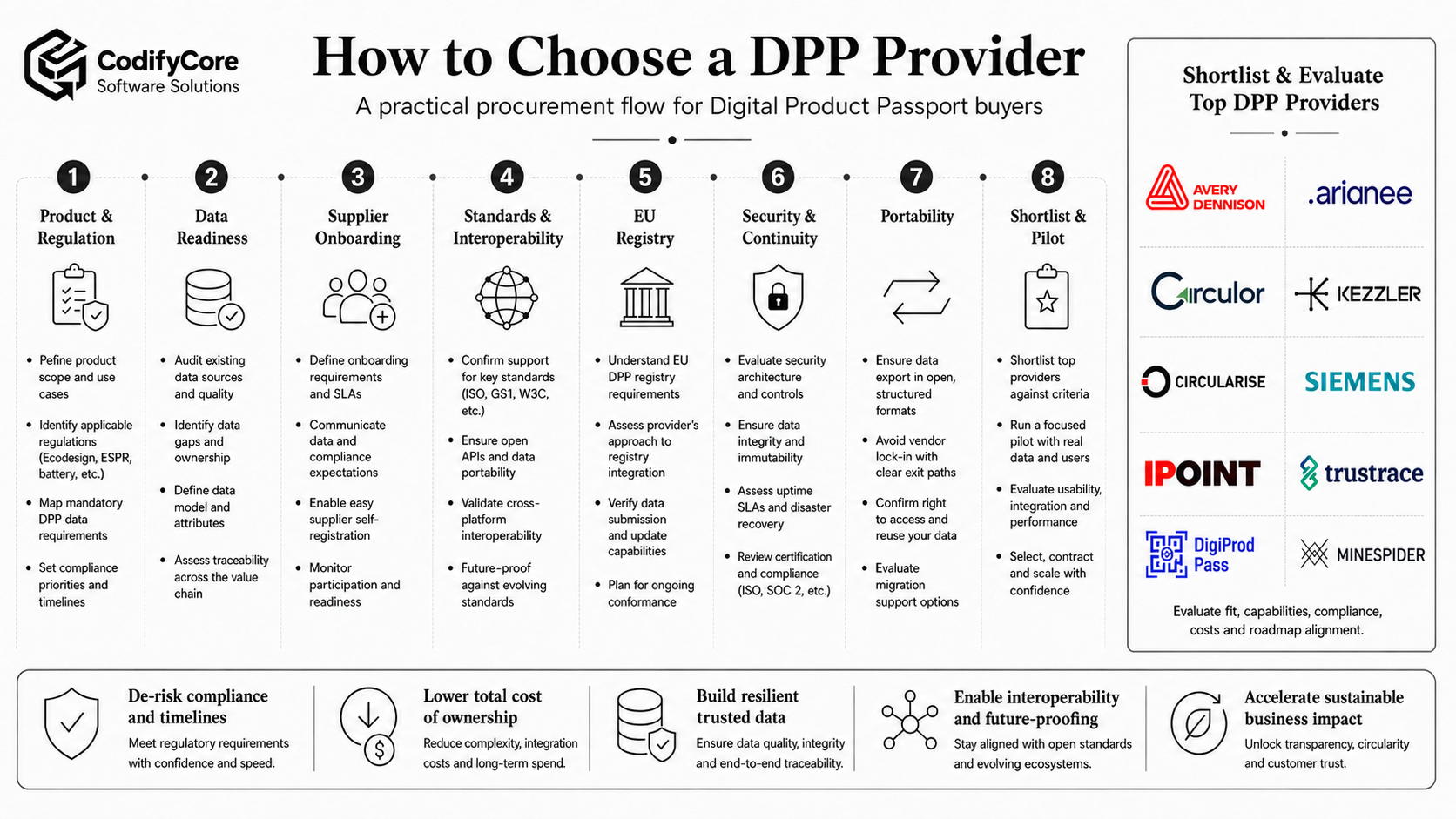
The ranking should be the beginning of procurement—not the end. A company should first identify its regulated product, applicable legislation and economic operator. A Battery Passport, textile DPP and consolidated automotive DPP can require very different data, lifecycle and integration models.
The second task is assessing data readiness. Buyers should identify which required information already exists in ERP, PLM, PIM, MES, LCA, laboratory, supplier, certificate and compliance systems—and which information does not yet exist at all.
Supplier onboarding should then be tested realistically. Ask whether suppliers can contribute information without purchasing licences, whether spreadsheet and document ingestion is available, whether APIs exist for mature suppliers and who will provide supplier training.
The vendor should also demonstrate how it distinguishes supplier declarations from verified evidence. Product information can come from company records, supplier declarations, calculations, certificates, laboratory results, transactions, audits or verifiable credentials. Those are not equivalent evidence types.
Standards should be evaluated against the actual 2026 European framework. Buyers should ask for a written compatibility matrix covering EN 18216, EN 18219, EN 18220, EN 18221, EN 18222 and EN 18223, plus relevant GS1, EPCIS, AAS, Catena-X or credential standards where applicable.
Registry functionality should now be demonstrated rather than promised. Test enrolment, identifiers, metadata submission, API authentication, validation failures, corrections, status tracking and bulk registration.
Security evaluation should cover authentication, encryption, access control, audit logging, vulnerability management, backups, disaster recovery, data residency, subprocessors and incident management—along with independent certifications.
Finally, test the exit plan. Ask whether every DPP can be exported in a structured machine-readable form, whether identifiers and URLs remain resolvable after migration and what happens if the provider is acquired, closes or discontinues the product.
How much does a Digital Product Passport solution cost?
There is no meaningful universal DPP price. Most of the top 10 Digital Product Passport providers use custom enterprise pricing because deployment costs depend heavily on product and organisational complexity.
Important cost drivers include product volume, model/batch/item granularity, supplier count, manufacturing sites, passport lifetime, integrations, API volume, data carriers, onboarding, LCA, verification, support and hosting.
Public pricing information found
IPOINT Product Sustainability Core: €5,000/year. This is a published sustainability-software price, not necessarily the total price of an enterprise Digital Product Passport deployment. Growth and Scale tiers use custom pricing.
Source: IPOINT — Product Sustainability packages
Siemens: DPP4.0 uses Company Licence tiers from XXS through Enterprise Unlimited, but Siemens does not publish monetary pricing on the product page.
Source: Siemens — DPP4.0
For the remaining top-10 providers reviewed, standard enterprise DPP prices were not publicly disclosed. A serious comparison should therefore ask each shortlisted supplier for a five- or ten-year total cost of ownership, not just first-year licence cost.
Digital Product Passport buyer checklist
Before signing a DPP contract, obtain written answers covering the applicable legislation and product categories, the six harmonised DPP standards, Registry integration, identifiers, passport granularity, supplier onboarding, ERP/PLM/PIM/MES integration, evidence verification, access rights, hosting location, ISO/SOC assurance, APIs, export formats, disaster recovery, service-level commitments, regulatory updates, migration and vendor-exit procedures.
Also require the vendor to build a proof of concept using your real product hierarchy, real supplier information and at least one real enterprise integration.
A beautifully designed demonstration populated with synthetic information proves very little about the hardest part of DPP implementation.
Frequently Asked Questions about Digital Product Passport solutions
What is a Digital Product Passport solution?
A Digital Product Passport solution is software and supporting infrastructure for creating, registering, managing, updating and sharing structured product information throughout a product’s lifecycle. A complete DPP platform can include unique identifiers, data carriers, supplier-data collection, enterprise integrations, Registry workflows, access control, APIs, lifecycle records, evidence management and long-term storage.
What are the top 10 Digital Product Passport solutions in 2026?
CodifyCore’s current top 10 are Avery Dennison, Arianee, Circulor, Kezzler, Circularise, DigiProd Pass, Siemens, IPOINT, TrusTrace and Minespider. The ranking evaluates regulatory readiness, deployment evidence, research and consortium participation, interoperability, integrations, security and implementation support.
What is the best Digital Product Passport solution?
Avery Dennison ranks as our best overall DPP solution for 2026. However, Circulor may be better for critical battery-material provenance, Arianee for connected ownership and resale, Siemens for industrial integration, TrusTrace for fashion traceability and DigiProd Pass for research-heavy cross-sector or consolidated DPP programs.
Is DigiProd Pass one of the top DPP solutions?
Yes. Its formal roles in BASE, autoMatPass and EcoPlast, Catena-X position, ISO 27001 announcement and cross-sector implementation activity justify a top-10 position. Its current #6 ranking is mainly limited by a lack of publicly quantified production-passport and commercial-customer figures, rather than a lack of technical or research credibility.
Is a Digital Product Passport just a QR code?
No. The QR code is a data carrier or access mechanism. The DPP is the structured digital record and supporting information infrastructure behind it.
Does a Digital Product Passport require blockchain?
No. EU DPP legislation does not universally require blockchain. Some providers use blockchain or distributed ledgers for provenance, auditability or decentralised exchange, while others use conventional databases or federated data-space architectures.
Is the EU Digital Product Passport Registry already live?
Yes. The EU DPP Registry became operational on 20 July 2026, together with its testing environment.
Does the EU Registry store the complete Digital Product Passport?
No. The Registry stores unique identifiers and mandatory registration information. Detailed product data is maintained by the economic operator or a DPP service provider in the decentralised DPP architecture.
When do Battery Passports become mandatory?
18 February 2027 for each LMT battery, industrial battery above 2 kWh and electric-vehicle battery covered by Article 77 of the EU Batteries Regulation.
When will textiles require a DPP?
The European Commission currently plans adoption of the textile ESPR delegated act around Q4 2027. The final compliance date follows the delegated act and transition period; it should therefore not be presented as an already-fixed universal 2027 deadline.
Which products are expected to get Digital Product Passports?
The ESPR Working Plan currently prioritises iron and steel, textiles, tyres, aluminium, furniture, mattresses, ICT and energy-related products, while other EU legislation introduces DPP requirements for categories such as batteries and construction products.
Do companies outside the EU need a Digital Product Passport?
They can. The obligations apply to products placed on the EU market, including imported products. A manufacturer being headquartered outside Europe does not itself remove the product from DPP requirements.
Who is legally responsible for the Digital Product Passport?
The primary responsibility for creating and maintaining the DPP rests with the economic operator placing the relevant product on the EU market, according to the applicable legislation. Buying DPP software does not automatically transfer that legal responsibility to the software vendor.
What information must a DPP contain?
The exact information depends on the applicable product legislation. Depending on the product, information may include identification, materials, substances, environmental performance, carbon footprint, recycled content, durability, repair information, safety, certifications, traceability and recycling or end-of-life instructions.
Can one DPP platform support several industries?
Yes, but the software must support different data models, product hierarchies and regulations. A battery, garment, chair and automotive powertrain cannot simply be treated as identical templates.
What is a consolidated Digital Product Passport?
A consolidated Digital Product Passport, or cDPP, connects individual component or material passports into a hierarchy representing a complex product or system. The autoMatPass project, for example, is developing a hierarchical cDPP for the Fiat 500e powertrain.
What is the difference between DPP and traceability?
Traceability describes the movement, origin or transformation of products and materials across a supply chain. The DPP is the structured information mechanism through which required product information is made available to relevant users. Traceability can be an important evidence source for a DPP, but the two are not synonymous.
What is the difference between a Battery Passport and a DPP?
A Battery Passport is a product-specific implementation of the Digital Product Passport concept governed by the EU Batteries Regulation. It contains battery-specific information and access requirements defined by that legislation.
Is Catena-X mandatory for a Digital Product Passport?
No. Catena-X is particularly important in automotive value chains, where it provides standardised, sovereign data exchange and ecosystem infrastructure. A DPP does not generally have to use Catena-X merely because it is sold in Europe.
What is a Catena-X-certified DPP?
It refers to a solution that has completed the relevant Catena-X conformity/certification process for a defined application or use case. Buyers should verify the exact certification rather than accepting general statements such as “Catena-X compatible.”
Is ISO 27001 mandatory for DPP providers?
Not universally. However, ISO 27001 is a valuable enterprise procurement signal because it demonstrates an independently audited information-security management system. Always verify that the certificate actually covers the organisation and DPP service you are buying.
Is SOC 2 equivalent to ISO 27001?
No. SOC 2 is an assurance framework examining controls against defined trust-service criteria, while ISO 27001 is an international standard for an information-security management system. Both can provide useful security evidence.
Who owns DPP data?
The contract should define this explicitly. Economic operators should pay particular attention to ownership and usage rights for product data, supplier information, generated analytics, derived datasets, aggregated information and data used for training AI systems.
Can confidential information be hidden from consumers?
Yes. DPPs can implement different access rights for consumers, authorities, repairers, recyclers, businesses and other authorised parties.
Can AI be used with Digital Product Passport data?
Yes. Structured DPP data can support AI-assisted compliance checks, product comparisons, repair guidance, supplier analysis, recycling decisions and automated information extraction. AI outputs still depend on the quality, permissions and evidentiary status of the underlying product data.
How much does DPP software cost?
Most enterprise DPP platforms use custom pricing. The total cost depends on passport count, suppliers, integrations, granularity, hosting, storage, verification, data carriers, implementation and support.
How long does DPP implementation take?
A limited pilot can potentially be completed within weeks or months. A multi-country production rollout involving ERP integration, complex suppliers, product hierarchies and evidence verification can take considerably longer. The biggest delay is often data readiness rather than software deployment.
Can a company build its own Digital Product Passport system?
Yes. But a production DPP can require identifiers, Registry workflows, APIs, access control, enterprise integrations, standards compliance, lifecycle management, long-term storage, portability and continuous regulatory updates.
Can Excel and a QR code be used as a DPP?
They can help during an early proof of concept, but are unlikely to provide a scalable enterprise architecture. Long-term requirements around APIs, interoperability, access rights, lifecycle updates, Registry integration and governance generally require more robust infrastructure.
How do I avoid DPP vendor lock-in?
Prioritise open identifiers, documented APIs, structured export, domain and resolver portability, long-term archiving, migration assistance and explicit contractual exit provisions. Test export and migration during procurement—not after deciding to change vendors.
What happens if the DPP provider goes out of business?
The economic operator’s compliance responsibilities may remain. Contracts should therefore address backups, export, continuity, identifiers, domains, resolvers, migration and long-term availability.
What systems should a DPP integrate with?
Common sources include ERP, PLM, PIM, MES, LCA, compliance applications, supplier systems, laboratory systems, certificates, IoT platforms, warranty applications, ecommerce, repair and recycling systems.
What should a DPP proof of concept include?
A useful proof of concept should use a representative real product, real data, multiple suppliers, at least one real enterprise integration, real access permissions, an actual data carrier, Registry testing and an export/portability exercise.
How many DPP vendors should a company shortlist?
For most enterprise procurements, three to five serious candidates provide enough competition without making the process unmanageable. Give every vendor exactly the same requirements and test scenario.
Should I simply choose the #1 DPP provider?
No. The overall ranking represents a broad global comparison. A textile brand could rationally select TrusTrace over several higher-ranked providers. An industrial manufacturer could prefer Siemens. A battery-material company could choose Circulor, while a complex cross-sector research or cDPP program might favour DigiProd Pass. Fit matters more than leaderboard position.
Final verdict: Which Digital Product Passport solution should you choose?
Avery Dennison ReadyDPP and atma.io is CodifyCore’s #1 overall Digital Product Passport solution for 2026 because it combines high-scale product identity, physical data carriers, connected-product infrastructure, global implementation capability and direct participation in European DPP initiatives.
Arianee follows closely and arguably offers the strongest connected-product infrastructure for ownership, authentication, warranty and resale.
Circulor leads in battery-material provenance and verified industrial supply-chain traceability.
Kezzler is exceptionally strong in persistent high-volume product identity.
Circularise stands out where complex materials and confidential supply-chain information must be exchanged securely.
DigiProd Pass has one of the strongest research and consortium portfolios in the market and is particularly notable for Battery Passports, multi-industry DPPs and consolidated DPP architecture. Its #6 position reflects the absence of public commercial-scale metrics rather than a shortage of technical credibility.
Siemens becomes extremely compelling when DPPs must integrate deeply into industrial engineering and manufacturing environments.
IPOINT is strongest when material compliance, LCA and sustainability data form the foundation of the DPP.
TrusTrace is one of the most credible dedicated solutions for fashion and textile supply chains.
And Minespider remains a strong specialist where trusted product data begins in mining, minerals and upstream materials.
The correct procurement decision is therefore not “Which company ranked first?” It is “Which provider can demonstrate, using our real products and real data, that it can meet our regulatory, integration, supplier, security and lifecycle requirements at production scale?”
Research & accuracy statement
This article is based on public information reviewed through 7 August 2026.
Where deployment statistics are published by vendors rather than independently audited third parties, they are presented as vendor-reported.
Pilot projects, memoranda of understanding, research consortia, certifications, production deployments and commercial customer relationships are treated as different evidence types and are not used interchangeably.
Digital Product Passport legislation, standards, company products and certifications are evolving rapidly. Buyers should verify all material claims directly with shortlisted vendors before procurement.
This article is independent market research and does not constitute legal, cybersecurity or regulatory advice.