
Blockchain is frequently proposed before the real software problem has been defined.
A product needs traceability, so blockchain is suggested.
A business needs stronger audit records, so blockchain is suggested.
Several companies need to exchange data, so blockchain is suggested.
A platform wants digital assets, automation or more customer trust—and again, blockchain becomes the proposed architecture.
But many of these requirements can be solved more simply with:
- A conventional database
- Secure APIs
- A managed multi-tenant platform
- Digital signatures
- An append-only audit log
- Verifiable credentials
- Event streaming
- A trusted third-party service
Blockchain becomes valuable only when its particular trust model solves a problem that these simpler architectures cannot solve adequately.
The central question is not:
Could this product use blockchain?
Almost any product could store a hash, transaction or token on a blockchain.
The useful question is:
Does this product need several independent parties to maintain shared state without giving one party complete control—and are the costs of distributed consensus justified?
If the answer is no, blockchain is probably not the right foundation.
If the answer is yes, blockchain may deserve serious evaluation.
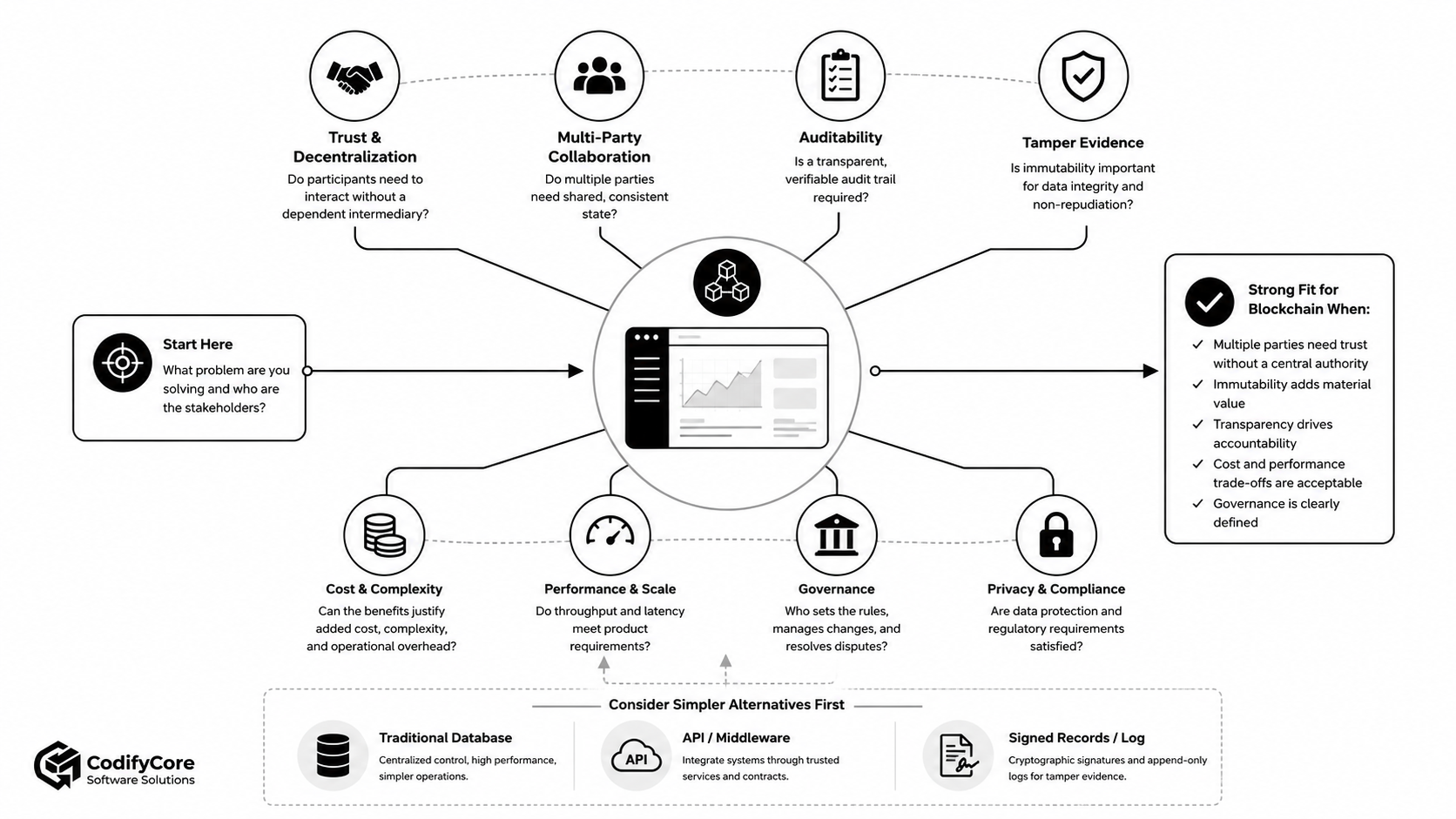
Quick answer: Does your software product need blockchain?
Your software product may need blockchain when all or most of the following are true:
- Several independent organisations must write to or validate shared data.
- The organisations do not fully trust one another.
- No acceptable central operator can own the definitive record.
- Participants need independently verifiable transaction history.
- Tamper resistance, shared execution or digital-asset ownership provides material business value.
- Governance rules can be agreed between the participating organisations.
- The product can accept the additional latency, cost and operational complexity.
- Privacy and regulatory requirements can be satisfied.
- The same outcome cannot be achieved more simply with a database, API or signed audit log.
You probably do not need blockchain when:
- One organisation controls the system.
- Users already trust a platform operator.
- Only one party writes the data.
- The main requirement is ordinary CRUD functionality.
- Records must be deleted or frequently corrected.
- High throughput and low latency are critical.
- The organisation needs a better audit log rather than distributed consensus.
- Blockchain would merely duplicate an existing authoritative database.
The practical rule is:
Use blockchain when decentralised agreement is a core product requirement. Do not use it merely as a different way to store data.
Key takeaways
- Blockchain is a distributed, tamper-evident ledger—not a universally superior database. [1]
- The first question is not whether data should be stored. It is whether several independent parties need to write or validate shared state.
- If a trusted central operator can run the system acceptably, a conventional architecture will usually be simpler, faster and less expensive.
- “Immutable” should be used carefully. NIST describes blockchains as tamper-evident and tamper-resistant rather than absolutely unchangeable. [1]
- A requirement for auditability does not automatically justify blockchain. Signed records and append-only Merkle logs can provide strong tamper evidence without a distributed consensus network. [6]
- Permissioned blockchains retain participant identities and governance controls. They do not eliminate centralisation; they redistribute selected authority among known participants. [3][4]
- Public blockchains are strongest when open participation, neutral execution and publicly verifiable digital ownership are essential.
- Smart contracts automate shared transaction rules, but they introduce new security, upgrade and governance risks. [8]
- Sensitive or personal data should generally remain off-chain, with commitments, keyed hashes or other proofs recorded where appropriate. [7]
- Blockchain cannot prove that external information is true. It can preserve what an authorised participant or oracle submitted.
- Tokens are useful when transferable digital ownership or cryptoeconomic incentives are part of the product model—not as a substitute for ordinary database IDs or loyalty points. [9]
- A blockchain pilot should validate the trust and governance model, not merely demonstrate that a transaction can be written to a ledger.
What is blockchain?
Blockchain is a distributed ledger maintained by a network of participants.
Transactions are grouped, ordered and cryptographically linked so that attempts to alter previous records can be detected and resisted according to the network’s consensus and governance model.
A blockchain commonly combines:
- Digitally signed transactions
- Cryptographic hashes
- An append-only transaction history
- Replication across nodes
- A consensus or agreement process
- Rules governing valid state changes
- Participant incentives or identities
- Smart-contract execution where supported
NIST describes blockchain as a tamper-evident and tamper-resistant ledger implemented in a distributed fashion, usually without a single central repository. [1]
What is the product actually buying?
When a software product adopts blockchain, it is not simply buying storage.
It is buying a particular set of trade-offs:
- Several nodes retain copies of the ledger.
- State changes require distributed validation.
- Participants can verify history independently.
- One operator may have less unilateral control.
- Changes to rules require network governance.
- Data and logic become more difficult to alter privately.
- Transactions may take longer and cost more.
- Errors can be harder to reverse.
- Sensitive data becomes harder to manage.
These characteristics may be valuable.
They may also be unnecessary.
What blockchain does well
Blockchain can be a strong architectural choice for several narrowly defined needs.
Shared state across independent organisations
Several organisations can maintain a consistent transaction history without one party owning the only authoritative database.
Tamper-evident history
Cryptographic linking and replication make silent historical alteration significantly more difficult.
Independent verification
Participants can verify transactions or state according to shared protocol rules rather than relying only on reports from one operator.
Digital assets
A network can represent and transfer ownership of digitally native assets or claims.
Shared execution
Smart contracts can execute transaction rules consistently across participating nodes.
Open participation
A public blockchain can allow participants to transact without bilateral onboarding by one platform owner.
Resilience against one operator
The network may continue operating even if one participant or infrastructure provider fails, depending on its architecture.
What blockchain does not do
It does not make incorrect data true
Suppose a supplier records:
Recycled content: 80%
The blockchain can prove:
- Which account submitted the value
- When it was submitted
- Whether the recorded transaction was later altered
It cannot prove that the supplier measured the recycled content correctly.
This is often called the oracle problem or the boundary between on-chain and off-chain truth.
Data quality still requires:
- Authoritative sources
- Verification
- Certification
- Audits
- Sensor assurance
- Legal accountability
It does not create trust between organisations
Blockchain can reduce the need to trust one operator with the transaction record.
Participants must still trust:
- Identities
- Governance
- Smart-contract code
- Oracle providers
- Wallets
- Key-management systems
- Software implementations
- Legal agreements
Blockchain changes where trust is placed. It does not remove trust.
It does not guarantee privacy
Public blockchain transactions are commonly replicated and visible across many nodes.
Even when names are absent, addresses and transaction patterns may be linkable.
Permissioned networks can restrict data, but privacy still requires deliberate architecture.
It does not eliminate administrators
Networks still need people or organisations to decide:
- Who may participate
- Which software version is accepted
- How defects are handled
- How keys are recovered
- How disputes are resolved
- How the protocol is upgraded
- Which data model applies
It does not eliminate centralisation
A network described as decentralised may still depend heavily on:
- One development organisation
- A small group of validators
- One cloud provider
- One wallet
- One bridge
- One token issuer
- One oracle
- One governance group
Decentralisation should be measured across the entire system, not inferred from the presence of a blockchain.
It does not make software secure
Smart contracts and supporting infrastructure remain software.
They can contain:
- Access-control defects
- Business-logic errors
- Input-validation failures
- Oracle weaknesses
- Reentrancy vulnerabilities
- Upgrade problems
- Key-management failures
OWASP’s 2026 Smart Contract Top 10 continues to identify these as major risk classes. [8]
The practical blockchain decision framework
A useful decision should proceed through a sequence of questions.
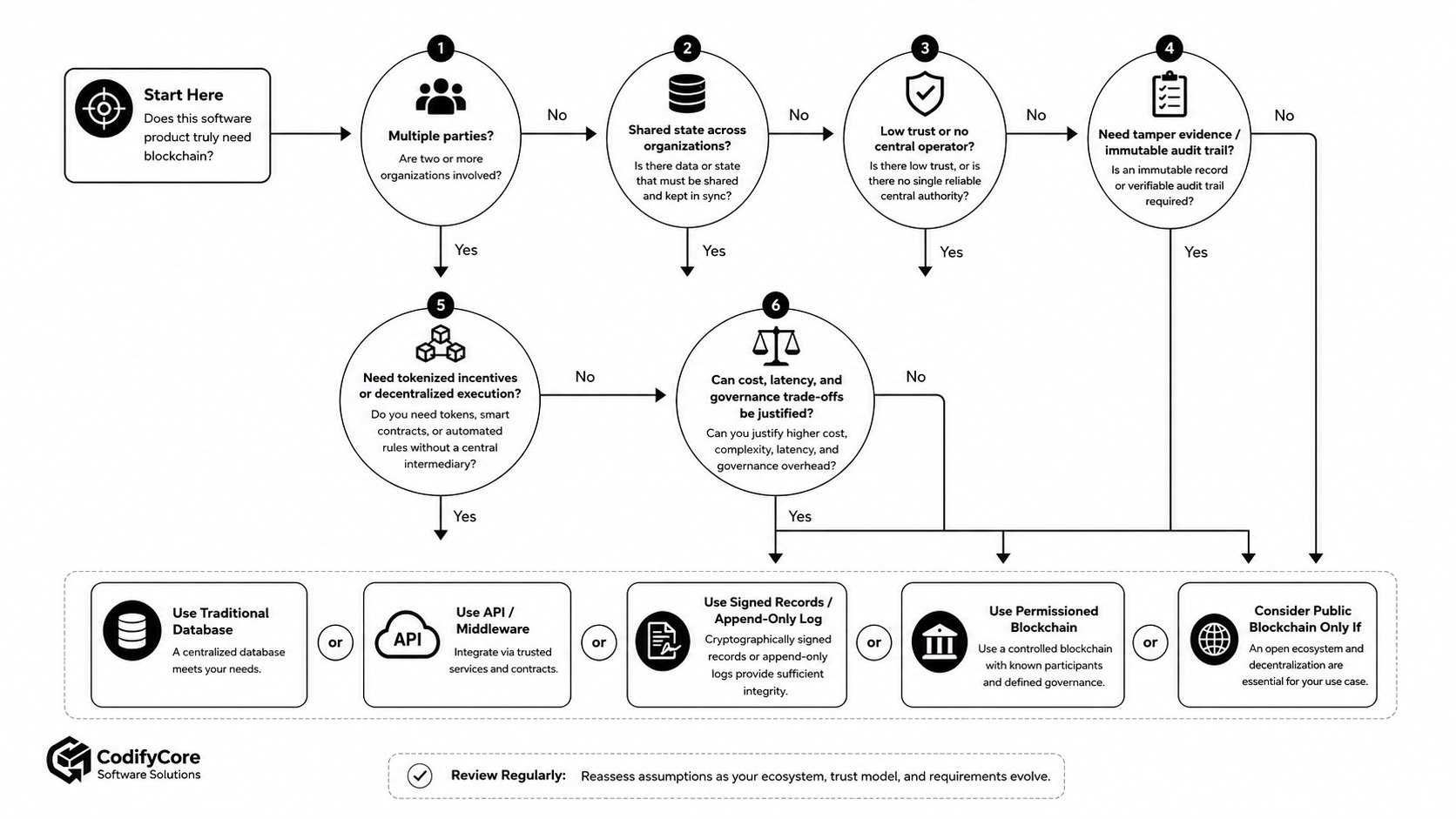
Question 1: Are multiple independent parties involved?
The first question is whether more than one independent organisation needs to participate in maintaining the shared system.
Examples may include:
- Manufacturers and suppliers
- Banks and payment institutions
- Insurers and healthcare providers
- Logistics operators and retailers
- Government agencies and regulated businesses
- Buyers and sellers in an open marketplace
Independent parties have:
- Different ownership
- Different administrators
- Different commercial interests
- Different legal responsibilities
- Different infrastructure
When the answer is no
If one company owns and operates the product, a traditional database is usually preferable.
Examples include:
- Internal HR system
- Customer relationship management
- Content-management platform
- Private inventory application
- Employee expense system
- Analytics dashboard
Adding nodes operated by the same company does not create meaningful decentralisation.
It creates distributed infrastructure under one authority.
A replicated SQL database can already provide:
- Availability
- Backups
- Read replicas
- Geographic resilience
- Audit logs
- Access controls
When the answer is yes
Continue to the next question.
Multiple parties alone do not justify blockchain.
They may still be comfortable using a shared SaaS platform or neutral intermediary.
Question 2: Must these parties share and update the same state?
Several organisations may exchange information without maintaining one common state.
For example:
- A supplier sends invoices to customers.
- A regulator receives periodic reports.
- A retailer requests product information.
- A partner consumes an API.
- A bank sends payment confirmation.
These interactions can often use:
- APIs
- Webhooks
- Events
- Secure file exchange
- Data spaces
- Federated databases
- Verifiable credentials
Blockchain becomes more relevant when participants need a jointly maintained sequence of state transitions.
Examples include:
- Transfer of an asset
- Shared settlement
- Multi-party approval
- Chain of custody
- Shared allocation of limited resources
- Jointly maintained ownership records
Ask what the state represents
Define the shared state precisely:
Asset:
Container C-192

Current custodian:
Logistics Company B

Previous custodian:
Manufacturer A

Transfer:
Accepted by both parties

Timestamp:
2026-06-20T11:30:00Z
Do not use a blockchain to share a collection of documents merely because several companies need access to them.
Question 3: Can an acceptable central operator exist?
This is often the decisive question.
Could one organisation or managed service operate the authoritative database in a way all participants accept?
Possible central operators include:
- Industry association
- Regulator
- Marketplace
- SaaS provider
- Consortium company
- Independent auditor
- Trusted infrastructure provider
When a central operator is acceptable
Use a conventional platform unless blockchain creates another measurable benefit.
A central operator can provide:
- Clear accountability
- Faster transactions
- Simpler correction
- Easier privacy management
- Lower operational overhead
- Familiar support
- Straightforward upgrades
When a central operator is unacceptable
Blockchain may deserve further evaluation when:
- Every potential operator is also a competitor.
- One party should not be able to rewrite history.
- Participants need their own independently verifiable record.
- Political or jurisdictional concerns make one operator unsuitable.
- The ecosystem is intended to remain open.
- One platform owner would create unacceptable lock-in.
- The network must continue if one organisation exits.
A classic blockchain decision model by Wüst and Gervais similarly begins by examining whether persistent shared state has multiple writers and whether a trusted third party is available. [2]
Question 4: Who needs to write or validate transactions?
A system with many readers but one writer does not necessarily need blockchain.
For example, a regulator may publish a public register.
Millions of users may read it, but only the regulator writes authoritative entries.
That can be implemented through:
- Signed records
- Public API
- Append-only log
- Merkle transparency tree
- Digitally signed snapshots
Blockchain is more relevant when multiple independent parties must:
- Propose transactions
- Approve transactions
- Validate transactions
- Maintain ledger copies
- Enforce shared rules
Do the writers distrust one another?
Multiple authorised writers may still fully trust one operator.
For example, employees in several departments may update one ERP system.
The fact that many people write does not create a decentralised trust problem.
Question 5: Is a tamper-resistant shared history essential?
Many products require audit history.
Far fewer require a distributed ledger.
Ask why history must be protected.
Ordinary audit requirement
The organisation needs to know:
- Who changed a record
- What changed
- When it changed
- Which account authorised it
A database audit table may be sufficient.
Strong tamper-evidence requirement
The organisation needs evidence that administrators could not silently rewrite the log.
Possible solutions include:
- Digitally signed events
- Write-once storage
- Immutable cloud retention
- Hash chaining
- External timestamps
- Merkle transparency logs
- Independent log replication
RFC 9162 demonstrates that append-only Merkle trees can provide efficient inclusion and consistency proofs without requiring a blockchain consensus network. [6]
Distributed-history requirement
Several independent organisations need to maintain and verify the same transaction history, and no one operator should be able to rewrite it alone.
This is a stronger case for blockchain.
“Immutable” is not absolute
NIST cautions that blockchain records should be described as tamper-evident and tamper-resistant rather than absolutely immutable.
Forks, governance decisions, attacks or protocol changes can affect what the network recognises as canonical history. [1]
Question 6: Do you need shared automated execution?
A smart contract can implement rules that all participating nodes apply to a transaction.
Examples include:
- Release payment after required approvals
- Transfer ownership
- Enforce transaction limits
- Distribute token rewards
- Settle trades
- Apply governance votes
- Allocate digital assets
Hyperledger Fabric describes smart contracts as executable transaction logic agreed between participating organisations, with policies determining which organisations must endorse transactions. [10]
When ordinary workflow is better
Use a traditional workflow engine when:
- One organisation controls the process.
- Rules change frequently.
- Administrators need to correct mistakes.
- Human judgement is central.
- Confidential logic cannot be replicated.
- The workflow requires complex integration.
- Transactions need compensation or reversal.
Workflow engines offer mature support for:
- Durable state
- Human tasks
- Timers
- Retries
- Compensation
- Versioning
- Error handling
When smart contracts add value
Smart contracts become more valuable when:
- Several organisations must accept the same execution rules.
- No participant should run the only implementation.
- The transaction controls digital assets already on the network.
- Independent verification of execution is essential.
- The rules can be specified deterministically.
Question 7: Do you need a token?
A token is not a required feature of every blockchain system.
Permissioned ledgers may operate without transferable tokens.
A token may be justified when the product needs:
- Digitally native transferable ownership
- Network participation incentives
- Staking or security deposits
- Programmable settlement
- Fungible network assets
- Fractional ownership
- Community governance rights
NIST describes tokens as instruments that can represent digital ownership, incentives, governance and programmable assets across blockchain systems. [9]
Weak token use cases
A token is probably unnecessary when it merely represents:
- An internal database ID
- Conventional loyalty points
- A non-transferable account balance
- A subscription entitlement
- A voucher controlled by one company
These can generally be implemented more simply in a database.
The token test
Ask:
Would the product still need blockchain if the token were removed?
If the answer is no, the product may be token-first rather than problem-first.
Question 8: Can the trade-offs be justified?
Blockchain changes non-functional requirements.
Evaluate:
- Transaction latency
- Finality
- Throughput
- Storage growth
- Network fees
- Node costs
- Development complexity
- Security-audit cost
- Governance overhead
- Key recovery
- Incident response
- Regulatory obligations
Public-network fees
Public smart-contract networks charge for computation and state changes.
Ethereum, for example, requires gas for transaction execution, with fees affected by computation and network demand. [5]
A product must decide:
- Who pays?
- Can the fee vary?
- Can users understand it?
- Can transactions wait?
- What happens when the network is congested?
Finality
A database transaction can often commit in milliseconds.
Distributed networks may distinguish between:
- Included
- Confirmed
- Finalised
On proof-of-stake Ethereum, finality depends on validator agreement between checkpoints and cryptoeconomic penalties. [5]
The required waiting period may be acceptable for asset settlement but inappropriate for an interactive application request.
Governance overhead
The network must govern:
- Participant admission
- Node operation
- Contract upgrades
- Emergency response
- Protocol changes
- Data models
- Fees
- Dispute resolution
- Member removal
The governance model is part of the software architecture.
Compare blockchain with simpler alternatives
Before choosing blockchain, compare it against the nearest alternative.
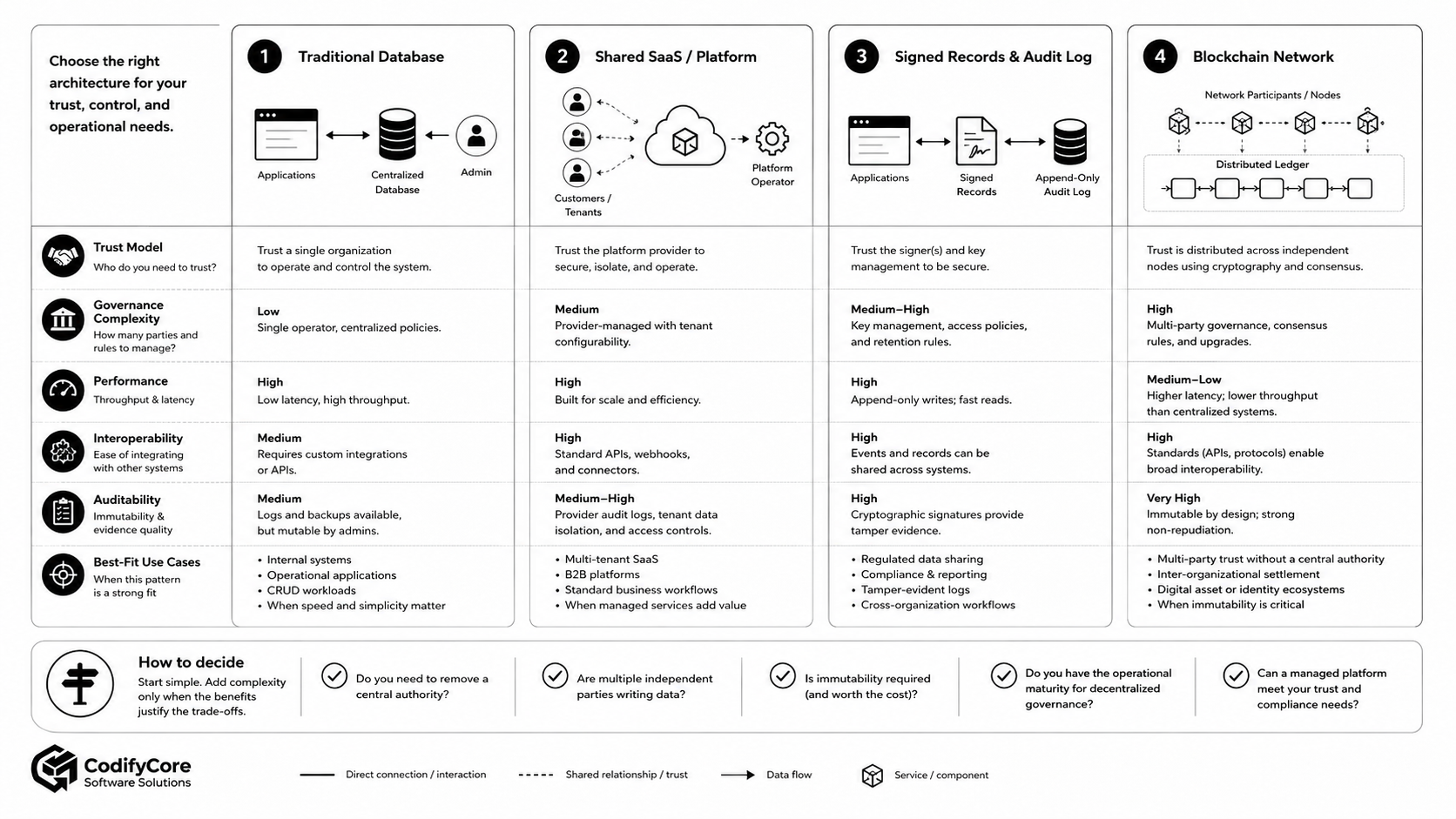
| Requirement | Traditional database | Shared SaaS platform | Signed or append-only log | Blockchain |
|---|---|---|---|---|
| One authoritative operator | Strong fit | Strong fit | Strong fit | Usually unnecessary |
| Several independent writers | Requires integration | Possible | Possible | Strong fit |
| No acceptable central operator | Weak fit | Weak fit | Limited | Strong fit |
| Low latency | Strong | Strong | Strong | Variable |
| High throughput | Strong | Strong | Strong | Usually lower |
| Easy correction or deletion | Strong | Strong | Moderate | Weak |
| Tamper evidence | Moderate | Moderate | Strong | Strong |
| Independent verification | Limited | Platform-dependent | Strong for logged records | Strong |
| Public participation | Weak | Platform-controlled | Read access possible | Strong on public chains |
| Programmable digital assets | Custom implementation | Platform-controlled | Weak | Strong |
| Privacy control | Strong | Strong | Strong | Requires careful design |
| Operational simplicity | Strong | Strong | Moderate | Weak |
| Multi-party governance | External process | Provider-led | External process | Built into network design |
Alternative 1: Traditional database
Use a relational, document or distributed database when:
- One organisation is accountable.
- Performance matters.
- Records require updates and deletion.
- Access is centrally governed.
- The system serves normal application workflows.
A traditional database is not technologically inferior.
It is often exactly the correct abstraction.
Alternative 2: Shared SaaS or neutral platform
A managed platform can coordinate multiple organisations through:
- Tenant isolation
- APIs
- Workflows
- Audit logs
- Contractual governance
- Role-based access
- Data exports
This is appropriate when participants trust the platform operator sufficiently or can manage the relationship contractually.
Alternative 3: Signed records
A record can be cryptographically signed by its issuer.
This can prove:
- Which key signed it
- Whether it changed
- When it was issued, if trusted timestamping is used
Signed records are useful for:
- Certificates
- Credentials
- Compliance evidence
- Supplier declarations
- Reports
- Documents
They do not require every recipient to share one ledger.
Alternative 4: Append-only transparency log
A Merkle-based log can provide:
- Inclusion proofs
- Consistency proofs
- Public or independent monitoring
- Evidence of log misbehaviour
- Efficient append-only verification
This may solve the requirement when the primary concern is detecting unauthorised historical modification.
It still depends on log governance and monitoring, but does not require a general-purpose blockchain. [6]
Alternative 5: Event streaming
An event platform can distribute immutable-style business events to several consumers.
Examples include:
- Order created
- Product shipped
- Certificate issued
- Account updated
- Service completed
Consumers can build their own state from the event history.
This is useful when the principal requirement is system integration rather than decentralised consensus.
Public, permissioned or hybrid?
Once blockchain appears justified, the next decision is which participation model is required.
Public permissionless blockchain
Anyone can generally:
- Read network data
- Submit transactions
- Operate supporting software
- Verify state
- Participate according to protocol rules
Strong fit when:
- The ecosystem must remain open.
- No organisation should approve every participant.
- Publicly verifiable digital assets are required.
- Neutral global settlement is valuable.
- The application needs composability with an existing public ecosystem.
Main trade-offs:
- Public data exposure
- Transaction fees
- Variable capacity
- Key custody
- Harder regulatory control
- Dependence on protocol governance
- Smart-contract security risk
Permissioned blockchain
Participants are known, approved and represented through digital identities.
Hyperledger Fabric, for example, uses membership service providers, certificates and policies to identify participants and assign network permissions. [3][4]
Strong fit when:
- Several companies share a business process.
- Participants are legally identifiable.
- Data visibility must be controlled.
- The consortium needs joint validation.
- Governance can be defined contractually.
- No participant should control the complete record alone.
Main trade-offs:
- Consortium governance
- Membership administration
- Node-operation cost
- Less open participation
- Risk of collusion
- Potentially limited decentralisation
- Complex onboarding
Permissioned consensus can often be faster and less computationally expensive because validators are identified and can be removed for misconduct. [3]
Hybrid architecture
A hybrid design keeps operational data off-chain while recording selected proofs or settlement events on-chain.
For example:
Off-chain:
Product specifications
Personal information
Documents
Commercial terms
High-volume events

On-chain:
Document commitment
Ownership transition
Approval
Timestamp
Credential status
Settlement
This is often more practical than placing complete business datasets on a ledger.
Data privacy and blockchain
Privacy must be analysed before deployment, not after the ledger has accumulated records.
Do not put sensitive data on-chain by default
Blockchain data may be:
- Replicated
- Retained indefinitely
- Visible to several participants
- Difficult to correct
- Difficult to erase
- Correlatable with other information
CNIL recommends processing cleartext personal data outside the blockchain and, where justified, storing commitments, keyed hashes or ciphertext instead. [7]
A hash is not automatically anonymous
A hash may still be personal data when:
- It can be linked to a person.
- The original input can be guessed.
- Another party retains the source data.
- The value is stable across contexts.
Avoid storing hashes of low-entropy identifiers such as:
- Email address
- Phone number
- National identity number
- Date of birth
without appropriate keyed constructions and legal analysis.
Plan for correction
Blockchain history is usually appended rather than overwritten.
A correction may look like:
Transaction 100:
Incorrect status recorded

Transaction 124:
Transaction 100 superseded
Correct status recorded
The incorrect information remains in history.
The product must determine whether this satisfies legal and operational requirements.
Permissioned does not mean private automatically
Hyperledger Fabric can restrict private data to authorised organisations while placing corresponding hashes in the shared block, but this still requires correct collection policies and key governance. [4]
The oracle problem
Smart contracts cannot directly know whether an off-chain event is true.
They depend on an external input source, often called an oracle.
Examples include:
- Market price
- Weather measurement
- Delivery confirmation
- Laboratory result
- Identity status
- Insurance event
Ask:
- Who supplies the input?
- Can that party be compromised?
- Are several sources used?
- What happens if sources disagree?
- Can the result be challenged?
- Is human review possible?
- Can the contract pause during uncertainty?
A decentralised ledger fed by one central data source still has a central trust point.
Smart-contract risk
Smart contracts can control valuable assets or irreversible state.
The code may be difficult to modify after deployment.
OWASP’s 2026 Smart Contract Top 10 includes risks such as:
- Access-control vulnerabilities
- Business-logic vulnerabilities
- Oracle manipulation
- Weak input validation
- Unsafe external calls
- Arithmetic errors
- Reentrancy
- Upgradeability defects [8]
Production controls
Use:
- Independent security review
- Automated testing
- Property-based testing
- Static analysis
- Fuzzing
- Formal methods where justified
- Limited permissions
- Time locks
- Emergency pause
- Upgrade governance
- Transaction limits
- Monitoring
- Incident-response procedures
Upgradeability is a governance decision
An upgradeable contract is easier to repair.
It also creates authority capable of changing the system.
A non-upgradeable contract reduces administrative control.
It also makes defects more difficult to correct.
There is no universally correct answer.
The upgrade policy should specify:
- Who proposes changes
- Who approves them
- Required delay
- Emergency process
- User notification
- Migration procedure
Governance is not an afterthought
A multi-organisation blockchain requires a governance agreement before technical deployment.
Define:
Membership
- Who can join?
- Who approves membership?
- What identity evidence is required?
- How is a participant removed?
Node operation
- Who runs validators or peers?
- What availability is expected?
- Which hosting locations are allowed?
- Who pays the operating cost?
Decision rights
- How many organisations approve changes?
- Does each participant have one vote?
- Are votes weighted?
- Can one organisation veto?
Smart-contract lifecycle
- Who deploys contracts?
- Who audits code?
- Who approves upgrades?
- How are old versions retired?
Data governance
- Which data is shared?
- Who owns it?
- Who may read it?
- How are errors corrected?
- How long is off-chain information retained?
Disputes
- Which law applies?
- Which organisation investigates?
- How are losses allocated?
- Is arbitration required?
- Can transactions be reversed operationally?
Hyperledger Fabric’s policy system illustrates how network membership, endorsement and configuration changes must be governed through explicit organisational rules. [4]
When blockchain is a strong fit
1. Multi-party asset transfer
Several organisations need to transfer ownership of a digital or physical asset while maintaining a jointly verifiable history.
Examples:
- Trade settlement
- Tokenised securities
- Shared collateral
- Digital collectibles
- Inter-company asset registries
2. Shared settlement without one platform owner
Participants need deterministic settlement across a neutral network.
3. Open digital-asset ecosystems
Assets must be:
- User-controlled
- Transferable
- Publicly verifiable
- Usable by applications from different providers
4. Consortium processes with partial trust
Known organisations need a shared ledger but do not want one member controlling the authoritative record.
Potential examples include:
- Trade finance
- Insurance syndication
- Shared logistics events
- Inter-organisational approvals
- Regulated market infrastructure
5. Public transparency with independent verification
The product needs a public, independently verifiable record, and the data is appropriate for permanent publication.
6. Cryptoeconomic network coordination
A network requires incentives, staking or token-based governance to coordinate participants who lack normal contractual relationships.
When blockchain is usually a weak fit
Internal business software
One company owns the users, database and business process.
Standard SaaS
Customers already trust the software provider to manage tenant data.
High-volume operational systems
The workload requires:
- Very low latency
- Frequent updates
- Large files
- Complex queries
- High transaction throughput
Private document storage
Documents should remain in controlled object storage, with signatures and hashes where needed.
Customer identity database
Identity data often requires correction, deletion, consent and privacy controls.
Ordinary supply-chain tracking
If one major platform operator is accepted, APIs and shared event standards may be enough.
Product traceability with unverifiable input
Blockchain does not improve the quality of supplier information merely by preserving it.
Loyalty points
A company-controlled balance rarely needs an open distributed network.
Audit logs managed by one organisation
Write-once storage, signatures and external log monitoring may be more appropriate.
Practical use-case assessments
Digital Product Passports
A Digital Product Passport does not inherently require blockchain.
A conventional DPP architecture can use:
- Product identifiers
- Secure APIs
- Verifiable credentials
- Data spaces
- Access policies
- Signed records
- Audit logs
Blockchain may add value when several independent organisations must update shared lifecycle state and no operator should control the history alone.
Sensitive product or personal data should remain off-chain.
Supply-chain provenance
Blockchain may be appropriate when:
- Several companies write events.
- Participants need independent verification.
- No neutral platform is accepted.
- Governance is clearly defined.
It is not sufficient when:
- Supplier claims remain unverified.
- Physical goods can be substituted.
- Sensors are insecure.
- Participants can collude.
- The shared identifiers are inconsistent.
Digital identity
Decentralised identifiers and verifiable credentials do not necessarily require every credential or presentation to be stored on a blockchain.
A ledger may be used for:
- Issuer registries
- Credential schemas
- Status
- Public keys
- Governance
Credentials and personal information should generally remain with the issuer or holder.
Compliance records
The organisation may only need:
- Signed evidence
- Trusted timestamps
- Append-only audit history
- External verification
A blockchain is stronger when several independent parties jointly maintain or verify the compliance history.
Payments
Public blockchain can provide:
- Global settlement
- Programmable assets
- Peer-to-peer custody
- Composability
Traditional payment infrastructure may provide:
- Consumer protection
- Reversibility
- Familiar identity controls
- Predictable user experience
- Established legal frameworks
The correct choice depends on the product’s settlement and custody model.
A blockchain readiness scorecard
Score each factor from 0 to 2.
| Factor | 0 | 1 | 2 |
|---|---|---|---|
| Independent organisations | One | Several under common control | Several independent parties |
| Shared writers | One writer | Limited shared input | Several authoritative writers |
| Central operator | Accepted | Possible but contested | Unacceptable or impossible |
| Trust | High | Partial | Low |
| Shared state | Not required | Useful | Essential |
| Tamper resistance | Ordinary audit sufficient | Strong evidence useful | Independent tamper resistance essential |
| Digital assets | None | Closed internal asset | Transferable network-native asset |
| Shared execution | Not needed | Some automation | Neutral shared execution essential |
| Open participation | Closed | Expandable consortium | Open ecosystem required |
| Performance tolerance | Milliseconds required | Seconds acceptable | Delayed finality acceptable |
| Privacy compatibility | Frequent deletion | Off-chain design possible | Public or persistent data appropriate |
| Governance maturity | One owner | Consortium forming | Agreed operating model |
Interpreting the score
0–8: A traditional architecture is likely better.
9–15: Investigate signed records, neutral platforms or permissioned integration before blockchain.
16–20: A permissioned blockchain pilot may be justified.
21–24: Blockchain is a strong candidate, with public versus permissioned determined by participation and governance.
This score is a discussion aid, not an automatic architecture generator.
A single critical requirement—such as mandatory deletion—can outweigh the total.
A practical implementation roadmap
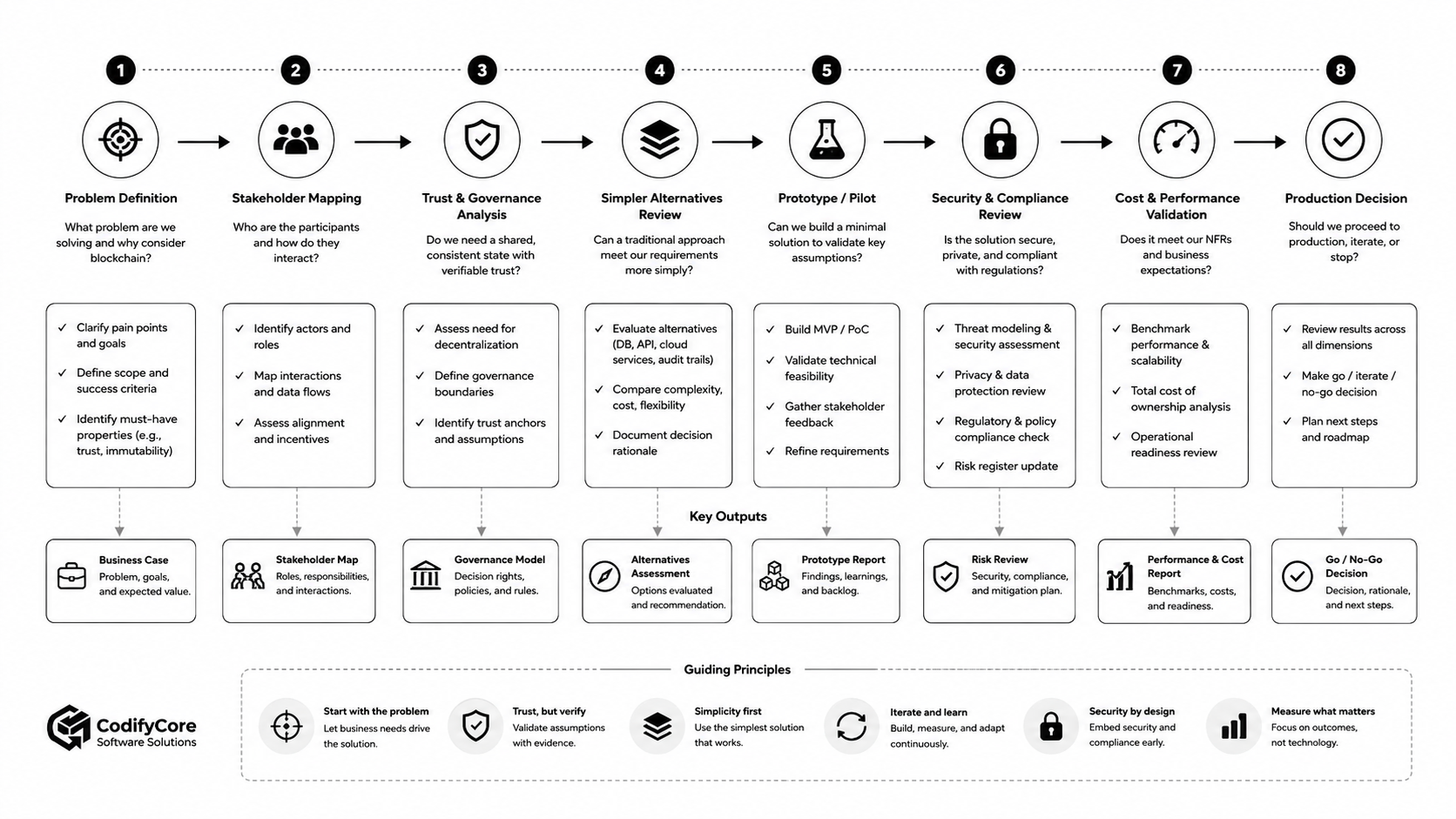
Phase 1: Define the problem
Document:
- Customer problem
- Business outcome
- Current process
- Current failure
- Success criteria
- Why blockchain is being considered
Avoid requirements such as:
Build a blockchain-based supply-chain platform.
Prefer:
Allow five independent companies to verify custody transfers
without giving any one company control over the historical record.
Phase 2: Map stakeholders
Identify:
- Data producers
- Data consumers
- Transaction validators
- Network operators
- Regulators
- Auditors
- End users
- Governance authority
Phase 3: Map trust
For every relationship, ask:
- Who trusts whom?
- Who might act dishonestly?
- Who can correct an error?
- Who can remove a participant?
- Which legal agreements already exist?
- Which party could operate a neutral service?
Phase 4: Define the shared state
Specify:
- Business objects
- Transaction types
- Writers
- Validators
- Readers
- Privacy levels
- Finality requirements
- Correction model
Phase 5: Evaluate simpler alternatives
Create working designs for:
- Central database
- Managed platform
- Federated API model
- Signed records
- Append-only log
- Event platform
- Blockchain
Compare them against the same requirements.
Phase 6: Design governance first
Before writing a smart contract, agree on:
- Membership
- Voting
- Node ownership
- Contract deployment
- Upgrade process
- Incident response
- Dispute resolution
- Cost sharing
- Exit process
Phase 7: Choose the network model
Decide whether the requirement is best served by:
- Public permissionless network
- Existing public layer-two network
- Permissioned consortium network
- Private single-operator ledger
- Hybrid architecture
A private ledger run entirely by one organisation should be compared honestly with a conventional database.
Phase 8: Build the smallest meaningful pilot
The pilot should include:
- At least two independent organisations
- Independent identities
- Realistic data
- Real governance decisions
- Failure scenarios
- Privacy controls
- Key recovery
- Performance measurement
A pilot run by one development team on several local nodes proves only that the software runs.
Phase 9: Threat-model the complete system
Include:
- Smart contracts
- Wallets
- Keys
- Nodes
- APIs
- Frontend
- Oracles
- Bridges
- Administrators
- Governance
- Supply chain
- Cloud infrastructure
Phase 10: Test non-functional requirements
Measure:
- Transaction latency
- Finality
- Throughput
- Storage
- Query performance
- Node recovery
- Network failure
- Cost per transaction
- Operational staffing
- Upgrade time
Phase 11: Test privacy and compliance
Determine:
- What is on-chain?
- Is it personal or confidential?
- Can it be corrected?
- Can access be withdrawn?
- Where are nodes located?
- Who is legally responsible?
- Which records must be retained?
- Which records must be deleted?
Phase 12: Define the production decision
The final decision should be one of:
- Proceed
- Proceed with reduced blockchain scope
- Use a hybrid design
- Return to a conventional architecture
- Stop the project
Choosing not to use blockchain can be a successful architectural outcome.
Questions to ask a blockchain vendor
- Why is blockchain necessary for this use case?
- Which party would have to be trusted without it?
- Who operates the nodes?
- Can one organisation change the rules?
- What consensus mechanism is used?
- What is the expected transaction finality?
- What is the measured throughput?
- Which data is stored on-chain?
- How is confidential data protected?
- How are incorrect records handled?
- How are smart contracts upgraded?
- Who pays transaction and infrastructure costs?
- How are keys recovered?
- What happens when a member leaves?
- Can the organisation export and migrate its data?
- Which features could be implemented without blockchain?
- What independent security audits have been completed?
- Who is legally accountable for network failures?
A vendor should be able to explain why its system needs distributed consensus without relying on vague language about transparency or innovation.
Common blockchain anti-patterns
Blockchain as a database upgrade
The product needs better data management but adopts a distributed ledger instead of fixing its data architecture.
Blockchain as marketing
The architecture is selected mainly to make the product sound innovative.
Single-company decentralisation
One company controls:
- All nodes
- All keys
- All contracts
- All users
- All governance
This may still be a useful ledger implementation, but it does not remove the central trust relationship.
On-chain document storage
Large documents are placed directly on-chain despite cost, privacy and correction problems.
Token without economic purpose
A token is created without a real need for transferability, incentives or shared governance.
Blockchain before governance
Technical development begins before participants agree on ownership, rules and liability.
Smart contracts for subjective decisions
Ambiguous legal or human decisions are forced into deterministic code without an exception process.
Assuming provenance proves authenticity
A record shows where information came from, but nobody verifies whether it was correct.
Ignoring the user experience
Users are expected to manage:
- Seed phrases
- Gas
- Networks
- Signatures
- Wallet approvals
without a strong product reason.
The most practical rule
Start with the simplest architecture that satisfies the trust model.
Add cryptographic signatures when records need attributable integrity.
Add append-only transparency when administrators should not be able to alter history silently.
Add a neutral platform when several organisations need coordination.
Add a permissioned blockchain when known organisations need jointly controlled shared state.
Use a public blockchain when open participation, neutral settlement or publicly verifiable digital ownership is essential.
Complexity should be earned by the problem.
Conclusion
Blockchain is not a general replacement for databases, APIs or cloud platforms.
It is a specialised architecture for shared state under distributed trust.
It becomes valuable when:
- Several independent parties participate
- Several parties write or validate transactions
- No acceptable central operator exists
- Participants require independent verification
- Tamper-resistant history or shared execution is essential
- Governance can be agreed
- The product can accept the trade-offs
If those conditions do not exist, blockchain will often make the software:
- More expensive
- Slower
- Harder to operate
- Harder to correct
- Harder to regulate
- Harder for users to understand
without solving a necessary problem.
The correct question is not:
How can blockchain be added to this product?
It is:
Which party should control the authoritative state, who must verify it independently, and what is the simplest architecture that satisfies that trust requirement?
Sometimes the answer will be a public blockchain.
Sometimes it will be a permissioned consortium ledger.
More often, it will be a database, an API or a signed audit log.
Choosing the simpler architecture is not a failure to innovate.
It is good software engineering.
Frequently Asked Questions
What is blockchain?
Blockchain is a distributed, cryptographically linked ledger maintained and validated by a network of participants.
Does every software product need blockchain?
No. Most products work more effectively with conventional databases, APIs and managed services.
What is the clearest sign that blockchain may be needed?
Several independent parties must write or validate shared state, and no acceptable central authority can control the definitive record.
Is blockchain better than a database?
Not generally. Databases are usually faster, simpler and easier to manage. Blockchain provides a different trust and governance model.
When should a traditional database be used?
Use a traditional database when one organisation controls the system and users accept it as the authoritative operator.
Can a blockchain record be changed?
Blockchain history is designed to be tamper-evident and resistant to change, but it should not be described as absolutely immutable in every circumstance.
Does blockchain guarantee data accuracy?
No. It preserves submitted transactions but cannot prove that off-chain information was correct when entered.
What is the oracle problem?
The oracle problem is the difficulty of securely bringing external facts—such as prices or delivery events—into a blockchain application.
What is a permissioned blockchain?
A permissioned blockchain restricts participation to approved and identifiable organisations or users.
What is a public blockchain?
A public blockchain allows open participation according to protocol rules and provides publicly verifiable state.
Does a permissioned blockchain require cryptocurrency?
No. Permissioned networks can operate without native or transferable tokens.
Does blockchain require smart contracts?
No. A blockchain may only record transactions. Smart contracts are needed when shared programmable execution is required.
When is a token justified?
A token is justified when digitally native transferable ownership, network incentives, staking or programmable settlement is part of the product model.
Can blockchain satisfy GDPR?
It may be possible to design GDPR-aware systems, but permanent replicated data creates significant challenges. Personal data should normally remain off-chain.
Should documents be stored on-chain?
Usually not. Store the document in controlled storage and record a commitment, keyed hash or proof when necessary.
Can an append-only log replace blockchain?
Yes, when the primary need is tamper evidence rather than distributed consensus among independent writers.
Is blockchain useful for supply chains?
It can be useful where several independent organisations require shared, verifiable records, but it cannot ensure that physical events or supplier claims are truthful.
Does blockchain eliminate intermediaries?
Not necessarily. It may replace one intermediary while introducing validators, wallet providers, oracle operators, software maintainers and governance bodies.
What is the biggest blockchain implementation risk?
The largest strategic risk is using blockchain where a simpler architecture would solve the problem more effectively.
How should a company begin evaluating blockchain?
Define the business problem, map the participants and trust relationships, compare simpler alternatives and pilot the governance model with independent organisations.